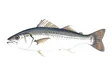
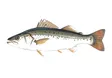
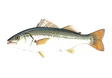
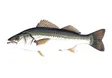
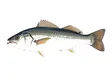
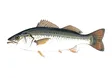
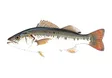
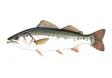
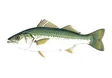
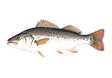
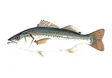
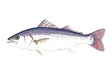
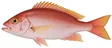
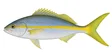
Common names

Types of snapper

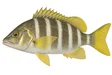
28 species carry snapper in an English common name. They sit in 1 family, so the group is a name, not a scientific rank.

About snapper

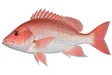
Lutjanidae, the snappers and fusiliers, are a family of percomorph fishes, mainly marine but with some members inhabiting estuaries and, in some cases, fresh water (e.g., Lutjanus goldiei). The family includes about 113 species. Most species are used for food and many are of high economic importance. Many species around the world are known in local languages as red snapper, including species from different genera (including Lutjanus and Pristipomoides)

Snappers inhabit tropical, subtropical, and warm-temperate regions of all oceans. Some snappers grow up to about 1 m (3.3 ft) in length, and one species, the cubera snapper, grows up to 1.52 m (5 ft 0 in) in length. Most are active carnivores, feeding on crustaceans or other fishes, though a few are plankton -feeders. They can be kept in aquaria, but commonly grow too fast to be popular aquarium fish. Most species live at depths reaching 100 m (330 ft) near coral reefs, but some species are found up to 500 m (1,600 ft) deep.

As with other fishes, some snapper species host parasites. A detailed study conducted in New Caledonia has shown that coral reef -associated snappers host about nine species of parasites per fish species.

Systematics

The following classification is based on Eschmeyer's Catalog of Fishes:

The genus † Parapelates Bannikov, 2008 is likely also closely related to the snappers, though its taxonomic classification at the family level remains indeterminate. A well-preserved skeleton of a potential fossil lutjanid or cichlid is known from the Middle Eocene of Cuba, representing one of the earliest records of the group from the Caribbean.

The former family Caesionidae, the fusiliers, was previously treated as distinct due to their distinctive morphology. However, it is now known to be paraphyletic with respect to the Lutjanidae, and its genera are now classified within the Lutjaninae.

The following cladogram is based on the phylogenetic tree from a 2007 study using Bayesian Inference to analyze a combined dataset of 16S and cyt b:
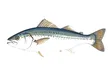
Snapper species in focus

These species profiles show how members of the group differ. Their biology describes each named species, rather than every fish in the group.

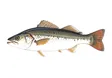
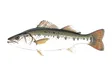
Cubera Snapper

The cubera snapper (Lutjanus cyanopterus), also known as the Cuban snapper, is a species of marine ray-finned fish, a snapper belonging to the family Lutjanidae. It is native to the western Atlantic Ocean. It is a commercially important species and is a sought-after game fish, though it has been reported to cause ciguatera poisoning.

Taxonomy

The cubera snapper was first formally described as Mesoprion cyanopterus in 1828 by the French zoologist Georges Cuvier with the type locality given as Brazil. The specific name is a compound of cyano meaning "blue"and pterus which means"fin" as Cuvier described it as having bluish-black membranes on its median fins.

Description

The cubera snapper has an oval-shaped, rather streamlined, elongate body, which is less deep than many other snapper species. It has a pair of front nostrils and a pair of rear nostrils that are simple holes in its snout. The mouth is relatively large with thick lips. The jaws are equipped with canine teeth, one enlarged pair being visible when the mouth is closed. The vomerine teeth are arranged in a crescent-shaped or triangular patch with no central posterior extension, with a tooth patch on each side of the roof of the mouth.

The preoperculum has a weakly developed knob and notch. This species has long pectoral fins, a continuous dorsal fin, and a truncated caudal fin. The dorsal fin contains 10 spines and 14 soft rays, while the anal fin has three spines and seven or eight soft rays, sometimes, a notch is seen behind the spiny part of the dorsal fin. The maximum total length recorded for this species is 160 cm (63 in), although a length of 90 cm (35 in) is more typical; the maximum published weight is 57 kg (126 lb). The overall colour of this species is grey to dark brown with pale to dark-grey flanks with some individuals showing a slight reddish hue on the body. The caudal fin is light grey, the pectoral fins may be translucent to pale grey, and a bluish hue is seen on the anal, pectoral, and pelvic fins. The juveniles show an indistinct barred pattern on their flanks.

Distribution and habitat

The cubera snapper is found in the western Atlantic Ocean, from as far north as Nova Scotia to as far south as Santa Catarina in Brazil, and throughout the Caribbean Sea and the Gulf of Mexico and around Bermuda. It has been recorded from the Flores Islands in the Azores. It occurs at depths between 1 and 85 m (3 ft 3 in and 278 ft 10 in). The juveniles shelter within beds of sea grass in in-shore waters or in mangroves, and have been recorded entering fresh water. The adults move off-shore, where they inhabit rocky ledge and reef habitats.

Read the full species guide.

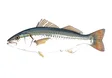
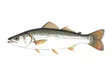
Gray Snapper

The mangrove snapper or gray snapper (Lutjanus griseus) is a species of snapper native to the western Atlantic Ocean from Massachusetts to Brazil, the Gulf of Mexico, Bermuda, and the Caribbean Sea. The species can be found in a wide variety of habitats, including brackish and fresh waters. It is commercially important and is sought as a game fish. It can also be found in the aquarium trade.

Description

Its color is typically greyish red, but can change color from bright red to copper red. It has a dark stripe running across its eye if observed from the top when it is under water. This species can reach a length of 89 cm (35 in), though most do not exceed 40 cm (16 in). The greatest recorded weight for this species is 20 kg (44 lb).

The mangrove snapper can be confused with the cubera snapper or black snapper, L. cyanopterus. Mangrove snapper are typically much smaller than cubera, but when they are of similar size, the two species can only be distinguished by examining the tooth patch on the inside roof of the mouth. Many specimens caught in Florida, specifically Punta Gorda, are actually misidentified dogtooth or dog snapper, L. jocu. The best way to distinguish between the two species is the dog snapper has a lighter triangle of color with a blue band under the eye and large, and sharp fangs in the front (canines), hence its common name. These fangs can deliver a painful bite, even in a small fish. The mangrove snapper feeds mostly on small fishes, crustaceans (such as crabs and shrimp), cephalopods, gastropods, polychaete worms and some planktonic items (including copepods and amphipods). It was also observed as systematically waiting under a maternal colony of buffy flower bats, for falling bats near the entrances of Lucayan cavern, Bahamas.

Habitat

The mangrove snapper is one of the most common species of snapper in warmer regions. It can be found in many areas from canals to grass flats, as well as in open water. Mangrove snapper also prefer structure, such as docks, mangroves, shipwrecks, and debris. Most mangrove snapper in the open water are generally found near bottom structure or reefs. They can be found at depths from 5 to 180 m (16 to 591 ft), though are mostly found at less than 50 m (160 ft).

Sport fishing

Mangrove snapper are common targets for anglers, and are highly prized for their light and flaky flesh. They can be found year around and are often found in the mangroves, and around docks or other structures. They are easy to catch, which makes fishing for them ideal for beginner anglers. In addition, they are usually found in schools, so catching many in a short time is not uncommon. They are relatively strong for their size, and they put up a good fight when hooked. They can be caught on a variety of baits, but are typically caught with live or frozen shrimp, squid, pilchards, mullet, ballyhoo, pinfish, and occasionally on artificial lures or baits. They can be spearfished, as well, but are sometimes a tough target, as they tend to be more wary of divers, rather than curious, and their wariness of baits and divers tends to increase as the fish grow larger. Most mangrove snapper are caught on light to medium tackle, and typical catches range from 8 to 14 in long (0.5-2.0 lb) in shallow or in-shore waters, and up to 20 in long (about 5 lb) in deeper waters. Larger fish are uncommon, but not rare.

Read the full species guide.

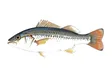
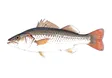
Mutton Snapper
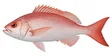
The mutton snapper (Lutjanus analis) is a species of marine ray-finned fish, a snapper belonging to the family Lutjanidae. It is found in the Western Atlantic Ocean.

Taxonomy

The mutton snapper was first formally described in 1828 by the French zoologist Georges Cuvier with the type locality given as Santo Domingo in the Dominican Republic. The specific name refers to the red, sharply pointed anal fin.

Description

The mutton snapper has a moderately deep, almond shaped body, with a nearly lunate caudal fin. The dorsal fin is almost two lobed and it has a sharply pointed anal fin. The pectoral fin is long, extending just past the origin of the anal fin. Both pairs of nostrils are simple holes. It has small eyes, a straight dorsal profile on the forehead and comparatively large terminal mouth with a protrusible upper jaw which is mostly covered by the cheek bone when the mouth is closed. The jaws are equipped with 1-2 tows of conical teeth with some of the outer row being enlarged into canine-like teeth. The vomerine teeth are arranged in a chevron shaped patch with another patch of teeth on each side of the palate. The dorsal fin has 10-11 spines and 13-14 soft rays while the anal fin contains 3 spines and 7-8 soft rays. The pectoral fin has 15-17, typically 16, rays. This is a colourful species with olive green on the back and upper flanks shading to reddish the lower flanks and abdomen. There is a black spot on the between the lateral line and the spiny part of the dorsal fin. There is a pair of blue stripes beneath the eyes and the higher one continues on to the operculum. The caudal fin has a black margin. When the fish is resting it has 10 to 12 dark vertical bars on the body, these merge into a solid colour when the fish is swimming. The fins are red. Small juveniles, around 15 mm (0.59 in) in length, have transparent fins and yellowish brown bands on the body, larger juveniles are marked with yellow bands on their body and a more prominent black spot than the adults. This fish attains a maximum total length of 94 cm (37 in), although 50 cm (20 in) is more typical, and the maximum published weight is 15.6 kg (34 lb).

Distribution and habitat

The mutton snapper is native to the western Atlantic Ocean where it occurs from Massachusetts in the north to Brazil in the south. It is commonest in the warmer waters of Florida, the Bahamas, the Caribbean Sea and in the Gulf of Mexico. This species occurs in comparatively shallow clear waters at depths from 25 to 95 m (82 to 312 ft) where the water temperature is between 18.9 and 27.8 °C (66.0 and 82.0 °F). The larger adults live in and around offshore reefs and in area of rock rubble, and the juveniles stay in inshore waters where they can be abundant in habitats such as tidal mangrove creeks, canals and shallow protected bays. The juveniles often shelter within turtle grass beds.

Read the full species guide.

Range

Where snapper live

How many of the 28 species are recorded in each state.
0
14
How many of the 28 species are recorded in each state.

Species

All 28 snapper species

Amarillo Snapper1 states
Lutjanus argentiventrisLutjanidaeNativeSaltBrackish
Black Snapper
Apsilus dentatusLutjanidaeNativeSalt
Blackfin Snapper2 states
Lutjanus buccanellaLutjanidaeNativeSalt
Blacktail Snapper1 states
Lutjanus fulvusLutjanidaeIntroducedFreshSaltBrackish
Cardinal Snapper2 states
Pristipomoides macrophthalmusLutjanidaeNativeSalt
Colorado Snapper1 states
Lutjanus coloradoLutjanidaeNativeSaltBrackish
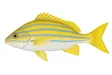
Common Bluestripe Snapper1 states
Lutjanus kasmiraLutjanidaeIntroducedSalt
Cubera Snapper5 states
Lutjanus cyanopterusLutjanidaeNativeSaltBrackish
Deepwater Longtail Red Snapper1 states
Etelis coruscansLutjanidaeNativeSalt
Dog Snapper5 states
Lutjanus jocuLutjanidaeNativeFreshSaltBrackish
Goldflag Snapper1 states
Pristipomoides auricillaLutjanidaeNativeSalt
Gray Snapper16 states
Lutjanus griseusLutjanidaeNativeFreshSaltBrackish
Green Jobfish
Aprion virescensLutjanidaeNativeSalt
Humpback Red Snapper
Lutjanus gibbusLutjanidaeIntroducedSalt
Lane Snapper8 states
Lutjanus synagrisLutjanidaeNativeSalt
Lavender Snapper1 states
Pristipomoides sieboldiiLutjanidaeNativeSalt
Mahogany Snapper4 states
Lutjanus mahogoniLutjanidaeNativeSalt
Mutton Snapper7 states
Lutjanus analisLutjanidaeNativeSaltBrackish
Northern Red Snapper12 states
Lutjanus campechanusLutjanidaeNativeSalt
Oblique-banded Snapper1 states
Pristipomoides zonatusLutjanidaeNativeSalt
Queen Snapper2 states
Etelis oculatusLutjanidaeNativeSalt
Randall's Snapper
Randallichthys filamentosusLutjanidaeNativeSalt
Rosy Snapper1 states
Pristipomoides filamentosusLutjanidaeNativeSalt
Ruby Snapper1 states
Etelis carbunculusLutjanidaeNativeSalt
Schoolmaster Snapper9 states
Lutjanus apodusLutjanidaeNativeSaltBrackish
Silk Snapper6 states
Lutjanus vivanusLutjanidaeNativeSalt
Vermilion Snapper9 states
Rhomboplites aurorubensLutjanidaeNativeSalt
Yellowtail Snapper6 states
Ocyurus chrysurusLutjanidaeNativeSalt