Humpback Red Snapper

Lutjanus gibbus

Lutjanidae · saltwater water fish

5 minute read · Species guide

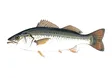
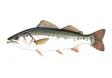
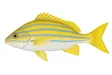
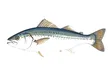
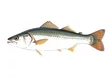
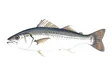
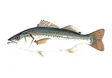
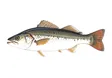
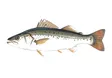
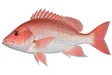
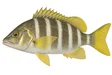
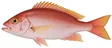
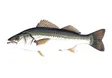
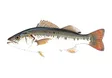
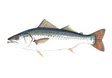
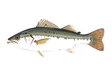
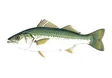
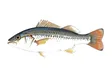
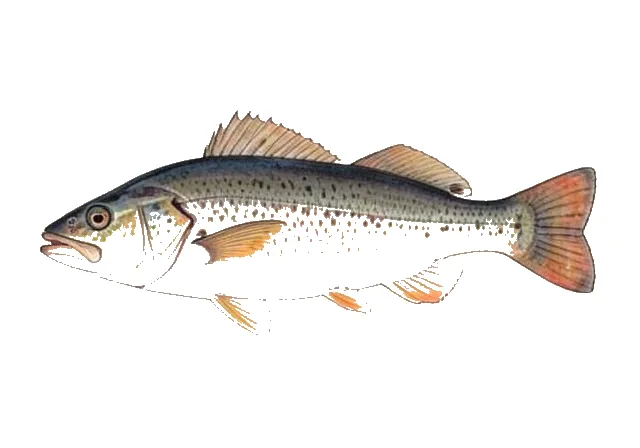
Humpback Red Snapper field guide illustration

About Humpback Red Snapper

The humpback red snapper (Lutjanus gibbus), the paddletail, paddletail snapper or hunchback snapper, is a species of marine ray-finned fish, a snapper belonging to the family Lutjanidae. It has a wide Indo-West Pacific distribution. It is a commercially important species, as well as being sought after as a game fish. It is also a popular species for display in public aquaria. It has been reported to cause ciguatera poisoning.

Taxonomy

The Humpback red snapper was first formally described in 1775 as Sciaena gibba by the Swedish speaking Finnish born explorer and naturalist Peter Forsskål with the type locality given as the Red Sea. The specific name, gibbus means "humpbacked", a reference to high, steep dorsal profile on the head of the adults.

Description

Humpback red snapper has a body which is relatively with a standard length which is 2.2 to 2.5 times its depth, with a head which has a very steeply sloped forehead a well developed known and notch in the preoperculum. The vomerine teeth are arranged in a crescent shaped patch with no rearwards extension and the tongue is smooth, lacking any teeth. The dorsal fin has 10 spines and 13–14 soft rays while the anal fin contains 3 spines and 8 soft rays. The rear part of the dorsal and anal fins are pointed in shape. The pectoral fins contain 16 to 17 rays and the caudal fin is forked with rounded lobes. This fish attains a maximum total length of 50 cm (20 in), although 45 cm (18 in) is more typical. The overall colour of this snapper is red or grey, darker on back and upper head. There is an orange tint on the lower part of gill cover and on the axil of the pectoral fin. The fins may be red but the median fins are normally dark brown to blackish with the soft-rayed part of the dorsal fin, the anal fin and the caudal fin having a thin white margin. The juveniles have a sizeable circular black spot at base of caudal fin.

Distribution and habitat

Lutjanus gibbus ha a wide Indo-West Pacific distribution. It ranges from the eastern African coast and the Red Sea to the Society and Line islands and from Australia in the south to southern Japan in the north. It has also been recorded from the Marquesas and south to Rapa Iti. In Australia it is found from Houtman Abrolhos to the Dampier Archipelago and reefs off the northern coast of Western Australia, the Ashmore Reef in the Timor Sea the on the eastern coast from the outer Great Barrier Reef and Coral Sea reefs south to Moreton Bay in Queensland with juveniles occurring south to Sydney. The humpback red snapper occurs at depths from 1 to 150 m (3 ft 3 in to 492 ft 2 in). It is associated with reefs and during the day gathers in large, mostly stationary aggregations on coral reefs. The juveniles shelter in beds of sea grass in protected areas of sandy and muddy substrates, while the aggregations are dominated by subadults. The larger adults inhabit deeper waters on coastal slopes.

Biology

The humpback red snapper feeds on fishes and invertebrates, such as shrimps, crabs, lobsters, stomatopods, cephalopods, echinoderms and ophiuroids. Off East Africa most spawning takes place during the spring and summer. Sexual maturity occurs at two and a half years old and they form spawning aggregations.

Fisheries

The humpback red snapper catch in 2010 was estimated at 3,100 t (3,100 long tons; 3,400 short tons), of which 2,500 t (2,500 long tons; 2,800 short tons) are unreported. It is an important species for fisheries in Japan. It is taken mostly using handlines, traps, spearfishing, and gill nets. It is a common item in fish markets, normally being sold as fresh fish. In the Pacific part of its range consumption of this species has been linked to ciguatera poisoning.

Article text: Wikipedia contributors, Humpback red snapper (source revision). Licensed under CC BY-SA 4.0. Retrieved 2026-10-11.
Identification and appearance

Lutjanus gibbus is pale reddish-grey to orange in color with reddish pectoral and pelvic fins (Lieske and Myers 2004). Adults have a steeply-sloped, concave head and humpback profile. The caudal fin is large and forked with rounded lobes, the upper lobe larger than the lower (Randall 2005, Gloerfelt-Tarp and Kailola 2022). Juveniles have a pale blue spot on each scale which forms the appearance of oblique lines on the body with a large black spot on the base of the caudal fin (Randall 2005). The vomerine teeth, a patch of teeth on the roof of the mouth used to hold prey, form a V-shape (Randall 2005).

Native range

This species is widely distributed in the western Pacific and eastern Indian oceans from east Africa and the Red Sea to Indonesia, the Ryuku and Ogasawara islands, northern Australia, New Caledonia, Micronesia, the Line Islands, the Tuamotu Archipelago and the Marquesas (Mundy 2005).

Habitat and ecology

Adults of this species prefer deep lagoon and seaward reef habitats from 1 to 150 m in depth, while the juveniles inhabit seagrass beds and coral in shallow areas of the reef (Myers 1999). By day the adults form large tightly packed stationary schools and disperse at night to feed (Randall 2005). Lutjanus gibbus adults have short conical teeth and jaw mechanics that produce a strong force for feeding on the preferred prey of crabs and other crustaceans (Nanami et al. 2010). Spawning occurs around the full moon throughout the warmer months of the year (Myers 1999, Nanami et al. 2010). In American Samoa, Taylor et al. (2018) describes clear sexual dimorphism in life span with females living up to 27 years and males only to 19 years. The median age at maturity for this population was 3.2 years (Taylor et al. 2018). In contrast, Moore (2019) found that in New Caledonia there were similar ages in life span with females reaching 38 years and males reaching 36 with maturity being reached around 3.4-3.9 years. Fishing pressure is lower in New Caledonia relative to other locations in the native range which could account for the variability in life spans (Moore 2019). This species is known to cause ciguatera poisoning (Bagnis et al. 1972, Myers 1999).

Introduction history

Stocked for fisheries enhancement.

Range

Where it lives

GBIF holds no US occurrence record for this species under this name. That is a gap in the record, not evidence that the fish is absent: ITIS files it as a US species.

Habitat

Water and movement

Water
WoRMS records this species in the sea.
USGS NAS habitat
Marine
US status
Exotic — the USGS Nonindigenous Aquatic Species database lists it as introduced from outside North America.

Classification

Taxonomy

Kingdom
Animalia
Phylum
Chordata
Superclass
Actinopterygii
Class
Teleostei
Order
Perciformes
Genus
Lutjanus
Species
Lutjanus gibbus
ITIS TSN
168866
WoRMS AphiaID
218480
GBIF key
2385035
Outside the US
ITIS also files it in Central Pacific Territories.

Common questions about Humpback Red Snapper

What is the scientific name of Humpback Red Snapper?
The scientific name is Lutjanus gibbus, in the family Lutjanidae. Classification follows ITIS.
Does Humpback Red Snapper live in fresh water or salt water?
WoRMS records this species in the sea.

Closest relatives

Other Lutjanus species

Same family

More Lutjanidae

Amarillo Snapper1 states
Lutjanus argentiventrisLutjanidaeNativeSaltBrackish
Black Snapper
Apsilus dentatusLutjanidaeNativeSalt
Blackfin Snapper2 states
Lutjanus buccanellaLutjanidaeNativeSalt
Blacktail Snapper1 states
Lutjanus fulvusLutjanidaeIntroducedFreshSaltBrackish
Cardinal Snapper2 states
Pristipomoides macrophthalmusLutjanidaeNativeSalt
Colorado Snapper1 states
Lutjanus coloradoLutjanidaeNativeSaltBrackish
Common Bluestripe Snapper1 states
Lutjanus kasmiraLutjanidaeIntroducedSalt
Cubera Snapper5 states
Lutjanus cyanopterusLutjanidaeNativeSaltBrackish
Deepwater Longtail Red Snapper1 states
Etelis coruscansLutjanidaeNativeSalt
Dog Snapper5 states
Lutjanus jocuLutjanidaeNativeFreshSaltBrackish
Goldflag Snapper1 states
Pristipomoides auricillaLutjanidaeNativeSalt
Gray Snapper16 states
Lutjanus griseusLutjanidaeNativeFreshSaltBrackish
Green Jobfish
Aprion virescensLutjanidaeNativeSalt
Ironjaw1 states
Aphareus rutilansLutjanidaeNativeSalt
Lane Snapper8 states
Lutjanus synagrisLutjanidaeNativeSalt
Lavender Snapper1 states
Pristipomoides sieboldiiLutjanidaeNativeSalt
Mahogany Snapper4 states
Lutjanus mahogoniLutjanidaeNativeSalt
Mutton Snapper7 states
Lutjanus analisLutjanidaeNativeSaltBrackish
Northern Red Snapper12 states
Lutjanus campechanusLutjanidaeNativeSalt
Oblique-banded Snapper1 states
Pristipomoides zonatusLutjanidaeNativeSalt
Queen Snapper2 states
Etelis oculatusLutjanidaeNativeSalt
Randall's Snapper
Randallichthys filamentosusLutjanidaeNativeSalt
Rosy Snapper1 states
Pristipomoides filamentosusLutjanidaeNativeSalt
Ruby Snapper1 states
Etelis carbunculusLutjanidaeNativeSalt

All 32 species in Lutjanidae