Common names

Types of anchovy

11 species carry anchovy in an English common name. They sit in 1 family, so the group is a name, not a scientific rank.

About anchovy

Anchovies are small, common forage fish of the family Engraulidae. Most species are found in marine waters, but several will enter brackish water, and some in South America are restricted to fresh water.

More than 140 species are placed in 16 genera; they are found in the Atlantic, Indian and Pacific Oceans, and in the Black Sea and the Mediterranean Sea. Anchovies are usually classified as oily fish.

Taxonomy

Anchovies are classified into two subfamilies and 16 genera:

Evolution

The earliest known fossil records of anchovy relatives are of large predatory stem -anchovies (Clupeopsis and Monosmilus) from the early and middle Eocene of the Tethys Ocean, in Belgium and Pakistan. The large fangs of these early anchovy relatives has led to the nickname "saber-toothed anchovies" (not to be confused with the extant genus Lycengraulis). The earliest record of a true anchovy is of the stem-engrauline Eoengraulis from the Early Eocene of Monte Bolca, Italy.

Despite their abundance in the modern day and their tendency to form huge schools, anchovies are relatively rare in the fossil record. Many species that were formerly considered fossil anchovies are thought to either not be anchovies or are too fragmentary to confidently assign to this group. The rarity of anchovies in the fossil record may be an artifact of preservation; fossil anchovies are only recognizable as such when well-preserved, but anchovies tend to inhabit highly turbid nearshore marine environments where preservation as fossils is much less likely, while well-preserved fossil fishes tend to be found in deposits formed in deeper water.

Characteristics

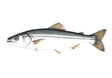
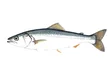
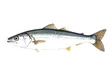
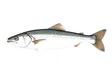
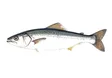
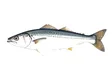
Anchovies are small, green fish with blue reflections due to a silver-colored longitudinal stripe that runs from the base of the caudal (tail) fin. They range from 2 to 40 centimetres (1 to 15 + 1 ⁄ 2 inches) in adult length, and their body shapes are variable with more slender fish in northern populations.

The snout is blunt with tiny, sharp teeth in both jaws. The snout contains a unique rostral organ, believed to be electro-sensory in nature, although its exact function is unknown. The mouth is larger than that of herrings and silversides, two fish which anchovies closely resemble in other respects. The anchovy eats plankton and recently hatched fish.

Distribution

Anchovies are found in scattered areas throughout the world's oceans, but are concentrated in temperate waters, and are rare or absent in very cold or very warm seas. They are generally very accepting of a wide range of temperatures and salinity. Large schools can be found in shallow, brackish areas with muddy bottoms, as in estuaries and bays.

The European anchovy is abundant in the Mediterranean, particularly in the Alboran Sea, Aegean Sea and the Black Sea. This species is regularly caught along the coasts of Crete, Greece, Sicily, Italy, France, Turkey, Northern Iran, Portugal and Spain. They are also found on the coast of northern Africa. The range of the species also extends along the Atlantic coast of Europe to the south of Norway. Spawning occurs between October and March, but not in water colder than 12 °C (54 °F). The anchovy appears to spawn at least 100 kilometres (55 nautical miles) from the shore, near the surface of the water.

Ecology

The anchovy is a significant food source for almost every predatory fish in its environment, including the California halibut, rock fish, yellowtail, shark, chinook, and coho salmon. It is also extremely important to marine mammals and birds; for example, breeding success of California brown pelicans and elegant terns is strongly connected to anchovy abundance.

Feeding behavior

Anchovies, like most clupeoids (herrings, sardines and anchovies), are filter-feeders that open their mouths as they swim. As water passes through the mouth and out the gills, food particles are sieved by gill rakers and transferred into the esophagus.

Black Sea

On average, the Turkish commercial fishing fleet catches around 300,000 tons per year, mainly in winter. The largest catch is in November and December.

Peru

The Peruvian anchovy fishery is one of the largest in the world, far exceeding catches of the other anchovy species.

In 1972, it collapsed catastrophically due to the combined effects of overfishing and El Niño and did not fully recover for two decades.

As food

A traditional method of processing and preserving anchovies is to gut and salt them in brine, allow them to cure, and then pack them in oil or salt. This results in a characteristic strong flavor and the flesh turning a deep grey. Pickled in vinegar, as with Spanish boquerones, anchovies are milder and the flesh retains a white color. In Roman times, anchovies were the base for the fermented fish sauce garum. Garum had a sufficiently long shelf life for long-distance commerce, and was produced in industrial quantities. Anchovies were also eaten raw as an aphrodisiac.

Today, they are used in small quantities to flavor many dishes. Because of the strong flavor, they are also an ingredient in several sauces and condiments, including Worcestershire sauce, caesar salad dressing, remoulade, Gentleman's Relish, many fish sauces, and in some versions of Café de Paris butter. For domestic use, anchovy fillets are packed in oil or salt in small tins or jars, sometimes rolled around capers. Anchovy paste is also available. Fishermen also use anchovies as bait for larger fish, such as tuna and sea bass.

The strong taste people associate with anchovies is due to the curing process. Fresh anchovies, known in Italy as alici, have a much milder flavor. The anchovies from Barcola (in the local dialect: sardoni barcolani) are particularly popular. These white fleshy fish, which are only found at Sirocco in the Gulf of Trieste, achieve the highest prices.

In Sweden and Finland, the name "anchovies"is related strongly to a traditional seasoning, hence the product"anchovies"is normally made of sprats and herring can be sold as"anchovy-spiced". Fish from the family Engraulidae are instead known as sardell in Sweden and sardelli in Finland, leading to confusion when translating recipes.

In Southeast Asian countries like Indonesia, Singapore, Malaysia and the Philippines, they are deep-fried and eaten as a snack or a side dish. They are known as ikan bilis in Malay, ikan teri in Indonesian and dilis in Filipino.
Anchovy species in focus

These species profiles show how members of the group differ. Their biology describes each named species, rather than every fish in the group.

Californian Anchoveta

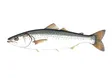
The Californian anchovy or northern anchovy (Engraulis mordax) is a species of anchovy found in the Eastern Pacific Ocean, ranging from Mexico to British Columbia. It is a small, Clupeoid fish with a large mouth and a long, laterally compressed body, which strongly resembles the European Anchovy (Engraulis encrasicolus) with only slight differences in girth and fin position. They have a euryhaline lifestyle defined by regular migrations between bays and open ocean for both spawning and foraging. Like Pacific sardines (Sardinops sagax), they compose a large fraction of the marine biomass in waters off the west coast of North America, where they are a vital keystone species in coastal pelagic waters. However, they are subject to seasonal boom & bust cycles that are chiefly caused by changes in water temperature and food availability; regularly switching places as the forage fish of prominence with the sardine during years defined by colder water temperatures, which makes them vulnerable to climate change. They have a small commercial fishery; mainly used as bait for fishermen or fish meal, with a dedicated small following as a food fish in San Francisco.

Morphology

Californian anchovies exhibit the basic anchovy body form like a large sub-terminal mouth that extends past the eye, a centrally located single dorsal fin on a compressed & elongated body, a forked caudal fin, the absence of a visible lateral line, and weak, shiny scales colored by crystalline guanine that complete its countershaded camouflage. The only way to confidently tell them apart from the European anchovy besides their range is to measure where the posterior side of their dorsal fins terminate on their body, which vertically matches exactly where the anal fin begins for Californian anchovies.

Purported "Bay" form

Trawling surveys in San Francisco Bay starting from the 1920s by famous ichthyologist Carl Leavitt Hubbs up to the present by scientists from UC Davis seem to support the existence of a separate "bay"form of the Californian anchovy that has fewer vertebrae than the oceanic"green-back"form, a proportionally larger head, a tan to transparent dorsum due to the near absence of guanine crystals in their chromatophores, and a residential lifestyle with no migration to coastal waters. Hubbs was confident enough about its existence that he described it as a subspecies named Engraulis mordax nanus Girard. However, all anchovies undergo regular shifts in dorsum color due to salinity changes during their migrations and transitions between their life stages, and that anchovies that closely resemble the"bay"form have been collected off the coast of Northern California. More research, preferably genetic analyses, on the"bay" form present in San Francisco Bay is needed to support its existence as a separate subspecies.

Distribution

The native range of the Californian anchovy is demarcated roughly between the nearshore waters off Haida Gwaii to the north and the Gulf of California to the south. Their range is divided into 3 phenotypically distinct sub-populations: a northern subpopulation between British Columbia and Monterey Bay, a central subpopulation between San Francisco Bay and coastal waters near El Rosario in central Baja California, and a southern subpopulation from Cedros Island southwards into the mouth of the Gulf of California. Although these subpopulations somewhat differ in certain characteristics like operculum width, body size, transferrin pattern types, and spawning times, they are not genetically distinct enough to warrant reclassification into separate subspecies.

Read the full species guide.

Broad-striped Anchovy

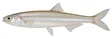
Anchoa hepsetus, commonly known as the broad-striped anchovy, is a species of ray-finned fish in the family Engraulidae. It grows to be about 15 cm (6 in) long. The broad-striped anchovy is found in the west Atlantic along the North American coast from Nova Scotia and the Maine coast scarcely, and abundantly from the Chesapeake bay to the West Indies and Uruguay. It is found most commonly in shoals along coastal waters, as deep as 73 m (40 fathoms) although mostly found in water shallower than this. The broad-striped anchovy spawns in spring. Their eggs are pelagic and hatch within 48 hours at regular spring temperatures. At young ages, it eats copepods, but as the fish ages, its diet begins to consist of other small crustaceans, molluscs, and worm larvae. It is an important food staple for large commercial fishes, such as the American seatrout. It is commonly eaten by birds. It is elongate with large eyes and protuberant snout, large mouth and underslung jaw. Its anal fin is quite short, and its front fin lies beneath the end of the dorsal fin. It is grey-green with black dots, but its notable feature is its silvery stripe from head to tail.

Read the full species guide.

Bay Anchovy

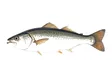
Anchoa mitchilli is a species of ray-finned fish in the family Engraulidae, the anchovies. Its common names include bay anchovy and common anchovy. It is native to the western Atlantic Ocean and the Gulf of Mexico. It is one of the most common fish species along the coastlines of the western Atlantic.

Etymology

The fish is named in honor of Samuel Latham Mitchill (1764–1831), naturalist, physician and U.S. Senator, who studied the fishes of New York.

Description

The bay anchovy is somewhat variable in appearance. It is a small, slender, schooling fish with a greenish body and a silvery stripe. It is characterized by its very long jaw, silvery belly, lateral stripe, and single dorsal fin. The dorsal fin is located directly above the anal fin origin. The adult male is generally about 6 centimetres (2.4 in) long, with a maximum length of 10 centimetres (3.9 in) to 11 centimetres (4.3 in). It has 14 to 16 rays in its dorsal fin, 24 to 30 in its anal fin, and 11 to 12 in the pectoral. It may live more than three years.

The bay anchovy is similar to other species in the genus Anchoa which occur in the same regions. The broad-striped anchovy is similar in appearance, but grows to a larger size, up to 15 centimetres (5.9 in). The Cuban anchovy has its anal fin set further back on the body.

Range and habitat

This species is distributed in the Atlantic Ocean and Gulf of Mexico along the eastern coasts of North America from Maine to Yucatán. It does not occur in the West Indies. It is well known in the Chesapeake Bay, where it is the most abundant fish.

It occurs in a wide range of water temperatures and salinities, including some hypersaline environments. It does not tolerate low-oxygen waters and easily asphyxiates when deprived of oxygen.

Read the full species guide.

Range

Where anchovy live

How many of the 11 species are recorded in each state.
0
9
How many of the 11 species are recorded in each state.

Species

All 11 anchovy species