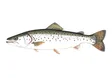
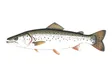
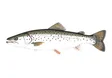
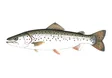
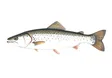
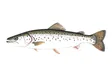
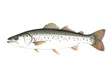
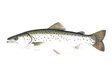
Common names

Types of whitefish

9 species carry whitefish in an English common name. They sit in 1 family, so the group is a name, not a scientific rank.

About whitefish

The freshwater whitefish are fishes of the subfamily Coregoninae, which contains whitefishes (both freshwater and anadromous) and ciscoes, and is one of three subfamilies in the salmon family Salmonidae. Apart from the subfamily Coregoninae, the family Salmonidae includes the salmon, trout, and char species of the subfamily Salmoninae, and grayling species of the subfamily Thymallinae. Freshwater whitefish are distributed mainly in relatively cool waters throughout the northern parts of the Northern Hemisphere.

Taxonomy

Two fossil genera (Beckius David, 1946 and Parastenodus David, 1946) are also known, both only from isolated scales from the Late Eocene or early Oligocene Kreyenhagen Shale of the San Joaquin Valley, California.

Niche

In their ecosystems, whitefish tend to be some of the largest fish and occupy niches as benthic predators. The recent invasion of several invasive species, including the sea lamprey and zebra mussels, has begun to pose a threat to the whitefish population by disrupting historic ecological relationships and prey distribution. This has been exacerbated by other changes to their habitat such as changes in land use, climate change, and the introduction of outside nutrients through runoff.

Whitefish as food

Freshwater whitefish is known for its mild flavor and high omega-3 fatty acid content. It is generally favored by those who dislike stronger fishy taste. Lake whitefish is one of the most commonly consumed varieties of freshwater whitefish. It is especially popular in the Great Lakes region, where it can frequently be found, usually grilled or fried, as a popular offering in many restaurants. Smoked whitefish is locally produced as well. Many freshwater whitefish species have also made up an important component of the traditional diets of many indigenous people who have historically inhabited its range. Smoked whitefish is sold in American delicatessens, especially those specializing in Jewish cuisine, either filleted or made into whitefish salad.

Use by Indigenous peoples

Lake whitefish, adikameg in Ojibwemowin, has historically been a staple food for the Anishinaabek, a diverse nation native to the Great Lakes region. In recent years, following several legal battles which restored the ability of native peoples to exercise their right to hunt and gather, whitefish has become a major resource for those communities. Native Alaskan communities also gather whitefish, specifically the inconnu (or sheefish), as a subsistence food.

Evolution due to human interaction

There are a multitude of species of freshwater whitefish, some are more valued economically than others. Fishing for markets is not uncommon for species such as Coregonus widegreni and Coregonus lavaretus. At the time, there was an increase in younger groups of C. widegreni because when fishing, humans only wanted the larger fish which ended up being the oldest.
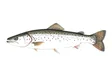
Whitefish species in focus

These species profiles show how members of the group differ. Their biology describes each named species, rather than every fish in the group.

Broad Whitefish

The broad whitefish (Coregonus nasus) is a freshwater whitefish species. Dark silvery in colour, and like a herring in its shape. Its distinctive features includes: a convex head, short gill rakers, and a mild overbite. It is found in the Arctic-draining streams, lakes, and rivers of far eastern Russia and North America. Its prey includes larval insects, snails, and shellfish. It is eaten by humans and brown bears.

Description

The broad whitefish is a herring-shaped fish with a more compressed body and convex head than other whitefishes. It is iridescent, with a dark olive-brown back, silvery grey sides, and a whitish bottom. Features that distinguish it from other species include a mild overbite and 18–25 short gill rakers. The fins of adults are grey, while those of young fish are grey. It reaches a maximum length of 70 centimetres (28 in), and a maximum weight of 16 kilograms (35 lb).

Distribution and habitat

The broad whitefish is found in Arctic-draining basins in northern Eurasia and North America from the Pechora River to the Perry River. Most commonly inhabiting streams, it is also found in lakes and estuaries with a salinity of less than 15 percent. Fish from freshwater populations sometimes migrate to or through ocean waters, especially in the winter. It is nerito-pelagic, meaning that it is found in inshore open water. Throughout its range it is widespread and abundant, and there are no known threats to its survival, though it could potentially be threatened by overfishing, habitat destruction caused by oil exploration, and alteration of rivers. It has a number of genetically distinct forms in the various basins it occurs in. It has been stocked successfully in Belgium and unsuccessfully in Latvia, Ukraine, Estonia, China. An introduction has been made in Mining, Austria, where a rod and reel record fish was caught in 2002.

Ecology

Recorded items in the broad whitefish's diet are chironomid midges, mosquito larvae, snails, bivalves, and crustaceans. It migrates upstream to spawn, except in some estuaries. These migrations are difficult for it, and many individuals become heavily scarred from infestations, lampreys, and fishing nets. It prefers streams with gravel bottoms, especially those with finer gravel, for spawning. After hatching, larval fish move downstream. In Russia, spawning occurs between July and November in various populations.

Read the full species guide.

Humpback Whitefish

The humpback whitefish (Coregonus pidschian), also referred to as the bottom whitefish, the Arctic whitefish or the pidschian, is a species of freshwater whitefish with a northern distribution. It is one of the members in the broader common whitefish complex, or the Coregonus clupeaformis complex. This fish lives in estuaries and brackish water near river mouths, in deltas and in slowly running rivers, in large lakes with tributaries, and floodplain lakes. It can migrate long distances upriver for spawning.

The distribution of Coregonus pidschian is in the Arctic basin, ranging from Northern Norway and Finland across the Russian coast to Alaska and up to the Mackenzie River drainage in North-West Canada. It is also found in the Okhotsk Sea basin.

Read the full species guide.

Lake Whitefish

The lake whitefish (Coregonus clupeaformis) is a species of freshwater whitefish from North America. Lake whitefish are found throughout much of Canada and parts of the northern United States, including all of the Great Lakes. The lake whitefish is sometimes referred to as a "humpback" fish due because of its small head size in relation to the length of the body. It is a valuable commercial fish and also occasionally taken by sport fishermen. Smoked, refrigerated, or vacuum-packed lake whitefish fillets are available in North American grocery stores. Other vernacular names used for this fish include Otsego bass, Sault whitefish, gizzard fish, common whitefish, eastern whitefish, Great Lakes whitefish, humpback whitefish, inland whitefish and whitefish.

Etymology

The scientific genus name Coregonus (co-regg'-on-us) means "angle eye"in Greek, and the species name clupeaformis means" herring -shaped" in Latin.

Description

The lake whitefish is similar in appearance to other whitefishes in the Coregoninae subfamily of the salmon family Salmonidae, such as the northern cisco (Coregonus artedi). As with all salmonids, it has an adipose fin. To the distinction from cisco, the lake whitefish has a snout which overhangs the short lower jaw, so that the mouth opens in a slightly inferior position. Thus the fish can feed on the bottom of lake beds or grab food particulates out of the water or from the surface of a water body. The cisco in turn has a short snout with a lower jaw that extends beyond the snout. Both the cisco and lake whitefish are discernible from the mooneye due to the small posterior dorsal adipose fin. In early life stages the cisco and lake whitefish are indistinguishable based on morphological characters alone, with genetic analyses being necessary to reliably identify species. Another notable feature of the lake whitefish is the presence of two small flaps in each nostril. Its coloration is typically silver to white with an olive to pale-green or brown dorsal hues. The ventral fins are white, and the tail has a dark posterior edge.

Lake whitefish from inland lakes can reach a weight upwards of 5 pounds (2,300 g); the largest caught on rod and reel weighed 14 pounds 6 oz, from Meaford, Ontario, in 1984. On average, the lake whitefish weighs around 4 pounds. They can grow to 31 inches (79 cm) and commonly reach 20 inches (51 cm).

Habitat

Lake whitefish are cool water fish. They are found in a large number of inland lakes, and they have been known to enter brackish water. The lake whitefish is distributed from Alaska and western Canada to the Atlantic coastal drainage of Maine and in New Brunswick north to Labrador.

Read the full species guide.

Range

Where whitefish live

How many of the 9 species are recorded in each state.
0
7
How many of the 9 species are recorded in each state.

Species

All 9 whitefish species