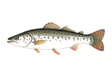
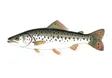
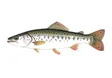
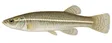
Common names

Types of topminnow

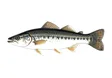
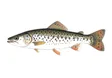
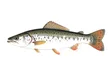
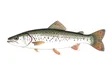
14 species carry topminnow in an English common name. They sit in 2 families, so the group is a name, not a scientific rank.

About topminnow

Fundulidae is the family of topminnows and North American killifishes.

Distribution

The 46 species are native to North America as far south as Yucatan, and to the islands of Bermuda and Cuba, occurring in both freshwater and marine environments.

Description

Most members of the family are small. While the giant killifish (Fundulus grandissimus) and northern studfish (Fundulus catenatus) can reach 20 cm (7.9 in) in length, most species are under 10 cm in length.

The distinguishing characteristic of the family is the maxillary bone, which is twisted instead of being straight.

While many species of the Fundulidae are listed as not threatened, there are some that are listed as endangered because of their environment. Many common species of the Fundulidae live in North America such as the United States and Mexico. They live in different ecosystem such as costal marshes, lagoons, rivers, streams with high elevations with clear water, and muddy conditions at lower elevation. They are able to adapt to different conditions which is increasing their survival rate.
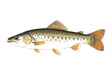
Topminnow species in focus

These species profiles show how members of the group differ. Their biology describes each named species, rather than every fish in the group.

Golden Topminnow

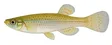
The golden topminnow (Fundulus chrysotus) is a fish of the genus Fundulus and is a United States native fish mostly distributed throughout the southeast, ranging from Kentucky and Ohio south into Florida. Although it has such a wide distribution throughout the south, the habitats and micro-habitats that it occupies do not differ much from one area of distribution to others. The golden topminnow is a small surface feeding fish that tends to reproduce late in the spring season and on into the early parts of the summer, and although the fry reach maturity fairly quickly the longevity of the golden topminnow is quite short. Because the golden topminnow is lower in the trophic level and is a small fish, it primarily feeds on small and/or drifting organisms at, or near the surface of, vegetated areas. This particular topminnow is not currently listed as an endangered species, nor does it have any particular type of management plan.

Geographic distribution

The golden topminnow is geographically distributed throughout the southeastern portion of the continental U.S. Specifically, the golden topminnow inhabits the Santee River Drainage of South Carolina west to the Trinity River Drainage of Texas. It can also be found throughout the Mississippi Embayment north to Kentucky and Missouri. Further south, the golden topminnow inhabits the Lower Coastal Plain and is commonly scattered throughout Florida. It has even been documented stretching its distribution northwest, extending into the Gulf Coastal Plain in McCurtain County Oklahoma and Mississippi County Missouri. Outside of these areas, the golden topminnow is extremely localized and uncommon.

Ecology

The golden topminnow's diet ranges from aquatic plants to terrestrial invertebrates but consists mostly of aquatic invertebrates. Food habits were studied among many different species of fish throughout Lake Seminole, Florida-Georgia, including the food habits of the golden topminnow. The golden topminnow was observed feeding on small proportions of Macrophytes (aquatic vegetation) and a much wider array of aquatic invertebrates, including Gastropoda (snails/slugs), large quantities of Ostracoda (seed shrimp), Ephemeroptera (mayflies), Coleoptera (water-beetles), and Chironomidae (non-biting midge flies). The golden topminnow's diet does not include vertebrate prey, and the most common food sources are seed shrimp and midge larvae with water beetles and mayflies as minor contributors to its diet. Because of its trophic level position, the golden topminnow also has a wide array of predators that feed on smaller, surface feeding vertebrates. These include, but are not limited to, the largemouth bass Micropterus salmoides, the redear sunfish Lepomis microlophus, the bluegill sunfish Lepomis macrochirus, and the bluespotted sunfish Enneacanthus gloriosus.

The golden topminnow is able to tolerate a range of salinity levels. When observed in 7 and 14 percent salinity, the golden topminnow had a 100 percent mean survival rate, whereas at 21 percent salinity, the rate decreased to 91 percent survival; at 28 percent salinity, the mean survival rate decreased to 24 percent, and at 35 percent salinity the mean survival rate was 0 percent. The salinity tolerances described above account for the golden topminnow's native range throughout coastal waters and brackish waters, allowing for survival and reproduction in a narrow range of salinities. Some major human influences to the golden topminnow population include habitat pollution and the conversion of marshlands and brackish water for agricultural purposes.

Life cycle

The golden topminnow breeds throughout the spring and on into the summer months from April to July, and sometimes as late as September. During courtship the male swims in loops or circles above or beside the female, sometimes pausing to bob his head up and down. Eggs are released individually and deposited on the roots of floating plants or on other fibrous material by the female, where afterwards they are fertilized one at a time by the male. After hatching the larvae rest on leaves or on the bottom and begin to grow quickly reaching maturation after 10 months. At maturation, the golden topminnow becomes slender with a rounded caudal fin and a deep caudal peduncle. The mouth is small and slightly superior and the dorsal fin is set far back on the body and begins posterior to the anal fin origin. A lateral line is absent with 7–9 dorsal rays, 9–11 anal rays, 12–14 pectoral rays and 6 pelvic rays. During the breeding season, males develop prickly contact organs on the side of the body between the dorsal and anal fins, and on the ends of the last few dorsal rays, anal fin, and outermost rays of the pectoral fin. The life expectancy of the golden topminnow is around 2 years.

Ross, S. T. 2001. The Inland Fishes of Mississippi. University Press of Mississippi, Jackson. 624 pp.

Read the full species guide.

Saltmarsh Topminnow

The saltmarsh topminnow (Fundulus jenkinsi) is a species of killifish of the family Fundulidae. It occurs in the coastal wetlands of the Gulf of Mexico in the United States.

Description

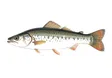
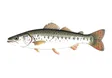
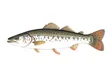
Saltmarsh topminnows have little color in life; there is cross-hatching on the back and sides that may be gray-green or fainter, and 12 to 30 dark round spots are often arranged in rows along the midside of the body from above the pectoral fin to the base of the caudal fin.

Ecology

Saltmarsh topminnows live in estuaries, coastal salt marshes and backwater sloughs including shallow tidal meanders of Spartina marshes. They are endemic to brackish water areas from Galveston Bay, Texas to Escambia Bay in the western panhandle of Florida.

Conservation

Habitat alteration, dredging, and marsh erosion are the most serious threats to the saltmarsh topminnow.

Read the full species guide.

Blackspotted Topminnow

The blackspotted topminnow, Fundulus olivaceus, is a species of fish in the family Fundulidae: the topminnows and North American killifishes. It is native to the south-central United States, where it is known from the drainages of the Mississippi River from Illinois to the Gulf of Mexico and as far west as Galveston Bay.

This species lives in clear streams with fast currents and sand or gravel substrates. It can often be found near the thick vegetation along the banks of the streams. It is omnivorous, consuming some plant matter along with a main diet of insects and other arthropods.

Description

The blackspotted topminnow has an elongate body up to 9.7 centimetres (3.8 in) long. It is brownish yellow to olive green on its upper side and has a wide, dark lateral band and distinct dark spots. The male has longer fins than the female and the fins of the male may take on a yellowish color during breeding. This species is very similar to the blackstripe topminnow (Fundulus notatus), which also has a dark lateral band. It can be distinguished from F. notatus by its darker, more numerous spots. The two may hybridize. In Fundulus olivaceus, the gill slit extends the dorsal to the uppermost pectoral fin ray. The distance from the origin of the dorsal fin to the end of the hypural plate is less than the distance from the origin of the dorsal fin to the preopercle or occasionally about equal to that distance. The mouth is sightly supraterminal.

Diet

The blackspotted topminnow eats various arthropods and algae.

Habitat

This species occurs near the surface in quiet or flowing, relatively clear, sand-gravel bottom headwaters, creeks, and small rivers; often occurring along margins near thick stands of emergent vegetation.

Read the full species guide.

Range

Where topminnow live

How many of the 14 species are recorded in each state.
0
9
How many of the 14 species are recorded in each state.

Taxonomy

Families in this group

Species

All 14 topminnow species