Common names

Types of cisco

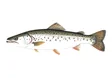
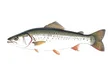
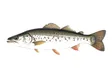
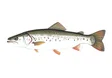
9 species carry cisco in an English common name. They sit in 1 family, so the group is a name, not a scientific rank.

About cisco

The ciscoes (or ciscos) are salmonid fish that differ from other members of the genus Coregonus in having upper and lower jaws of approximately equal length and high gill raker counts. These species have been the focus of much study recently, as researchers have sought to determine the relationships among species that appear to have evolved very recently. Cisco is also specifically used for the North American species Coregonus artedi, also known as lake herring.

In previous taxonomic classifications, the ciscoes have been identified as a subgenus Leucichthys of the genus Coregonus. Based on molecular data this is not a natural classification however, as the ciscoes are polyphyletic, comprising two different lineages within the freshwater whitefishes.

Continental North American ciscoes: Coregonus artedi sensu lato

Eight taxa of cisco have been recognized in the Laurentian Great Lakes and other interior lakes in once-glaciated parts of North America.

Usually, several taxa of ciscoes are found in a single lake. They exhibit different habitat distributions, feeding and breeding habits and morphological adaptations e.g. in their gill raker numbers. In the Great Lakes, at least five ciscoes coexist.

According to genetic analyses, these cisco types do not represent unique, separate evolutionary lineages, but similar cisco morphs have evolved and attained their specific characteristics largely independently in each lake. Therefore, it has been suggested that they should not be recognized formally as distinct taxa, but all considered members of a single species, Coregonus artedi (sensu lato). or Coregonus artedi complex. Nevertheless, for conservation and management purposes the sympatric morphs in each lake should be considered ESUs, evolutionarily significant units. This taxonomic view is not widely accepted however, which has complicated discussions of the conservation status of some species.

Ciscoes have been exploited in commercial fisheries, particularly in the Laurentian Great Lakes where the deepwater forms were the basis of the so-called chub fishery. The chub fishery had nothing to do with the various cyprinid fish species known as chubs but was exclusively based on the various species of ciscoes. The fishery continued as cisco stocks fell and non-native species such as sea lamprey, rainbow smelt and alewife spread through the system and increased in abundance. Alewife, in particular, have been implicated as a predator of cisco eggs and larvae, and as a competitor with ciscoes. The fishery shifted focus from species to species as cisco numbers declined and has been largely defunct for some years.

Ciscoes of northwestern North America

Three species of cisco inhabit waters of the northwestern North America. These have been found to represent distinct evolutionary lineages, by genetic data.

Eurasian ciscoes

The ranges of the three cisco species above extend across Beringia to the Asian coasts. Of those the Arctic cisco and least cisco (= sardine cisco) are widespread through northern Siberia. In the inland waters of northern Europe, the European cisco or vendace (Coregonus albula) replaces the Siberian sardine cisco. Some of the cisco lineages are genetically very close, such as the European and sardine ciscoes. Within some species, geographically separated populations have been treated as distinct taxa, despite close genetic relationships, such as the vendace and the pollan (Arctic cisco) on the British Isles. The European cisco has also evolved into ecologically distinct sympatric populations or ecomorphs independently within several lakes (e.g. autumn and spring spawning populations, normal and dwarf morphs), which have been designated as distinct taxa, making the systematics complicated as with the North American Coregonus artedi complex.

Phylogeny

Based on molecular data from mitochondrial DNA, the ciscoes comprise two distinct, unrelated groups:
Cisco species in focus

These species profiles show how members of the group differ. Their biology describes each named species, rather than every fish in the group.

Arctic Cisco

The Arctic cisco (Coregonus autumnalis), also known as Arctic omul (Russian: Омуль), is an anadromous species of freshwater whitefish that inhabits the Arctic parts of Siberia especially Yenisey Gulf. It can also be found in Alaska and Canada. It has a close freshwater relative in several lakes of Ireland, known as the pollan, alternatively regarded as conspecific with it, or as a distinct species.

Taxonomy

The freshwater omul of the Lake Baikal, formerly considered a subspecies Coregonus autumnalis migratorius of the Arctic cisco, has no close genetic relationship to it and is now classified as a separate species, Coregonus migratorius.

Description

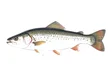
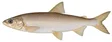
The Arctic cisco has a relatively small head with a non-prominent snout. It has a metallic silver body, a brown or dark green back, and nearly colorless fins. It has neither spots nor teeth on its jaw. It does not have a patch of teeth on its tongue. It can reach 50 cm (20 in) in length and weight up to 2 kg (4.4 lbs) but is usually less than 40 cm (16 in) in length and 1 kg (2.2 lbs) in weight.

Distribution and habitat

The Arctic cisco can be found in the Beaufort Sea, Colville River delta, and freshwater drainages east of the Sagavanirktok River. It can be found in several drainages in the Northwest Territories and Siberia, such as the Chaun River, and is not often found east of Point Barrow.

Read the full species guide.

Bering Cisco

The Bering cisco or Lauretta whitefish (Coregonus laurettae) is a freshwater whitefish found in Alaska and part of Russia. It is often considered to be the same species as the more common Arctic cisco (Coregonus autumnalis).

Description

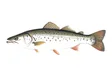
The Bering cisco has an elongate, compressed body. It is silvery-coloured, with a brownish or greenish back. Its pelvic and pectoral fins are almost clear, and its other fins are spotted white. It is distinguished from the Arctic cisco by its smaller number of gill rakers. It reaches a maximum length of 48 centimetres (19 in).

Distribution

The Bering cisco is found in Alaska from Cook Inlet on the south coast to Oliktok Point on the Arctic coast. It occurs on the Yukon River as far upstream as Dawson City, on the Porcupine River, and in the lakes of the Brooks Range. There are some reports of Bering ciscoes from the Chukchi Peninsula and the Kamchatka Peninsula, these presumably being migrants from Alaska.

Ecology

The Bering cisco is usually found in river mouths, brackish lagoons, and coastal waters, but may penetrate far upstream. Most populations are anadromous, migrating as far as 2,100 kilometres (1,300 mi) inland to spawn during the late summer. In most of its range, the Bering cisco is abundant. Its habitats are mostly remote and pristine, and it has no known threats. In rivers, it may be the most abundant migratory fish. In estuaries, the Bering cisco is an important "keystone species", serving as an important source of food for larger animals. The Bering cisco is taken commercially, and sold as "white trout". In New York, smoked Bering ciscoes are popular, and are esteemed for their creamy flesh. They are sold instead of the usual holiday food of Great Lakes whitefishes. Subsistence fishermen also take the Bering cisco in small numbers, as do commercial fishermen fishing for salmon during its migration.

The Bering cisco feeds on amphipods and other invertebrates and small fish such as sculpins. It migrates to clear and shallow streams in the late summer, not feeding during migration. Not eating during migration is typical among salmon, but rare in whitefishes. Spawning occurs in clear, cool streams with 1 to 3 inch gravel. A year after hatching, young ciscoes drift downstream to estuaries. The Bering cisco becomes sexually mature when it is four to nine years old.

Read the full species guide.

Least Cisco

Coregonus sardinella, known as the least cisco or the sardine cisco, is a fresh- and brackishwater salmonid fish that inhabits rivers, estuaries and coastal waters of the marginal seas of the Arctic Basin, as well as some large lakes of those areas.

In North America it is found from the Murchison River (Nunavut) west through the Bering Strait to the Bristol Bay (Bering Sea) in Alaska, and in the Russian Arctic from the northern part of the Bering Sea across the Siberian Arctic coast to the Kara Sea and Kara River and further to the Pechora River drainage on the European side. It has been introduced in some lakes and rivers in Uzbekistan and Kazakhstan.

Read the full species guide.

Range

Where cisco live

How many of the 9 species are recorded in each state.
0
5
How many of the 9 species are recorded in each state.

Species

All 9 cisco species