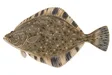
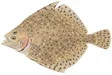
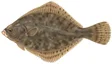
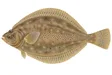
Common names

Types of flounder

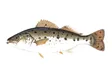
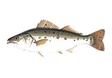
13 species carry flounder in an English common name. They sit in 4 families, so the group is a name, not a scientific rank.

About flounder

Flounders are a group of flatfish species. They are demersal fish, found at the bottom of oceans around the world; some species will also enter estuaries.

Taxonomy

The name "flounder" is used for several only distantly related species, though all are in the suborder Pleuronectoidei (families Achiropsettidae, Bothidae, Pleuronectidae, Paralichthyidae, and Samaridae). Some of the better known species that are important in fisheries are:

Eye migration

Larval flounder are born with one eye on each side of their head, but as they grow from the larval to juvenile stage through metamorphosis, one eye migrates to the other side of the body. As a result, both eyes are then on the side which faces up. The side to which the eyes migrate is dependent on the species type. As an adult, a flounder changes its habits and camouflages itself by lying on the bottom of the ocean floor as protection against predators.

Habitat

Flounders ambush their prey, feeding at soft muddy areas of the sea bottom, near bridge piles, docks, and coral reefs.

A flounder's diet consists mainly of fish spawn, crustaceans, polychaetes and small fish. Flounder typically grow to a length of 22–60 centimeters (8 + 1 ⁄ 2 – 23 + 1 ⁄ 2 in), and as large as 95 centimeters (37 in). Their width is about half their length. Male Platichthys have been found up to 130 kilometres (70 nautical miles) off the coast of northern Sardinia, sometimes with heavy encrustations of various species of barnacle.

Threats

World stocks of large predatory fish and large ground fish, including sole and flounder, were estimated in 2003 to be only about 10% of pre-industrial levels, largely due to overfishing. Most overfishing is due to the extensive activities of the fishing industry. Current estimates suggest that approximately 30 million flounder (excluding sole) are alive in the world today. In the Gulf of Mexico, along the coast of Texas, research indicates the flounder population could be as low as 15 million due to heavy overfishing and industrial pollution.
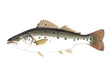
Flounder species in focus

These species profiles show how members of the group differ. Their biology describes each named species, rather than every fish in the group.

Gulf Stream Flounder

The Gulf Stream flounder (Citharichthys arctifrons) is a species of fish belonging to the family Paralichthyidae native to waters off eastern North America.

Description

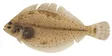
The Gulf Stream flounder is a lefteyed flatfish whose mouth that lies about adjacent to its eyes. The defining characteristic of the Gulf Stream flounder is its large scales, which number about 40 on its lateral line. The left pectoral fin is noticeably longer than the right side pectoral fin. The pelvic fins are of equal size in female members of the species, but the right fin is larger in males. The fish is brown on the visible side of its body, and white on its blind side. It is colored dark brown on the upper side of its body, and a brownish white on the lower part of its body.

Distribution and habitat

The species is found from George's Bank to southern Florida.

Read the full species guide.

Smallmouth Flounder

Etropus microstomus, the smallmouth flounder, is a species of fish belonging to the family Cyclopsettidae.

Appearance

The smallmouth flounder is a lefteyed flatfish, and is therefore very thin when lying on its side. Its mouth and eyes lie on the same side of its body, and are small compared to the rest of its head, and the lateral line has approximately 41 to 45 scales. The left pelvic fin lies below the lateral line, about one quarter down its body. The smallmouth flounder has 13 rakers on its first gill arch. It is usually colored olive brownish with a white blind side, and it can grow up to 5 inches long.

Occurrence

The species ranges from New York to Virginia, and has occasionally been seen farther south.

Read the full species guide.

Summer Flounder

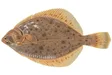
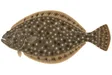
The summer flounder or fluke (Paralichthys dentatus) is a marine flatfish that is found in the Atlantic Ocean off the East Coast of the United States and Canada. It is especially abundant in waters from North Carolina to Massachusetts.

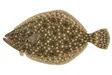
They have laterally-compressed bodies meaning that their body is flattened side-to-side. Covering the body are eye-like spots.

Habitat

The summer flounder has a range in the western Atlantic from Nova Scotia to Florida, possibly farther south where the summer flounder may mix and be confused with its close relative the southern flounder (Paralichthys lethostigma) which lacks the eye-like spots of the summer flounder. Paralichthys dentatus is most common to the coastal and shelf waters off of the northeast U.S. where they are commonly called Fluke. In the spring months fluke leave their winter stay in the deep ocean waters, where spawning occurs, to move into the inshore waters along beaches, inlets, bays, estuaries, canals, and creeks where they will stay until autumn or even early winter.

Description

They typically grow around 38.1-50.8 cm (15 to 20 inch) in length and weighs around (0.4-1.3 kg 1 to 3 lbs) though they may grow as heavy as 9 kg (26 lbs). The average summer flounder reaches sexual maturity at 2 years and lives up to 20 years. Females are often the largest and oldest specimens. The maximum observed age for females is 17 years while males have a maximum observed age of 15 years.

There are typically 5 to 14 ocellated (eye-like) spots on the body. The teeth are quite sharp and well developed on both upper and lower jaws.

Behavior

Adults are highly predatory and considered mostly piscivorous. They are often lie buried with only their head exposed to ambush prey. Prey items includes sand lance, menhaden, atlantic silverside, mummichog killifish, small bluefish, porgies, squid, shrimp, and crabs. While primarily considered a bottom fish, they are rapid swimmers over short distances and can become very aggressive, feeding actively at mid-depths, even chasing prey to the surface.

They are capable of rapidly burrowing into muddy or sandy bottoms.

Read the full species guide.

Range

Where flounder live

How many of the 13 species are recorded in each state.
0
10
How many of the 13 species are recorded in each state.

Taxonomy

Families in this group

Species

All 13 flounder species