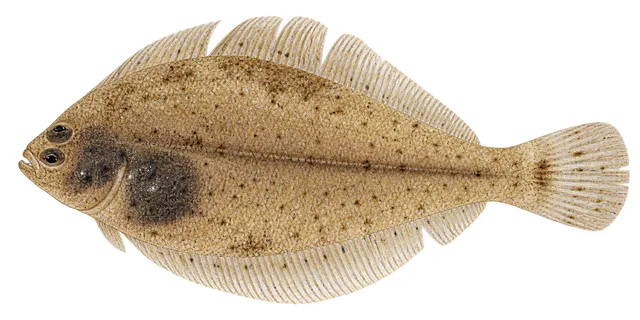
Smallmouth Flounder

Etropus microstomus

Paralichthyidae · saltwater water fish

1 minute read · Species guide

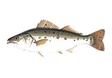
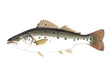
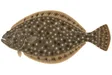
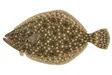
Smallmouth Flounder field guide illustration

About Smallmouth Flounder

Etropus microstomus, the smallmouth flounder, is a species of fish belonging to the family Cyclopsettidae.

Appearance

The smallmouth flounder is a lefteyed flatfish, and is therefore very thin when lying on its side. Its mouth and eyes lie on the same side of its body, and are small compared to the rest of its head, and the lateral line has approximately 41 to 45 scales. The left pelvic fin lies below the lateral line, about one quarter down its body. The smallmouth flounder has 13 rakers on its first gill arch. It is usually colored olive brownish with a white blind side, and it can grow up to 5 inches long.

Occurrence

The species ranges from New York to Virginia, and has occasionally been seen farther south.

Article text: Wikipedia contributors, Etropus microstomus (source revision). Licensed under CC BY-SA 4.0. Retrieved 2026-10-11.
Range

Where it lives

Share of 299 GBIF observation records with a state location, across 17 states.
0%
41.1%
Share of 299 GBIF observation records with a state location, across 17 states.

Habitat

Water and movement

Water
WoRMS records this species in the sea.

Classification

Taxonomy

Kingdom
Animalia
Phylum
Chordata
Superclass
Actinopterygii
Class
Teleostei
Order
Pleuronectiformes
Genus
Etropus
Species
Etropus microstomus
ITIS TSN
172730
WoRMS AphiaID
158801
GBIF key
2408956
Outside the US
ITIS also files it in Canada.

Common questions about Smallmouth Flounder

What is the scientific name of Smallmouth Flounder?
The scientific name is Etropus microstomus, in the family Paralichthyidae. Classification follows ITIS.
Does Smallmouth Flounder live in fresh water or salt water?
WoRMS records this species in the sea.
Where has Smallmouth Flounder been recorded in the United States?
GBIF has observations in 17 states, with the most records in New Jersey, New York, Virginia. The map shows observation records, which do not establish the complete natural range.

Same family

More Paralichthyidae