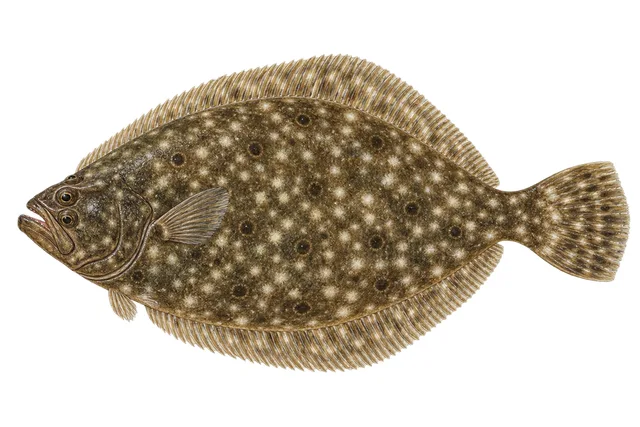
Summer Flounder

Paralichthys dentatus

Paralichthyidae · saltwater and brackish water fish

10 minute read · Species guide

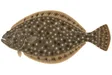
Summer Flounder field guide illustration

About Summer Flounder

The summer flounder or fluke (Paralichthys dentatus) is a marine flatfish that is found in the Atlantic Ocean off the East Coast of the United States and Canada. It is especially abundant in waters from North Carolina to Massachusetts.

They have laterally-compressed bodies meaning that their body is flattened side-to-side. Covering the body are eye-like spots.

Habitat

The summer flounder has a range in the western Atlantic from Nova Scotia to Florida, possibly farther south where the summer flounder may mix and be confused with its close relative the southern flounder (Paralichthys lethostigma) which lacks the eye-like spots of the summer flounder. Paralichthys dentatus is most common to the coastal and shelf waters off of the northeast U.S. where they are commonly called Fluke. In the spring months fluke leave their winter stay in the deep ocean waters, where spawning occurs, to move into the inshore waters along beaches, inlets, bays, estuaries, canals, and creeks where they will stay until autumn or even early winter.

Description

They typically grow around 38.1-50.8 cm (15 to 20 inch) in length and weighs around (0.4-1.3 kg 1 to 3 lbs) though they may grow as heavy as 9 kg (26 lbs). The average summer flounder reaches sexual maturity at 2 years and lives up to 20 years. Females are often the largest and oldest specimens. The maximum observed age for females is 17 years while males have a maximum observed age of 15 years.

There are typically 5 to 14 ocellated (eye-like) spots on the body. The teeth are quite sharp and well developed on both upper and lower jaws.

Behavior

Adults are highly predatory and considered mostly piscivorous. They are often lie buried with only their head exposed to ambush prey. Prey items includes sand lance, menhaden, atlantic silverside, mummichog killifish, small bluefish, porgies, squid, shrimp, and crabs. While primarily considered a bottom fish, they are rapid swimmers over short distances and can become very aggressive, feeding actively at mid-depths, even chasing prey to the surface.

They are capable of rapidly burrowing into muddy or sandy bottoms.

Like most members of the left-eye flounders, they have exceptional capacity for dynamic camouflage being able to change the color and pattern of their dark side to match the surrounding bottom. They are able to match the substrate with a high degree of precision, including the different sizes of grains and artificial checkerboards. However since their eyes face away from the bottom, it is unknown if this process is vision-mediated.

Commercial fishing, angling, and food quality

Commercial methods for summer flounder typically include trawling. Recreational fishing is typically done while drifting in a boat or casting from shore using a wide variety of methods which include live or cut baits on a bottom rig, artificial lures, or weighted jigs tipped with strip baits. It is considered an excellent food fish with firm, mild-tasting white flesh.

Management

The summer flounder is often considered to be, by far, the most important flounder along the Atlantic coast as it is important to both the commercial fishing industry and very popular for recreational fishing in the northeast United States. In addition to commercial fishing, businesses such as recreational charters, party boats, bait and tackle stores, and any number of businesses associated with boating and angling may depend on a viable summer flounder angling season. Because of this importance there has been much debate and concern over summer flounder populations and government imposed recreational size and creel regulations which currently vary from state to state. Recent debate has centered on whether summer flounder are on the decline due to overfishing, and this has made the summer flounder an important species of topic in the reauthorization of the Magnuson-Stevens Fishery Conservation and Management Act of 2006.

The Mid-Atlantic Fishery Management Council provides management of the summer flounder species. The management of summer flounder is established between the U.S.-Canadian border to North Carolina's southern border. Due to summer flounder migrating between federal and state waters, the management council works in conjunction with the Atlantic State Marine Fisheries Commission and the National Marine Fisheries Service (NMFS).

Article text: Wikipedia contributors, Summer flounder (source revision). Licensed under CC BY-SA 4.0. Retrieved 2026-10-11.
NOAA Fisheries

Life history and status

NOAA management region
New England/Mid-Atlantic, Southeast

About the species

The summer flounder fishery in the U.S. operates from Maine to the North Carolina/South Carolina border. Summer flounder is one of the most sought after commercial and recreational fish along the Atlantic coast. Summer flounder is found in inshore and offshore waters from Nova Scotia, Canada, to the east coast of Florida. Summer flounder are mainly caught in bottom otter trawls, but are also taken by pound nets and gillnets in estuarine waters. The market for summer flounder is for human consumption and is primarily sold fresh. U.S. wild-caught summer flounder is a smart seafood choice because it is sustainably managed and responsibly harvested under U.S. regulations. Implementing regulations are found at 50 CFR part 648 subpart G.

Population status

According to the 2025 stock assessment, summer flounder is not overfished and not subject to overfishing. Summary stock assessment information can be found on Stock SMART .

Scientists at NOAA’s Northeast Fisheries Science Center estimate the abundance of summer flounder using data collected during their annual bottom trawl surveys, along with data from state- and university-run surveys.

The summer flounder stock declined to record lows in the late 1980s and early 1990s. With improved reproduction and survival rates and sustainable management, spawning stock biomass (a measure of the amount of summer flounder able to reproduce) has increased substantially.

Appearance

  • Summer flounder have flat bodies.
  • They are white below and some shade of brown, gray, or drab above.
  • They’re nicknamed “chameleons of the sea” because they’re able to change their coloring to blend in with the texture and color of the bottom where they live.
  • They also have spots on their back and can be distinguished because at least five of these dark spots are arranged in an "X" pattern.
  • Summer flounder is a left-eyed flatfish (both eyes are on the left side of its body when viewed from above with the dorsal fin facing up). When larvae develop into juveniles, their right eye moves across the top of the head to the left side.

Biology

  • Summer flounder grow fast and have a relatively short life, about 12 to 14 years.
  • Males grow to more than 2 feet in length and females grow up to 3 feet.
  • They are able to reproduce when they reach age 2 or 3.
  • Summer flounder spawn in the fall and early winter when they migrate offshore.
  • They spawn several times throughout the spawning season.
  • Spawning peaks in October and November when water temperatures change and autumn plankton is most productive. The combination of these elements improves the chance of survival for larval summer flounder.
  • Depending on their size, females have between 460,000 and more than 4 million eggs. They release the eggs into the water column and the eggs hatch in waters of the continental shelf.
  • Newly hatched larvae move with the currents toward coastal areas, where they develop into juveniles.
  • Summer flounder eat a mixed diet of fish and invertebrates throughout their life.
  • Larval and post-larval flounder feed on zooplankton (tiny floating animals) and small crustaceans.
  • Juveniles eat crustaceans and fish.
  • Adults are opportunistic feeders, eating whatever food is convenient at the time, and feed mostly on fish and crustaceans.
  • Summer flounder lay on the ocean floor concealed, partly by sand and partly by their coloration, and wait for their prey to swim by. When suitable prey appears, flounder ambush them.
  • Larval and juvenile summer flounder are preyed upon until they grow large enough to fend for themselves. Predators include spiny dogfish, monkfish, cod, hakes, sea raven, longhorn sculpin, and fourspot flounder. Large sharks, rays, and monkfish prey on adult summer flounder.

Where they live

  • Larval summer flounder live in estuaries and coastal lagoons.
  • Juveniles burrow in the sediment in marsh creeks, seagrass beds, mud flats, and open bays, notably Pamlico Sound and Chesapeake Bay. Because this important life stage takes place near heavily populated urban areas, maintaining good water quality is important for successful growth and survival of young summer flounder.
  • Adults spend most of their lives on or near the seafloor burrowing in the sand. They’re also found in marsh creeks, seagrass beds, and sand flats.
  • Adult summer flounder migrate inshore and offshore seasonally with changes in water temperature. In the winter and early spring, they’re found offshore along the outer edge of the continental shelf. In late spring and early summer, they move inshore into shallow coastal waters and estuaries. Summer flounder migrate back offshore in the fall.
  • Summer flounder are found in the Atlantic Ocean from Nova Scotia to the east coast of Florida.
  • In U.S. waters, summer flounder are most common in the mid-Atlantic region from Cape Cod, Massachusetts, to Cape Fear, North Carolina.

Fishery management

NOAA Fisheries, the Mid-Atlantic Fishery Management Council , and the Atlantic States Marine Fisheries Commission cooperatively manage the summer flounder fishery because significant catch of these species comes from both state waters (0–3 nautical miles offshore) and federal waters (3-200 nautical miles offshore).

Managed under the Summer Flounder, Scup, and Black Sea Bass Fishery Management Plan : Using scientific data on the summer flounder resource and fishery, managers determine how much summer flounder can be harvested the following year. They allocate 60 percent of the annual catch limit to the commercial fishery and 40 percent to the recreational fishery. The commercial catch limit is further distributed among the states based on their share of commercial landings during the 1980s. Fish and mesh size limits protect juvenile fish and help to maintain the part of the population that is able to reproduce. A permit is required to sell and purchase summer flounder. Monitoring of sea turtle catch occurs in the southern portion of the fishery. There is a moratorium on entry into the commercial fishery. There are reporting requirements.

Fishing regulations

Possession Limits and Fish Size Requirements

In 2026, we approved conservation equivalency for the summer flounder recreational fishery. Under conservation equivalency, states or regions develop minimum sizes, possession limits, and fishing seasons that will achieve the necessary level of conservation. Please contact your state for information on summer flounder regulations that apply to you.

Commercial gear

Otter trawlers – Vessels fishing under a summer flounder moratorium permit must have a minimum mesh size of 5.5-in diamond mesh or 6-in square mesh applied throughout the net body, extension(s), and codend.

Vessels with a summer flounder moratorium permit not fishing under the above mesh requirements may retain no more than 100 lb from May 1 through October 31, and no more than 200 lb from November 1 through April 30.

Some vessels may be exempt from certain gear restrictions under certain conditions when fishing in the Summer Flounder Small-Mesh Exemption Area . Contact our Permit Office for more information on this exemption area and associated Letter of Authorization .

Turtle Excluder Device (TED) – Summer flounder trawlers fishing within the Summer Flounder Fishery Sea Turtle Protection Area are required to use a TED as detailed at 50 CFR part 223. Vessels fishing north of Oregon Inlet, NC, are exempted from this requirement from January 15 through March 15.

Management

The summer flounder fishery is managed in state and federal waters by the Mid-Atlantic Fishery Management Council, in conjunction with the Atlantic States Marine Fisheries Commission. NOAA Fisheries serves as the implementing body for rules and regulations within the fishery.

The commercial fishery is managed using commercial quotas allocated to the states, size limits, and gear requirements. The recreational fishery also uses size limits, along with seasons and bag limits to manage summer flounder.

The fishing year runs from January 1 through December 31, with NOAA Fisheries Greater Atlantic Region jurisdiction covering from Maine to the latitude of the North Carolina/South Carolina border.

Control Dates for the Summer Flounder Fishery: Commercial - Vessels with qualified landings between January 26, 1985 , and January 26, 1990 ; Recreational Charter/Party - February 11, 2025.

Science

NOAA Fisheries conducts various research activities on the biology, behavior, and population health of summer flounder. The results of this research are used to inform management decisions for this species.

For detailed information about stock status, management, assessments, and resource trends, you can search for summer flounder, and any other species of interest, using NOAA’s StockSMART web tool .

Summer Flounder Research in the Northeast

Scientists from NOAA’s Northeast Fisheries Science Center conduct annual spring and fall bottom trawl surveys in areas from just south of Cape Hatteras to Canadian waters. These survey results—along with data from surveys run by states and universities and catch data from commercial fisheries—help scientists estimate the abundance of summer flounder and other species in the Mid-Atlantic and New England.

Fishery Observer Program

The Northeast Fisheries Science Center’s Fishery Observer Program plays a vital role in the conservation and management of the fisheries from Maine to North Carolina. The program has collected information on landings and discards in the commercial summer flounder fisheries for more than 20 years.

Range

Where it lives

Share of 1,829 GBIF observation records with a state location, across 17 states.
0%
23.5%
Share of 1,829 GBIF observation records with a state location, across 17 states.

Habitat

Water and movement

Water
WoRMS records this species in brackish water and the sea.

Classification

Taxonomy

Kingdom
Animalia
Phylum
Chordata
Superclass
Actinopterygii
Class
Teleostei
Order
Pleuronectiformes
Genus
Paralichthys
Species
Paralichthys dentatus
ITIS TSN
172735
WoRMS AphiaID
158826
GBIF key
2408866
Outside the US
ITIS also files it in Canada.

Common questions about Summer Flounder

What is the scientific name of Summer Flounder?
The scientific name is Paralichthys dentatus, in the family Paralichthyidae. Classification follows ITIS.
Does Summer Flounder live in fresh water or salt water?
WoRMS records this species in brackish water and the sea.
Where has Summer Flounder been recorded in the United States?
GBIF has observations in 17 states, with the most records in New Jersey, North Carolina, New York. The map shows observation records, which do not establish the complete natural range.

Closest relatives

Other Paralichthys species

Same family

More Paralichthyidae