Appearance and identification
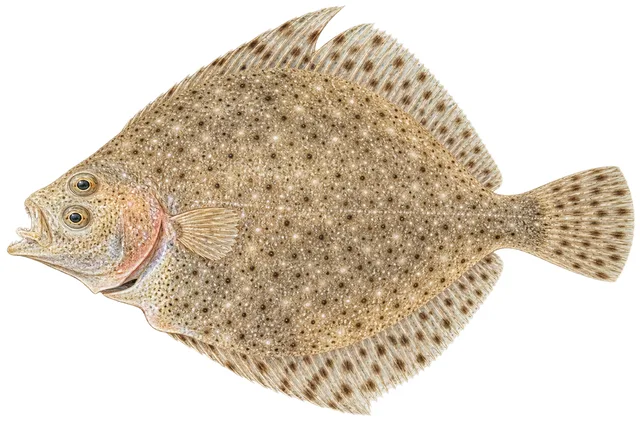
A windowpane's rounded body is almost as wide as it is long and is notably thin. On the upper, eyed side, light greenish-brown skin carries dark brown and white spots. The lower surface is white.
The front of the dorsal fin has a distinctive fringe. The tips of its first 10 to 12 rays are free rather than connected by fin membrane. Together with the left-side eye position and translucent body, this is a useful identification feature.
Sources: Windowpane Flounder species profile
Adult size
NOAA gives a typical adult length of 10 to 12 inches. This is an adult size description, not an age measurement or a promise that every individual reaches exactly the same length. The young stages have a different body form before settling as flatfish.
Sources: Windowpane Flounder species profile
Range and habitat
The northwestern Atlantic range extends from the Gulf of St. Lawrence to Florida. Windowpane occupy relatively shallow water, with juveniles settling in inshore areas after metamorphosis.
As they age, young fish move into deeper offshore habitat. This age-related movement helps explain why an inshore observation and an offshore adult catch can both describe the same species without indicating identical habitat use at every life stage.
Sources: Windowpane Flounder species profile
Diet and feeding
Young windowpane commonly eat copepods suspended in the water column. Adults take bottom-associated prey, including shrimp, small fishes, lobsters, and crabs. The change in diet accompanies the move from early life in the water column to a flattened body near the seabed.
Sources: Windowpane Flounder species profile
Spawning and development
Spawning dates differ by region. NOAA describes an autumn peak on Georges Bank, spring and autumn spawning in southern New England, and spring activity with a strong autumn peak in the Mid-Atlantic. A single spawning month would conceal those geographic differences.
Larvae hatch with one eye on each side of the head. As the body flattens, the right eye moves onto the left side. Once this metamorphosis is complete, the young fish settles to the bottom. The direction of eye movement is opposite to that of a right-eyed flounder such as American plaice.
Sources: Windowpane Flounder species profile
Population and management context
NOAA assesses the Gulf of Maine–Georges Bank and southern New England–Mid-Atlantic stocks separately. Its profile cites 2017 assessments with different overfished classifications for those two stocks. Those are dated, regional assessments, not a single species-wide label.
The fish belongs to the Northeast groundfish management system. The official profile and its linked stock assessments provide the management context behind the regional distinctions.
Sources: Windowpane Flounder species profile