Shovelnose Sturgeon

Scaphirhynchus platorynchus

Acipenseridae · freshwater water fish

5 minute read · Species guide

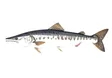
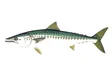
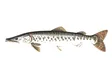
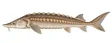
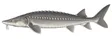
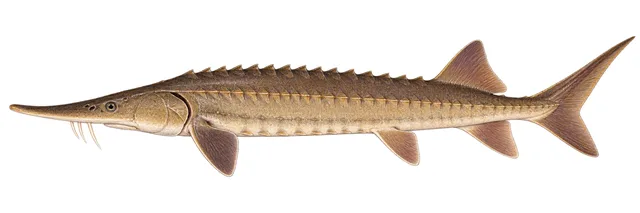
Shovelnose Sturgeon field guide illustration

About Shovelnose Sturgeon

The shovelnose sturgeon (Scaphirhynchus platorynchus) is the smallest species of freshwater sturgeon native to North America. It is often called hackleback, sand sturgeon, or switchtail. Switchtail refers to the long filament found on the upper lobe of the caudal fin (often broken off as adults). Shovelnose sturgeon are the most abundant sturgeon found in the Missouri River and Mississippi River systems, and were formerly a commercially fished sturgeon in the United States of America (Pflieger 1997). In 2010, they were listed as threatened under the U.S. Endangered Species Act due to their resemblance to the endangered pallid sturgeon (S. albus), with which shovelnose sturgeon are sympatric.

Description

The sturgeons of the family Acipenseridae have bony scutes along the sides and back and four barbels on the underside of the rostrum. A total of 25 extant species of sturgeon are recognized, including 17 within the genus Acipenser. Sturgeon are distributed around the northern part of the Northern Hemisphere (holarctic distribution) and have marine, freshwater, and anadromous members. Sturgeons, including the shovelnose, are highly regarded for their flesh and their roe, from which premium grades of caviar are made (Barton 2007).

They can reach 1 metre (39 in) in length and up to 4.8 kilograms (11 lb) in weight but 50–85 centimetres (20–33 in) and 2.5 kilograms (5.5 lb) is more common.

The scientific name Scaphirhynchus, Greek, means "spade snout", and platorynchus, Greek, means "broad snout". It has a bill-like snout. The shovelnose sturgeon is characterized by a long slender filament on the upper lobe of the caudal fin. They have a flattened rostrum (modified snout) that is also shovel-shaped. There are four fringed barbels on the ventral side of the rostrum that can be found in a straight line, which is equidistant from the mouth opening to the tip of the snout, unlike pallid sturgeon. The belly of the shovelnose sturgeon is covered with scale-like plates, which is another distinguishing factor from pallid sturgeon who have primarily scaleless bellies. Coloration of the shovelnose sturgeon ranges from a light-brown to buff with a white belly (Pflieger 1997).

Distribution, habitat, and reproduction

The shovelnose sturgeon, as its distribution represents, is impacted very little by turbidity. The Missouri River and the Mississippi River systems tend to carry high sediment loads. Here the sturgeon inhabits the open channel or main channel areas of the large rivers. It lives on the bottom, often in areas with swift current and sand or gravel bottom. As with many riverine fish species, the shovelnose sturgeon does not have a restricted home range and may travel long distances (Pflieger 1997).

The shovelnose sturgeon feeds on the bottom, using its highly protrusible mouth to suck up its food. The diet is mainly aquatic insect larvae, consisting principally of mayflies, true flies (Diptera), and caddisflies. The sturgeon also feed on crustaceans, worms, and small fish (Carlson et al. 1985;Held 1969). As a result of bottom feeding, it is a host to the glochidia (larvae) of several species of freshwater mollusc, including Quadrula pustulosa (pimpleback), Obovaria olivaria (hickorynut) and Lampsilis teres (yellow sandshell). It is the only known host of the hickorynut mussel.

A typical sturgeon's life history includes a migration from feeding grounds to breeding grounds in large rivers. During spawning, behavior changes and swimming near the surface occurs. Females do not spawn every year and spawning chronology is not readily evident. Spawning takes place over gravel in fairly swift water. Eggs hatch after 3 to 5 days, and the larvae—about 1 cm long—drift downstream to suitable rearing areas in the river (Barton 2007). Carlson et al. (1985) found that the growth of the shovelnose sturgeon is relatively slow, reaching 21.3 inches (54 cm) in five years.

Conservation

In 1997, it was estimated that roughly 25 tons of Shovelnose sturgeon were harvested each year for their roe and for eating. The roe of the shovelnose sturgeon was marketed as "hackleback" caviar. As old-world sources of Caspian and Black Sea sturgeon caviar became overfished, especially in the wake of the collapse of the Soviet Union, roe from shovelnose sturgeon became commercially important. The flesh of the sturgeon is widely considered a delicacy, especially smoked sturgeon. Poaching of the shovelnose sturgeon is becoming a problem, as they must be 8–10 years old before spawning can occur, and females do not become gravid every year. There has some interest in marketing the shovelnose sturgeon as an aquarium species. In 2010, the shovelnose sturgeon was listed as threatened under the U.S. Endangered Species Act due to its resemblance to the endangered pallid sturgeon (Scaphirhynchus albus), with which shovelnose sturgeon are sympatric.

Article text: Wikipedia contributors, Shovelnose sturgeon (source revision). Licensed under CC BY-SA 4.0. Retrieved 2026-10-11.
Diet and feeding

The FishTraits compilation records these diet categories for this species: invertebrates or larval fish; larger animal prey (a source category covering fish, crayfish, crabs, or frogs). These are broad categories, not a claim that every individual consumes every example in a category.

Reported feeding positions include bottom feeding. The compilation combines published observations; diets can vary with age, locality, and available food.

Habitat preferences

Reported habitat associations include medium to large rivers, streams and small rivers.

The source records associations with sand, gravel. An association indicates reported use, rather than an exclusive requirement.

Reproduction and parental care

The compilation reports a representative maturity age of 6 years. Its maturity field summarizes mean, median, or modal estimates, usually for females; male estimates can be used when female data are unavailable. It is not a fixed age at which every fish first breeds.

Recorded spawning months are May, Jun for the source’s reporting region (WI). This is a regional calendar, not a range-wide schedule.

The reproductive-guild classification includes spawning on open substrates without guarding the brood.

Size and recorded longevity

FishTraits reports a maximum total length of 100 centimetres. Some entries use an estimated asymptotic length; this value should not be treated as a certified record catch.

Recorded longevity in the compilation is 45 years. Wild observations were preferred, but captive records were accepted where wild records were unavailable, and unspecified records were assumed wild. The value is not a guaranteed wild lifespan or an aquarium life expectancy.

Record fish

State records in 5 states

  • Montana14.125 lbs.

    Missouri River · 5/21/10 · Chad Buck

  • Wisconsin7 lbs. 13.1 oz.

    Mississippi River · Vernon · 05/28/2017

  • Minnesota6 lb 7 oz

    Mississippi River near Red Wing · Goodhue · 2/19/2012

  • Arkansas5 lbs., 0 oz.

    Spring River · 10/10/2008 · D. Victor Waits, Holts Summit, MO · rod and reel

  • Oklahoma1 lbs 10.00 ozs

    Arkansas River · 05/07/1996 · Tommy Jenkins · rod and line

Each figure is the state agency’s own certified record. The site holds record tables for 11 states so far, so a state missing here has not been read yet. It is not a state where this fish holds no record.

Range

Where it lives

Share of 607 GBIF observation records with a state location, across 23 states. The orange dots are USGS stream-survey sites where this species was caught.
0%
25.4%
Share of 607 GBIF observation records with a state location, across 23 states. The orange dots are USGS stream-survey sites where this species was caught.

A blank area on the dot layer usually means nobody sampled there, not that the fish is absent. Turn on “every survey site” to see where the survey looked.

The USGS stream survey caught it at 61 of its sites, in 12 states. That survey and the GBIF records are two different counts of two different things, so the site keeps them apart.

Habitat

Water and movement

Water
WoRMS records this species in fresh water.
Migration
Migratory
Pattern

Classification

Taxonomy

Kingdom
Animalia
Phylum
Chordata
Superclass
Actinopterygii
Class
Chondrostei
Order
Acipenseriformes
Genus
Scaphirhynchus
Species
Scaphirhynchus platorynchus
ITIS TSN
161082
WoRMS AphiaID
1022840
GBIF key
2402084

Common questions about Shovelnose Sturgeon

What is the scientific name of Shovelnose Sturgeon?
The scientific name is Scaphirhynchus platorynchus, in the family Acipenseridae. Classification follows ITIS.
Does Shovelnose Sturgeon live in fresh water or salt water?
WoRMS records this species in fresh water.
Where has Shovelnose Sturgeon been recorded in the United States?
GBIF has observations in 23 states, with the most records in Kansas, Minnesota, Illinois. The map shows observation records, which do not establish the complete natural range.

Closest relatives

Other Scaphirhynchus species

Same family

More Acipenseridae