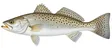
Freshwater Drum

Aplodinotus grunniens

Sciaenidae · freshwater water fish

9 minute read · Species guide

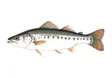
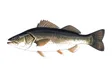
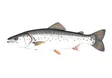
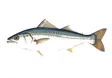
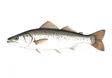
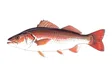
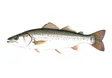
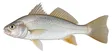
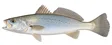
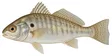
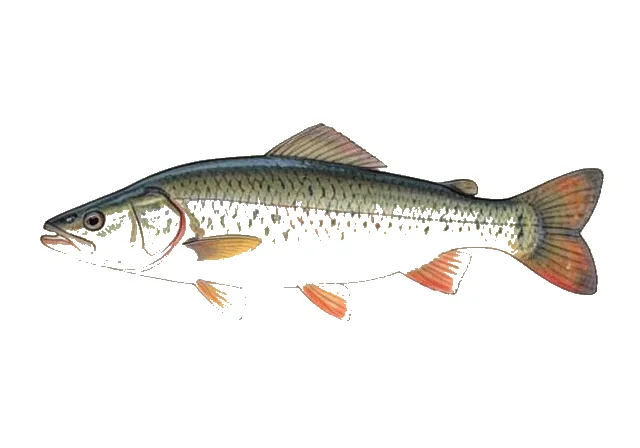
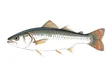
Freshwater Drum field guide illustration

About Freshwater Drum

The freshwater drum, Aplodinotus grunniens, is a fish endemic to North and Central America. It is the only species in the genus Aplodinotus, and is a member of the family Sciaenidae. It is the only North American member of the group that inhabits freshwater for its entire life. Its generic name, Aplodinotus, comes from Greek meaning "single back", and the specific epithet, grunniens, comes from a Latin word meaning "grunting". It is given to it because of the grunting noise that mature males make. This noise comes from a special set of muscles within the body cavity that vibrate against the swim bladder. The purpose of the grunting is unknown, but due to it being present in only mature males and during the spawning season, it is assumed to be linked to spawning.

The freshwater drum is also called Russell fish, shepherd's pie, gray bass, Gasper goo, Gaspergou, gou, grunt, grunter, grinder, gooble gobble, and croaker. It is commonly known as sheephead and sunfish in parts of Canada, and the United States.

Distribution

Freshwater drum are the only North American member of their family to exclusively inhabit freshwater (freshwater family members in genera Pachypops, Pachyurus, Petilipinnis and Plagioscion are from South America, while Boesemania is Asian). Their great distribution range goes as far north as the Hudson Bay, and reaches as far south as Guatemala. Their longitudinal distribution goes as far east as the eastern Appalachians and stretches as far west into Texas, Kansas, and Oklahoma. Freshwater drum are considered to be one of the most wide-ranging species in North America.

Description

The drum typically weighs 5–15 lb (2.3–6.8 kg). The world record was caught on Nickajack Lake in Tennessee, and weighed in at 54 lb 8 oz (24.7 kg). The freshwater drum is frequently gray or silvery but may be more bronze or brown colored, common in the Lake Erie population. It is a deep-bodied fish with a divided dorsal fin consisting of 10 spines and approximately 30 rays. The pectoral fins are elongated and pointed, and the lateral line extends into the caudal fin, which has a rounded or pointed margin.

The eye of the freshwater drum contains a tapetum lucidum within the retinal pigmented epithelium, as in other sciaenids. In other sciaenids this structure has been found to contain packed lipid spherules which contribute to its reflective properties.

Extensive pharyngeal tooth pads are present in upper and lower sets, with cardiform and villiform teeth gradually being replaced by molariform teeth as the fish grows larger.

Ecology

The freshwater drum prefers clear water, but it is tolerant of turbid and murky water. They prefer the bottom to be clean sand and gravel substrates.

The diet of the freshwater drum is generally benthic and composed of macroinvertebrates (mainly aquatic insect larvae and bivalve mussels), as well as small fish in certain ecosystems. Freshwater drum show distinct seasonal differences in their diet. In April and May, the drum feeds on dipterans. During these months, dipterans make up about 50 percent of the freshwater drum's diet. In August through November, they tend to eat fish (which are primarily young-of-the-year Gizzard shad). The percentage of fish in their diet at this time ranges from 52 to 94 percent. Other items in the drum's diet are mollusks and crayfish.

The freshwater drum competes with several organisms. During its early stages in Lake Erie, it has been shown to compete with yellow perch, the trout-perch, and the emerald shiner. During its adult lifetime, it competes with yellow perch and silver chub in deep water, and competes with black bass in the shoal areas.

Predators on drum include humans and other fish. During its first year, the freshwater drum serves as a forage fish for many species of predatory fish. These include smallmouth bass, walleye, and many other piscivores. After its first year, the primary predators on freshwater drum are humans. The drum is an important commercial crop on the Mississippi River, but in other areas it constitutes only a small portion of the commercial catch. Consistent with other sciaenids, freshwater drum are strongly nocturnal with the bulk of most catches being derived from night angling/sampling. Commercial fisheries are present for this species, although market price tends to be quite low. Thus, many freshwater drum are harvested as bycatch from targeted higher-value species.

There has been some research on the freshwater drum's impact on the invasive zebra mussel in northern lakes and rivers. Zebra mussels are consumed by freshwater drum once they reach a length of 25 cm (9.8 in), but drum under 35 cm (14 in) in length only eat small mussels and reject the larger ones. The fish larger than 35 cm (14 in) exhibit less selectivity and consume mussels relative to their availability in lakes. These larger fish are not restricted by their ability to crush zebra mussels, but they are restricted by the size of the clumps that they can remove. The drums' eating of zebra mussels contributes to a high mussel mortality, but not enough to have an impact on their spread, or control the population.

Life history

During the summer, freshwater drums move into warm, shallow water that is less than 33 ft (10 m) deep. The freshwater drum then spawn during a six to seven-week period from June through July when the water reaches a temperature of about 65 °F (18 °C). During the spawn, females release their eggs into the water column and males release their sperm. Fertilization is random. Males generally reach sexual maturity at four years, whereas females reach maturity at five or six years. Females from six to nine years old have a clutch size of 34,000 to 66,500 eggs and they spawn in open water giving no parental care to their larvae. The eggs then float to the top of the water column and hatch between two and four days. Due to the broadcasting of eggs in open water and lack of parental care, many eggs and larvae fall victim to predation upon hatching, the pro- larvae average 3.2 mm (1 ⁄ 8 in) long. The post-larval stage begins about 45 hours after hatching and a length of 4.4 mm (3 ⁄ 16 in) is attained.

Females grow at a faster rate than the males and adult characteristics start to form at a length of 15 mm (1 in). Females continue to outgrow the male throughout their lives reaching a length of 12 to 30 in (30 to 76 cm). Usually the freshwater drum weighs 2–10 lb (0.91–4.54 kg), but they can reach well over 36 lb (16 kg). Freshwater drums are long-lived and have attained maximum ages of 72 years old in Red Lakes, Minnesota and 32 years old in the Cahaba River, Alabama. Though they can reach very old age, the average age of a freshwater drum is between 6 and 13 years. In some cases, otoliths provide such a long record of growth that they can be studied using the same techniques as those used by dendrochronologists.

Current management

There are few management practices for the species, and in many regions daily bag limits are unlimited. The freshwater drum is not federally or state listed by any states. Although the commercial harvest is up to 1 million pounds per year, they are in no danger of overharvest. In the Mississippi River alone, the commercial catch has reached about 300,000 lb (136,078 kg) in recent years. Due to its abundance, many states allow bowfishing and other non-conventional means to harvest the fish.

Article text: Wikipedia contributors, Freshwater drum (source revision). Licensed under CC BY-SA 4.0. Retrieved 2026-10-11.
Diet and feeding

The FishTraits compilation records these diet categories for this species: invertebrates or larval fish; larger animal prey (a source category covering fish, crayfish, crabs, or frogs). These are broad categories, not a claim that every individual consumes every example in a category.

Reported feeding positions include bottom feeding and surface or water-column feeding. The compilation combines published observations; diets can vary with age, locality, and available food.

Habitat preferences

Reported habitat associations include medium to large rivers, streams and small rivers, still-water habitats.

The source records associations with muck, clay or silt. An association indicates reported use, rather than an exclusive requirement.

The species is classified as tolerant of a broad range of salinities. This flag does not specify a salinity range for aquarium care.

Reproduction and parental care

The compilation reports a representative maturity age of 4.5 years. Its maturity field summarizes mean, median, or modal estimates, usually for females; male estimates can be used when female data are unavailable. It is not a fixed age at which every fish first breeds.

Recorded spawning months are Apr, May for the source’s reporting region (NC). This is a regional calendar, not a range-wide schedule.

The reproductive-guild classification includes spawning on open substrates without guarding the brood.

Size and recorded longevity

FishTraits reports a maximum total length of 95 centimetres. Some entries use an estimated asymptotic length; this value should not be treated as a certified record catch.

Recorded longevity in the compilation is 11 years. Wild observations were preferred, but captive records were accepted where wild records were unavailable, and unspecified records were assumed wild. The value is not a guaranteed wild lifespan or an aquarium life expectancy.

Identification and appearance

Laterally compressed, silver, deep bodied fish. Has a long dorsal fin relative to its total length containing a deep notch. Mouth is sub-terminal with a blunt rounded snout (Goldstein and Simon 1999). Anal fin has seven soft rays and two spines, with the first being much shorter than the second. Dorsal fin usually has 10 spines and 29 to 32 rays. Possesses 20 to 24 gill rakers (Knapp 1953). A unique feature of these fish is that the lateral line extends into their rounded caudal fin. Scales are ctenoid and the number of scales on the lateral line ranges from 49 to 53 (Hubbs et al. 1991). Except for general coloration and the absence of a dark spot on the caudal fin, this species closely resembles its saltwater relative, the Red Drum (Trautman 1981; Robison and Buchanan 1988; Etnier and Starnes 1993; Ross and Brenneman 2001; MN DNR 2005; TPWD 2009).

Native range

East of the Rocky Mountains in the St. Lawrence-Great Lakes, Hudson Bay, and Mississippi River basins from Quebec to northern Manitoba and southern Saskatchewan in Canada and south to the Gulf of America. Present in the Rio Grande and other Texas rivers, and Gulf Coast drainages from Mobile Bay, Georgia and Alabama, through eastern Mexico to the Rio Usumacinta system in Guatemala (Barney 1926; Page and Burr 1991). This species is native and abundant in Lakes Michigan, Huron, Erie, and Ontario (Richardson 1831; Dekay 1855; Bean 1903; Forbes and Richardson 1908; Halkett 1913; Cudmore-Vokey and Crossman 2000; Roth et al. 2013).

Habitat and ecology

Spawning occurs in open water during May and June when water temperatures reach 18 to 26°C (Wrenn 1969; Swedberg and Walburg 1970; Fremling 1980). Large females are capable of laying up to 600,000 positively buoyant eggs (Wrenn 1969; Fremling 1980), which float at the surface until they hatch roughly 24 hours later in warmer waters (Swedberg and Walburg 1970). Sexual maturity is reached after 4 to 6 years, with individuals measuring at least about 20 cmin length (Diaber 1953; Priegel 1969; Wrenn 1969). The maximum reported age of this species is 13 years (Altman and Dittmer 1962), but on average, it lives for 6–8 years (Etnier and Starnes 1993; Ross and Brenneman 2001).

Record fish

State records in 6 states

  • Arkansas45 lbs., 7 oz.

    Lake Wilson · 07/11/2004 · Chuck Piker, Hamburg, AR · rod and reel

  • Alabama41 lbs 8 oz

    Wilson Reservoir · 7/24/1949 · Wilson Brock, Birmingham

  • Oklahoma38 lbs

    Tenkiller · 05/23/1976 · Harold Phillips · rod and line

  • Minnesota35 lb 3 oz

    Mississippi River near Winona · Winona · 10/5/1999

  • Montana21.59 lbs.

    Fort Peck- Ghost Coulee · 5/3/03 · Matt Washut

  • Texas14.95 lb

    Brazos Lake · Apr 22, 2022 · Michael A. Fulton · Bluegill

Each figure is the state agency’s own certified record. The site holds record tables for 11 states so far, so a state missing here has not been read yet. It is not a state where this fish holds no record.

Range

Where it lives

Share of 11,224 GBIF observation records with a state location, across 32 states. The orange dots are USGS stream-survey sites where this species was caught.
0%
23.6%
Share of 11,224 GBIF observation records with a state location, across 32 states. The orange dots are USGS stream-survey sites where this species was caught.

A blank area on the dot layer usually means nobody sampled there, not that the fish is absent. Turn on “every survey site” to see where the survey looked.

The USGS stream survey caught it at 1,802 of its sites, in 25 states. That survey and the GBIF records are two different counts of two different things, so the site keeps them apart.

Habitat

Water and movement

Water
WoRMS records this species in fresh water.
USGS NAS habitat
Freshwater
US status
Native transplant — native to part of the United States, moved to other waters inside it.
Migration
Undetermined
Pattern
Disagreement
4 published references do not agree on the pattern: Non-migratory, Potamodromous. The site shows every assignment rather than picking one.

Classification

Taxonomy

Kingdom
Animalia
Phylum
Chordata
Superclass
Actinopterygii
Class
Teleostei
Order
Perciformes
Genus
Aplodinotus
Species
Aplodinotus grunniens
ITIS TSN
169364
WoRMS AphiaID
590490
GBIF key
2400265
Outside the US
ITIS also files it in Canada.

Common questions about Freshwater Drum

What is the scientific name of Freshwater Drum?
The scientific name is Aplodinotus grunniens, in the family Sciaenidae. Classification follows ITIS.
Does Freshwater Drum live in fresh water or salt water?
WoRMS records this species in fresh water.
Where has Freshwater Drum been recorded in the United States?
GBIF has observations in 32 states, with the most records in Texas, Minnesota, Oklahoma. The map shows observation records, which do not establish the complete natural range.

Same family

More Sciaenidae