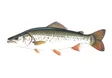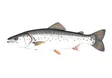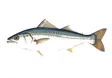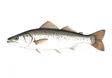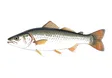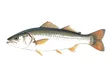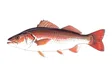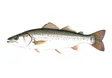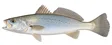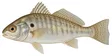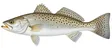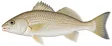
Description
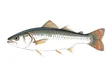
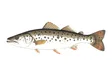
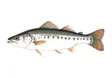
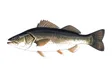
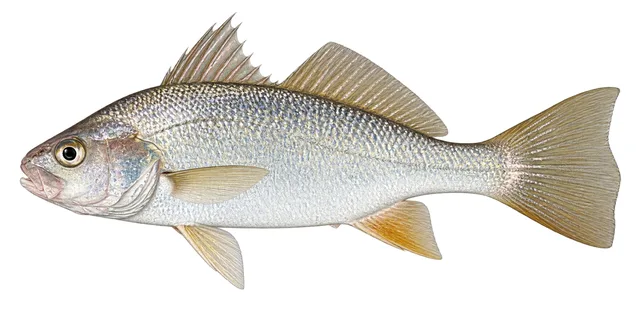
Bairdiella chrysoura has a moderately large, obliquely rising terminal mouth. The lower jaw projects further than the upper jaw. The chin does not bear a barbel but has three pairs of mental pores (the arrangement of the barbels and under-chin pores provides a means to distinguish between different members of the family Sciaenidae). The preopercle, the bony plate just in front of the operculum, bears a few spines set at an angle. The dorsal fin has ten to eleven spines and nineteen to twenty-three soft rays. The anal fin has two spines, the second of which is sharp and more than two thirds the length of the first soft ray, and eight to ten soft rays. This fish has a two-chambered swim bladder which is connected to the inner ear. It has good hearing, on a par with the goldfish which is renowned for its auditory ability. Its general color is silvery, greenish, or bluish on the dorsal surface and silvery or yellowish on the underside. The fins are yellowish or greyish.
Silver perch are similar in appearance to the sand seatrout or silver seatrout, two closely related species of weakfish. Seatrout usually have 1 or 2 prominent canine teeth at the tip of upper jaw and do not have chin pores.
Distribution and habitat
Bairdiella chrysoura are native to the east coast of the North America. Its range extends from New York to Mexico. They are found inshore in seagrass beds, tidal creeks and rivers, and marshes.
Behavior
Bairdiella chrysoura spawns in shallow, saline portions of bays and other inshore areas, peaking between May and September. Silver perch mature by second or third year (by 6 inches). Adults eat crustaceans and small fishes. They may live to 6 years.
Additional field notes
Silver perch is a small coastal drum, rather than a freshwater perch. Its plain silvery sides and yellowish lower fins make it easy to overlook among the fishes of an estuary.
Sources: Bairdiella chrysoura species account
Field identification notes
Look for a moderately long, compressed body with a large eye and a mouth opening at the front of the head. There is no chin barbel and no stripe along the side. Small spines at the corner of the gill-cover margin are another identification clue. The Smithsonian account gives a maximum length of 25 cm.
Sources: Bairdiella chrysoura species account
Habitat and range notes
This fish uses inshore sand and mud bottoms and enters estuaries, sometimes reaching fresh water. The Smithsonian regional account extends from Cape Cod to the western Gulf of Mexico. Its occurrence in an estuary should therefore be considered alongside salinity and bottom habitat, rather than the name “perch.”
Sources: Bairdiella chrysoura species account
Feeding and life-history notes
The diet recorded in the account includes small crustaceans, worms, fishes, and zooplankton. Both eggs and larvae are recorded as pelagic, occupying the water column rather than remaining attached to the bottom.
Sources: Bairdiella chrysoura species account
Guide sources
Research reviewed 2026-10-17.
- Bairdiella chrysoura species account — Smithsonian Tropical Research Institute
Article text: Wikipedia contributors, Bairdiella chrysoura (source revision). Licensed under CC BY-SA 4.0. Retrieved 2026-10-11.