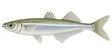
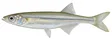
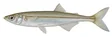
Common names

Types of silverside

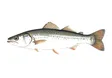
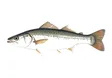
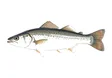
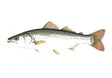
8 species carry silverside in an English common name. They sit in 1 family, so the group is a name, not a scientific rank.

About silverside

The Atheriniformes, also known as the silversides, are an order of ray-finned fishes that includes the Old and New World silversides, the rainbowfishes, and several less-familiar families, including the unusual Phallostethidae. The order includes at least 354 species. They are found worldwide in tropical and temperate marine and freshwater environments.

Description

Atheriniformes are generally elongated and silvery in colour, although exceptions do exist. They are typically small fish, with the largest being the Argentinian silverside, with a head-body length of 50 cm (20 in), but possibly up to 82 cm (32 in). The smallest species, such as the Bangkok minnow, reach only 2 cm (0.79 in) in adult length.

Members of the order usually have two dorsal fins, the first with flexible spines, and an anal fin with one spine at the front. The lateral line is typically weak or absent. Atheriniform larvae share several characteristics; the gut is unusually short, a single row of melanophores occurs along the back, and the fin rays do not become evident until some time after hatching. They scatter their eggs widely, with most species attaching them to aquatic plants.

Taxonomy

Classification of the Atheriniformes is uncertain, with the best evidence for monophyly in the larval characteristics mentioned below. Their closest relatives are thought to be the Cyprinodontiformes.

Nelson 2016 recognizes the infraseries Atherinomorpha, part of the sub series Ovalentaria which includes the orders Atheriniformes, Beloniformes, and Cyprinodontiformes, citing the larval characteristics and supporting molecular studies of these taxa as support for monophyly of this grouping. The sister taxon to the Atherinomorpha appears to be the Mugiliformes.

Following Nelson (2006), the family Melanotaeniidae includes the subfamilies Bedotiinae, Melanotaeniinae, Pseudomugilinae, and Telmatherininae, to demonstrate their monophyly. However, in a 2004 study, a different classification scheme classifies the families Bedotiidae, Melanotaeniidae, and Pseudomugilidae (also include Telmatherinine genera) in a suborder Melanotaenioidei. Thus, the number of families in Atheriniformes varies from author to author.

In addition, two extinct families (Mesogasteridae, containing Latellagnathus and Mesogaster, and Rhamphognathidae, containing only Rhamphognathus) are known from the Early Eocene of Monte Bolca, Italy. Uniquely, these large-sized atheriniforms appear to have adapted for a macropredatory lifestyle, potentially due to open ecological niches at the time.
Silverside species in focus

These species profiles show how members of the group differ. Their biology describes each named species, rather than every fish in the group.

Rough Silverside

Membras martinica, the rough silverside, is a species of Neotropical silverside from the family Atherinopsidae, it is the type species of the genus Membras.

Description

Membras martinica has an elongated body with a rather pointed snout and oblique mouth. The color is pale yellow to off-white with silvery stripe along the flanks and a white swimbladder which can be seen through its flesh. There are two dorsal fins, there are only spines in the first dorsal fin. The pectoral fins are situated high on its flanks. The back has parallel colored rows. This species has scales which are rough to the touch. The caudal fin has a dusky margin. The maximum recorded total length of 12.5 centimetres (4.9 in).

Distribution

Membras martinica occurs in the western central Atlantic as far north as New York south to Veracruz in Mexico. It has also been recorded in rivers, for example in the Hudson River as far upstream as Peekskill, New York and far upstream in the St. John's River, Florida as well as from a number of Mexican river systems.

Habitat and biology

Membras martinica is a pelagic species which occurs in a variety of different habitat types. The normal habitat is exposed shoreline and beaches where there is a firm substrate is also occurs on coastal rivers. On the coastlines around the Gulf of Mexico the females are ripe in the warmer months from early Spring in to the early fall with a hiatus reported between May and July. This results in two size classes of juveniles each year. Spawning occurs just beyond the surf zone and the eggs are demersal and stick to each other, forming large clusters which are transported into the intertidal zone by the waves.

Read the full species guide.

Inland Silverside

The inland silverside (Menidia beryllina) is a neotropical silverside native to eastern North America, and introduced into California. It is a fish of estuaries and freshwater environments.

Inland silversides are quite elongate even for silverside, with lengths six to seven times depth. They have large eyes, a considerably upturned mouth, and a head noticeably flattened on top. Of the two widely separated dorsal fins, the anterior fin is small and has four to five weak spines, while the posterior fin is larger, with one spine and eight or nine rays. The lengthy anal fin is somewhat sickle-shaped, has one spine and 16 to 18 rays. As befits the name, they are silvery on the sides; the back is somewhat yellow, and the underside is a translucent green. These are small fish, with 15 cm recorded, but most adults 10 cm or less.

Read the full species guide.

Atlantic Silverside

The Atlantic silverside (Menidia menidia), also known as spearing in the northeastern United States, is a small species of fish that is one of the most abundant fish species present in estuarine habitats along the Atlantic coast of North America. It is a common subject of scientific research because of its sensitivity to environmental changes. According to the IUCN Red List, this species is stable and has no major threats to its populations, so it is marked Least Concern. Despite being an extremely common species, most individuals die after one year once they migrate offshore, but a few will make it to two years. The fish is mostly translucent, with white coloring on the anterior end of the body and brown speckling on the top of the head, the posterior scales on the back, and near the jaw. A distinctive silver band runs the length of the fish, next to the lateral line. Their mouths are large compared to other Menidia species, and their first dorsal fins are placed more posteriorly than other silversides.

Taxonomy and evolution

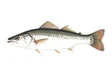
Atlantic silversides belong to the Atherinopsidae family and the Menidia genus. These fishes are distinguished from other similar species by their rounder and less compressed bodies. Order Atheriniformes includes six families of similar smaller silver fishes, that range from freshwater to marine habitats. The genus Kirtlandia was previously thought to be a part of Menidia but has since been separated. Members of the Kirtlandia genus have thicker and glossier scales and are typically found in the Chesapeake Bay region. The genus Menidia is characterized by their broad silver stripe running down each side and has a similar appearance to Osmeridae. They are often mistaken as members of Osmeridae; however, silversides do not have an adipose fin and instead have one spiny and one soft dorsal fin.

Distribution

The Atlantic silverside is found in the West Atlantic, ranging from the Gulf of St. Lawrence in Canada to northeastern Florida in the USA. It is one of the most common fish in the Chesapeake Bay and in the Barnegat Bay. Recent studies have found that their range may reach farther north than previously thought, as juvenile members of this species were found north of the Laurentian Channel in beach seines.

Human uses

These small fish are a delicacy in some countries like Portugal and are either eaten raw or fried in batter. They are also a common bait fish used by fishermen. This species also serves as a great example of environmental sex determination (ESD) in juvenile fishes, and many studies have been conducted on the topic. While northern populations are controlled only by genetics, southern populations are influenced by environmental conditions.

Read the full species guide.

Range

Where silverside live

How many of the 8 species are recorded in each state.
0
6
How many of the 8 species are recorded in each state.

Species

All 8 silverside species