Inland Silverside

Menidia beryllina

Atherinopsidae · freshwater and saltwater and brackish water fish

8 minute read · Species guide

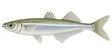
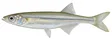
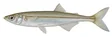
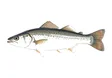
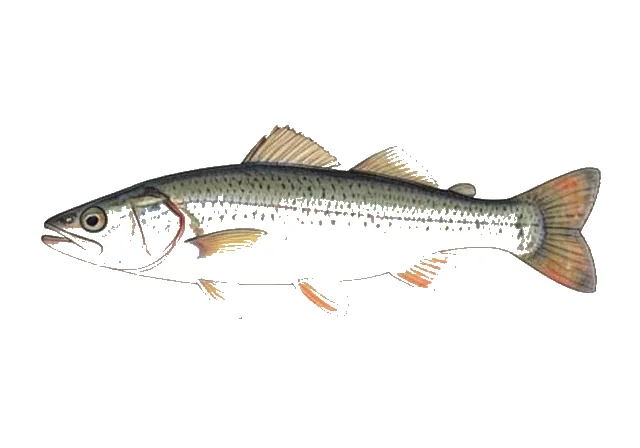
Inland Silverside field guide illustration

About Inland Silverside

The inland silverside (Menidia beryllina) is a neotropical silverside native to eastern North America, and introduced into California. It is a fish of estuaries and freshwater environments.

Inland silversides are quite elongate even for silverside, with lengths six to seven times depth. They have large eyes, a considerably upturned mouth, and a head noticeably flattened on top. Of the two widely separated dorsal fins, the anterior fin is small and has four to five weak spines, while the posterior fin is larger, with one spine and eight or nine rays. The lengthy anal fin is somewhat sickle-shaped, has one spine and 16 to 18 rays. As befits the name, they are silvery on the sides; the back is somewhat yellow, and the underside is a translucent green. These are small fish, with 15 cm recorded, but most adults 10 cm or less.

They primarily feed on zooplankton, moving in enormous schools capable of depleting populations of the small arthropods and crustaceans they favor. In turn, they are prey for a variety of fish and birds. The silversides congregate in the shallows, generally over sand or gravel bottoms with overhead cover if possible, but then move out to open water in search of additional food, which increases predation risk. They are often observed in a sort of daily migration pattern as a result.

The exact native range of the inland silverside is not known; they are widespread along the Atlantic coast from Maine to Florida, and along the Gulf of Mexico. In the Mississippi River they can be found in backwaters and reservoirs as far north as Missouri and Illinois, hundreds of miles inland.

They were introduced into Clear Lake and the Blue Lakes of California in 1967, in order to control the Clear Lake gnat Chaoborus asticopus and midges, and in lakes and reservoirs of Alameda County and Santa Clara County the following year. From there they spread into the San Francisco Bay and Central Valley, and have since become widespread in central California. In some areas, they are the most abundant fish of any species. Peter Moyle suggests that this fish may have contributed to the demise of the Clear Lake splittail, although the effect of the silversides' introduction on California ecosystems not been much studied.

Inland silversides are currently an EPA approved indicator species for acute marine aquatic toxicity testing and short-term chronic toxicity estimating of marine and estuarine organisms. Due to their susceptibility to stormwater and heavy metal pollution, inland silversides are often used as an indicator for watershed health, as a study of an introduced population in San Diego, CA found that even 5–10% effluent concentration of pollutants could cause abnormal embryo and larval development. Elevated levels of pollutants, often due to the inflow of stormwater, have been found to cause increased egg mortality. Furthermore, exposure to pollutants such as cadmium, chromium, and copper can cause abnormal inflation of the swim bladder leading to buoyancy and locomotion issues, affecting individual's ability to feed, which can lead to sharp declines in population. Other developmental consequences of exposure to heavy metals and other pollutants include spinal curvature, reduced body size, and different eye sizes. Compared to other species in the estuarine and river environments, inland silversides often display adverse effects to far lower concentrations of pollutants, emphasizing their susceptibility to the influx of chemical and heavy metal pollutants.

Along with their susceptibility to chemical pollutants, inland silverside embryos exhibit negative effects when exposed to pathogenic funguses, such as Beaveria bassiana. Beaveria bassiana is an insecticide pathogenic fungus used in agricultural pest control that is usually nontoxic to nontarget vertebrates. Beaveria bassiana has been found to degrade inland silverside embryos eventually leading to embryo deaths. Extracellular enzymes secreted by the fungus are able to digest proteins of the chorion, the outermost layer, of the embryo, eventually causing the chorion to rupture, instantly killing the embryo. Unlike exposure to chemical pollutants, exposure to the fungus led to immediate death rather than developmental abnormalities, as toxins secreted by fungus quickly digests the proteins of the embryos. These adverse reaction to Beaveria bassiana further indicate the sensitivity of inland silversides to foreign pollutants and microorganisms.

Inland silversides, Menidia beryllina, have distinct spawning behavior throughout their range, with individuals in the northern range exhibiting a unimodal spawning season between May and July and those in the southern range displaying either a bimodal spawning season, often spawning in the spring and again in the early fall. Inland silversides are dependent on water temperature for spawning, with both the initiation and cessation of spawning occurring within similar temperature ranges throughout their geographical range. Spawning is initiated when water temperatures are between 13.5 and 17.0 °C (56.3 and 62.6 °F) and spawning ends when water temperature rises to 27.0 to 32.4 °C (80.6 to 90.3 °F). Many populations, especially those in Texas and Florida, are r-strategists, producing high numbers of offspring, but displaying little if any parental care. Along with a lack of parental care, this strategy also includes rapid sexual maturation and reproduction at a young age. Growth rates in female individuals have been observed to be far greater than those of males with juvenile females growing between 0.31mm/day – 0.34mm/day and juvenile males growing between 0.20mm/day – 0.27mm/day.

Article text: Wikipedia contributors, Inland silverside (source revision). Licensed under CC BY-SA 4.0. Retrieved 2026-10-11.
Diet and feeding

The FishTraits compilation records these diet categories for this species: algae or phytoplankton; invertebrates or larval fish. These are broad categories, not a claim that every individual consumes every example in a category.

Reported feeding positions include surface or water-column feeding. The compilation combines published observations; diets can vary with age, locality, and available food.

Habitat preferences

Reported habitat associations include medium to large rivers, streams and small rivers, creeks, still-water habitats.

The source records associations with sand, vegetation, organic debris. An association indicates reported use, rather than an exclusive requirement.

The species is classified as tolerant of a broad range of salinities. This flag does not specify a salinity range for aquarium care.

Reproduction and parental care

The compilation reports a representative maturity age of 1 years. Its maturity field summarizes mean, median, or modal estimates, usually for females; male estimates can be used when female data are unavailable. It is not a fixed age at which every fish first breeds.

Batch or serial spawning has been reported somewhere in the species’ range. This does not establish the same spawning pattern for every population.

Recorded spawning months are May, Jun for the source’s reporting region (NC). This is a regional calendar, not a range-wide schedule.

The reproductive-guild classification includes spawning on open substrates without guarding the brood.

Size and recorded longevity

FishTraits reports a maximum total length of 15 centimetres. Some entries use an estimated asymptotic length; this value should not be treated as a certified record catch.

Recorded longevity in the compilation is 2 years. Wild observations were preferred, but captive records were accepted where wild records were unavailable, and unspecified records were assumed wild. The value is not a guaranteed wild lifespan or an aquarium life expectancy.

Identification and appearance

Smith (1985); Hubbs et al. (1991); Page and Burr (1991); Etnier and Starnes (1993). Chernoff et al. (1981) concluded that the Mississippi silverside M. audens is conspecific with M. beryllina; they also recognized that peninsular Florida populations living in marine environs, formerly considered M. beryllina, to be a distinct species (i.e., M. peninsulae).

Native range

Eastern North America including Atlantic and Gulf slopes (mostly near the coast) from Massachusetts to the Rio Grande drainage, Texas, and southeastern New Mexico; north from the Mississippi River and major tributaries (mainly Arkansas and Red Rivers) to southern Illinois and eastern Oklahoma. Also in Mexico (Page and Burr 1991).

Introduction history

Intentionally stocked as forage for sport fish in most locations, but unknown in the Canadian River system. Unauthorized introduction into Clear Lake, California, in 1967 to control the Clear Lake gnat Chaoborus astictopus and chironomid midges, and to serve as a nutrient reservoir to control bluegreen algae blooms (Moyle et al. 1974a; Moyle 1976a). A few introductions in California were authorized; however, many additional stockings were unauthorized and help to spread this fish (Moyle et al. 1974a). Introduction to the upper Mississippi and Ohio Rivers may be the result of dispersal through the Tennessee-Tombigbee waterway (Etnier and Starnes 1993) or natural dispersal up the Mississippi made possible by a change in water quality (Burr et al. 1996). Brood stock for Missouri introductions came from Lake Texoma, Oklahoma (Pflieger 1997).

Ecological impacts

In Oklahoma, the inland silverside has almost completely replaced the brook silverside Labidesthes sicculus, an ecologically similar species (Gomez and Lindsay 1972; Moyle 1976a). Cook and Moore (1970) gave details of the stocking in Clear Lake, California. In Clear Lake, inland silversides were reported as having displaced native fishes, including the hitch Lavinia exilicauda, the Sacramento blackfish Orthodon microlepidotus, and the now extinct Clear Lake splittail Pogonichthys ciscoides, apparently through competition for food. Inland silversides also may have replaced or diminished introduced bluegill (Moyle 1976a). Li et al. (1976) found the introduction of Mississippi silversides inhibited growth of black and white crappies Pomoxis spp. for the first two years of life and enhanced growth after that time. Moyle and Holzhauser (1978) discussed effects on feeding habits of introduced largemouth bass. Moyle et al. (1974) speculated that if this silverside reaches the delta area, it could negatively impact the Delta smelt Hypomesus t. transpacificus and perhaps juvenile striped bass. Baerwald et al. (2012) detected Delta smelt DNA in the gut contents in Mississippi silversides collected in the Sacramento Deepwater Ship Channel. Moyle (1976a) and Dill and Cordone (1997) provided detailed discussion of the history and reasons for this species' introduction into California and of its impacts.

Range

Where it lives

Share of 62,871 GBIF observation records with a state location, across 29 states. The orange dots are USGS stream-survey sites where this species was caught.
0%
89.1%
Share of 62,871 GBIF observation records with a state location, across 29 states. The orange dots are USGS stream-survey sites where this species was caught.

A blank area on the dot layer usually means nobody sampled there, not that the fish is absent. Turn on “every survey site” to see where the survey looked.

The USGS stream survey caught it at 228 of its sites, in 18 states. That survey and the GBIF records are two different counts of two different things, so the site keeps them apart.

Habitat

Water and movement

Water
WoRMS records this species in fresh water, brackish water and the sea.
USGS NAS habitat
Freshwater;Marine
US status
Native transplant — native to part of the United States, moved to other waters inside it.
Migration
Not migratory

Classification

Taxonomy

Kingdom
Animalia
Phylum
Chordata
Superclass
Actinopterygii
Class
Teleostei
Order
Atheriniformes
Genus
Menidia
Species
Menidia beryllina
ITIS TSN
165993
WoRMS AphiaID
159227
GBIF key
2412295

Common questions about Inland Silverside

What is the scientific name of Inland Silverside?
The scientific name is Menidia beryllina, in the family Atherinopsidae. Classification follows ITIS.
Does Inland Silverside live in fresh water or salt water?
WoRMS records this species in fresh water, brackish water and the sea.
Where has Inland Silverside been recorded in the United States?
GBIF has observations in 29 states, with the most records in Texas, Florida, Louisiana. The map shows observation records, which do not establish the complete natural range.

Closest relatives

Other Menidia species

Same family

More Atherinopsidae