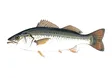
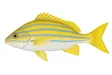
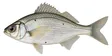
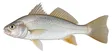
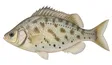
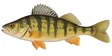
These species profiles show how members of the group differ. Their biology describes each named species, rather than every fish in the group.
The pirate perch (Aphredoderus sayanus) is a freshwater fish that commonly inhabits coastal waters along the east coast of the United States and the backwater areas of the Mississippi Valley. This species is often found towards the bottom of clear, warm water habitats with low currents. These fish are normally solitary, carnivorous, and nocturnal. The pirate perch is known to consume live mosquito larva, amphipods, glass shrimp, meal worms, small fish, dragonfly and stonefly larvae, and earthworms.
The pirate perch is related to the trout-perches in the family Percopsidae, but only loosely; as it is in the family Aphredoderidae. The genus name, Aphredoderus, literally translates to "excrement throat" in Greek, referencing the unusual location of its anus in the throat region. The specific name sayanus is a tribute to naturalist Thomas Say. Charles C. Abbott gave the fish its common name after observing it eating only other fishes.
Description
This small fish is up to 14 cm (5.5 in) in total length. It is dark brown, sometimes with a darker band near the base of the tail. In young individuals the anus is located between the pelvic fins, but migrates forward as the fish grows, before it settles on the throat region.
Pirate perch may be the only known animal to exhibit a chemical camouflage, or crypsis that is generalized and effective among a wide number of potential prey species.
Distribution
The pirate perch is a freshwater species found in temperate climates where the water temperature generally ranges from 5 to 26 °C (41–79 °F). They are found most commonly in central and eastern North America. The pirate perch occurs in rivers of the Atlantic and Gulf slopes, the Mississippi Valley, and scattered parts of the eastern Great Lakes Basin. The subspecies A. s. gibbosus occurs west of the Eastern Continental Divide and in the Gulf of Mexico basin west of the Mississippi River, while the nominate subspecies occurs along most of the Atlantic coast north of the Florida–Georgia border; intergrades are found from Florida to Mississippi. Pirate perch once occurred in Pennsylvania, in the Delaware River drainage, but have since likely been extirpated, according to the Nature Conservancy. The species may also be extirpated in Ohio. Its geographic range is very limited in the United States, and the creation of dams and the increasing effects of urbanization are restricting the overall habitat size for the fish, which could eventually lead to this species becoming extirpated in some areas.
Ecology
These fish can be found in densely vegetated areas, places with woody debris, and underneath banks in root masses. Debris in deep water with undercut banks and slow inside flows are used more by this species. The area where the perch reside is dependent on their size, with medium to large perch occupying places that were more structurally complex than small ones. They are known to congregate in these areas to avoid predation from piscivorous birds, otters, or mink. The pirate perch has nocturnal feeding habits; their diet consists of live mosquito larva, amphipods, glass shrimp, meal worms, small fish, dragonfly and stonefly larvae, and earthworms.
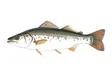 Read the full species guide.
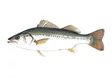
The white perch (Morone americana) is not a true perch but is a fish of the temperate bass family, Moronidae, notable as a food and game fish in eastern North America. In some places it is referred to as "Silver Bass".
The common name "white perch" is sometimes applied to the white crappie (Pomoxis annularis).
Description
Generally silvery-white in color, hence the name, depending upon habitat and size specimens have begun to develop a darker shade near the dorsal fin and along the top of the fish. This sometimes earns them the nickname "black-back". White perch have been reported up to 49.5 cm (19.5 in) in length and weighing 2.2 kg (4.9 lb).
Ecology
Although favoring brackish waters, it is also found in fresh water and coastal areas from the St. Lawrence River and Lake Ontario south to the Pee Dee River in South Carolina, and as far east as Nova Scotia. They are also found in the lower Great Lakes, Finger Lakes, Long Island Sound and nearby coastal areas, Hudson and Mohawk River system, Delaware Bay and Chesapeake Bay. It is also found occasionally in small landlocked lakes and ponds.
Diet
White perch are known to eat the eggs of many species native to the Great Lakes, such as walleye and other true perches. At times, fish eggs are 100% of their diet. They prefer to eat small minnows like mudminnows and fathead minnows.
In the Chesapeake Bay, white perch commonly prey upon grass shrimp, razor clams, and bloodworms which are all common to the region.
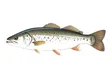 Read the full species guide.
The Sacramento perch (Archoplites interruptus) is a species of freshwater sunfish endemic to California, and transplanted to other parts of the western United States. It is the only extant species within the genus Archoplites. It is the only species of freshwater sunfish whose native habitat resides west of the Rocky Mountains, while all the other species are native to the east. Due its small range and the impact of introduced species on it, it is considered Endangered on the IUCN Red List.
They are indigenous to the Sacramento–San Joaquin River Delta, Pajaro, and Salinas River areas but have been widely introduced outside their native range throughout California. They have also been introduced outside of the state, in Nebraska, Nevada, Oregon, Utah, Colorado, Arizona, New Mexico, South Dakota, North Dakota, and Texas, to revive their populations. While there is no updated analysis of their populations in these states, it is certain that they still exist throughout California. However, there is speculation of viable populations in Utah, Nevada, and Colorado. The Sacramento perch's native habitat is in sluggish, heavily vegetated waters of sloughs and lakes. It can reach a maximum overall length of 73 cm (29 in) and a maximum weight of 1.4 kg (3.1 lb), and it has been reported to live as long as nine years. Its adaptability to different habitats is variable, and it can survive on various food sources, from insects, bottom-dwelling snails, phytoplankton, and small fishes. As young perch, they consume mainly small crustaceans and eventually move on to insect larvae and then smaller fish as adults.
Taxonomy
Archoplites interruptus belongs to the family Centrarchidae, within the order Centrarchiformes. Although called the Sacramento perch, A. interruptus is not a perch strictly speaking. The perches are members of the genus Perca in the family Percidae. Being the only native centrarchid west of the Rockies, the Sacramento perch is believed to closely resemble the ancestral fish that split from the rest of the other species residing in the east. This split was believed to occurred during the Middle Miocene period, which is about 15.5 to 5.2 MYA. It was initially thought that the Sacramento perches' close relatives were the flier (Centrarchus macropterus) and crappies (Pomoxis spp.). However, a reevaluation of this using DNA sequences shows that it is most closely related to the Rock Bass.
A. interruptus is currently the only species of the genus Archoplites, but Girard, an ichthyologist, originally assigned it to Centrarchus. The genus name comes from the Greek words that mean anus and armor, which refers to the anal spines. The species name, interruptus, refers to the irregular stripe pattern on its sides.
Description
The body shape of this fish is laterally compressed, and it is considered to be deep-bodied for a Centrarchid species. Being deep-bodied refers to it being wide in length from its ventral to dorsal side. On average, its depth is 2.5 times greater than the average length of all other Centrarchids. This fish has a slightly angled mouth in the superior position, indicating that it feeds on insects near the middle of the water column. The mouth is large, with numerous small teeth found on its jaws, tongue, and roof of its mouth. The dorsal fin has a strictly spiny portion with about 12–14 spines that is continuous, with the soft-rayed portion that has 10–11 spines. It has fairly large cycloid scales numerously ranging from 38 to 48 along the lateral line in an adult. It has a combination of white, silver, and dark brown colored scales.
The Sacramento perch is most identifiable by its irregular dark brown vertical bars that almost resemble stripes, giving it great cryptic coloration in dark and vertically broken-up habitats provided by aquatic plants. The females, however, tend to have these bars less prominent and have more of an even coloration with the silver scales. There are about 25–30 gill rakers in its gills, and has black spots on the operculum. During the breeding season, there tends to be more sexual dimorphism. Overall, the males become darker with metallic green-purple scales and display purple opercula, as shown in the right image.
Distribution
Historically, the Sacramento perch was found throughout the Central Valley of California at elevations below 100 m. The Sacramento perch was very popular for recreational fishing. It was so abundant that this species was commonly used as a food fish eaten regularly. It inhabited sloughs, slow-moving rivers of the Pajaro and Salinas rivers, and lakes with emergent vegetation such as Clear Lake. This species has been eliminated from 90% of its natural habitat due to habitat destruction, egg predation by invasive fish species, and interspecific competition with other centrarchids, mainly bluegill. Sacramento perch are quite rare in their native range and are found primarily in warm, turbid, and alkaline farm ponds, reservoirs, and recreational lakes that it has been introduced into. Sacramento perch populations exist in six California watersheds, including Clear Lake Reservoir, Cedar Creek, Walker River, upper Owens River, Mono Lake, and Abbotts Lagoon. In Colorado, there were two successful introductions in private land, one in Abrams Lake and the other in Gilberts Pond. The growth rate of the fish here was very rapid, but spawning is yet to be determined. Sacramento perch populations in Nevada were transplanted in 1877 from the Sacramento River into Washoe Lake. Eventually, they were moved again into Pyramid and Walker Lake in 1880. These populations have grown and expanded in Eureka, Churchhill, Elko, Humbolt, Lander, and Washoe counties. However, the populations in Pyramid and Washoe Lake need a current reevaluation since the state of Nevada has been implementing actions of introducing large predatory game fish such as walleyes, basses, and other centrarchid species. In Utah, the early populations of Nevada were transplanted in the Garrison Reservoir along the Bear River. According to the state wildlife agency, in 2006, the population was still present but with a small population. Due to a lack of recent population surveys, this is also currently unknown.
 Read the full species guide.