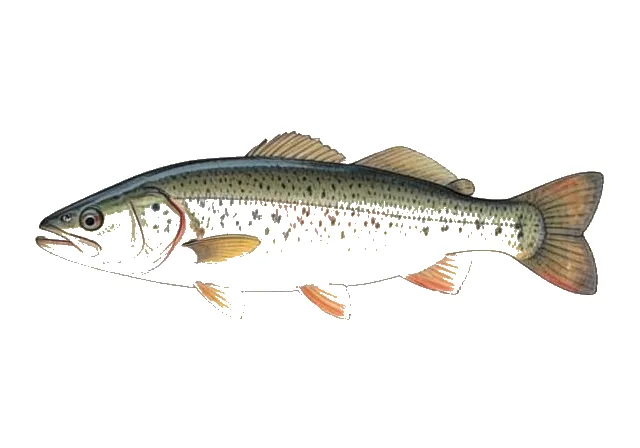
The common name "white perch" is sometimes applied to the white crappie (Pomoxis annularis).
Description
Generally silvery-white in color, hence the name, depending upon habitat and size specimens have begun to develop a darker shade near the dorsal fin and along the top of the fish. This sometimes earns them the nickname "black-back". White perch have been reported up to 49.5 cm (19.5 in) in length and weighing 2.2 kg (4.9 lb).
Ecology
Although favoring brackish waters, it is also found in fresh water and coastal areas from the St. Lawrence River and Lake Ontario south to the Pee Dee River in South Carolina, and as far east as Nova Scotia. They are also found in the lower Great Lakes, Finger Lakes, Long Island Sound and nearby coastal areas, Hudson and Mohawk River system, Delaware Bay and Chesapeake Bay. It is also found occasionally in small landlocked lakes and ponds.
Diet
White perch are known to eat the eggs of many species native to the Great Lakes, such as walleye and other true perches. At times, fish eggs are 100% of their diet. They prefer to eat small minnows like mudminnows and fathead minnows.
In the Chesapeake Bay, white perch commonly prey upon grass shrimp, razor clams, and bloodworms which are all common to the region.
Reproduction
White perch are a prolific species. The female can deposit over 150,000 eggs in a spawning session, lasting just over a week. Several males will often attend a spawning female, and each may fertilize a portion of her eggs. The young hatch within one to six days of fertilization.
At times, a parasite known as Lironeca ovalis is located in the gills. Its presence is believed to reduce the growth rate of white perch.
The white perch is currently recovering from a loss of population in the Hudson River.
Aquatic nuisance species
Some states consider the white perch to be a nuisance species due to its ability to destroy fisheries. They have been associated with the declines in both walleye and white bass populations because they feed heavily on baitfish used by those species and outcompete them for food and space. Many states have enacted laws forbidding possession of live white perch. Additionally, these states recommend not releasing captured white perch back into the water to help control its spread.
Article text: Wikipedia contributors, White perch (source revision). Licensed under CC BY-SA 4.0. Retrieved 2026-10-11.
Diet and feeding
The FishTraits compilation records these diet categories for this species: invertebrates or larval fish; larger animal prey (a source category covering fish, crayfish, crabs, or frogs). These are broad categories, not a claim that every individual consumes every example in a category.
Reported feeding positions include bottom feeding and surface or water-column feeding. The compilation combines published observations; diets can vary with age, locality, and available food.
Habitat preferences
Reported habitat associations include medium to large rivers, streams and small rivers, still-water habitats.
The source records associations with muck, clay or silt. An association indicates reported use, rather than an exclusive requirement.
The species is classified as tolerant of a broad range of salinities. This flag does not specify a salinity range for aquarium care.
Reproduction and parental care
The compilation reports a representative maturity age of 3.5 years. Its maturity field summarizes mean, median, or modal estimates, usually for females; male estimates can be used when female data are unavailable. It is not a fixed age at which every fish first breeds.
Recorded spawning months are Apr for the source’s reporting region (NC). This is a regional calendar, not a range-wide schedule.
The reproductive-guild classification includes spawning on open substrates without guarding the brood.
Size and recorded longevity
FishTraits reports a maximum total length of 49.5 centimetres. Some entries use an estimated asymptotic length; this value should not be treated as a certified record catch.
Recorded longevity in the compilation is 12 years. Wild observations were preferred, but captive records were accepted where wild records were unavailable, and unspecified records were assumed wild. The value is not a guaranteed wild lifespan or an aquarium life expectancy.
Identification and appearance
White Perch are a small silvery, greenish-gray fish with a dark, highly domed back. The belly is whitish, and the lower jaw projects slightly. It has three spines in its anal fin and a deep notch in the dorsal fin. The tail is also mildly forked. Woolcott (1962); Mansueti (1964); Smith (1985); Page and Burr (1991); Jenkins and Burkhead (1994). White Perch are visually quite similar to White Bass (Morone chrysops). The following distinguishing features can be used to identify White Perch from White Bass. White Perch: anal ray count of 9–10, body depth is greatest before the spinous dorsal fin, and the side of the body lacks distinct longitudinal lines. White Bass: anal ray count is >10, body depth is greatest under the spinous dorsal fin, and the side of body has distinct longitudinal lines.
Native range
Atlantic Slope drainages from St. Lawrence-Lake America drainage, Quebec, south to Pee Dee River, South Carolina (Page and Burr 1991). Populations in the Lake America drainage probably became established following construction of the Erie Canal.
Habitat and ecology
White Perch is a euryhaline species, inhabiting fresh, brackish and coastal waters. It is commonly found in estuaries, rivers, and inland lakes. Adults prefer habitats with little cover and muddy/silty/sandy substrate. White Perch in estuaries are semi-anadromous, migrating from saltier bays and coastal areas into the fresher areas of streams and rivers to spawn in spring. Landlocked populations can spawn in freshwater rivers and lakes and typically migrate from deep to shallow waters to spawn. Males and females mature after 1–4 years (Bur 1986). Females are oviparous and broadcast adhesive eggs onto sandy substrate to eventually be fertilized externally by the males. Fecundity ranges from 20,000–457,000 eggs per female (Bur 1986; Jenkins and Burkhead 1994; Okoye et al. 2008). White Perch is a highly opportunistic forager with a generalist diet, including macroinvertebrates, crustaceans and fish (Couture and Watzin 2008; Jones et al. 2015). Fish eggs (including its own) are also an important part of its diet particularly in the spring (Schaeffer and Margraf 1987). This species is consumed by piscivores including Walleye (Sander vitreus), Striped Bass (M. saxatilis), Muskellunge (Esox masquinongy), and Catfish (Icturlidae) (Hoyle et al. 2017; Andrews et al. 2018; Schmitt et al. 2019).
Introduction history
White Perch was brought from New Jersey to Nebraska in 1964, and fry produced that year in a hatchery were accidentally introduced into a reservoir that provided access to the Missouri River (Hergenrader and Bliss 1971). White Perch has been stocked intentionally in other areas for sportfishing. In Kansas, fish found at Browning Oxbow on the Missouri River are believed to have come from Nebraska. The species was not recorded from the Missouri River in Missouri until the 1990s (Pflieger 1997). The source of the fish in the two Kansas reservoirs is a result of stock contamination from a Striped Bass stocking (Mosher, personal communication). White Perch were stocked in West Virginia in the early 1900s (Cincotta, personal communication) and are being illegally stocked by individuals in inland lakes in Indiana (R. Robertson and D. Keller, personal communication).
Ecological impacts
Bur and Klarer (1991) found that Morone americana has a large portion of its diet consisting of zooplankton in the central basin of Lake Erie. In comparison to available zooplankton, a disproportionately large amount was the invasive Bythotrephes cederstroemi (Bur and Klarer 1991).
Parrish and Margraf (1990) hypothesized that White Perch compete with native Yellow Perch (Perca flavescens) for zooplankton. They determined that growth rates of Yellow Perch had declined since the invasion of White Perch in Lake Erie, especially in the western basin. They also determined that the two species had considerable diet overlap and found one sample in which White Perch consumed 27 percent more food than Yellow Perch.
Parrish and Margraf (1994) speculated that competition between White Perch and forage fishes, such as Emerald Shiner (Notropis atherinoides) and Spottail Shiner (N. hudsonius), may actually be more complex and may be responsible for the declines of the latter species. Decline of these species could also affect Walleye, the top predator in Lake Erie (Parrish and Margraf 1994).
Within three years after being introduced into a Nebraska reservoir, White Perch had completely replaced the previously dominant Black Bullhead (Ameiurus melas). Species composition changed from 74 percent Black Bullhead to 70 percent White Perch in that timeframe (Hergenrader and Bliss 1971).
Feiner et al. (2013a, b) found significant overlap in trophic niche and resource use between White Perch and Walleye, Largemouth Bass (Micropterus salmoides), Bluegill (Lepomis macrochirus), Striped Bass (M. saxatilis), and White Bass in three lakes in North Carolina, suggesting the potential for resource competition.
Invasion of the Great Lakes brought White Perch into sympatric distribution with White Bass, a closely related but previously allopatric species, allowing hybridization to occur. White Perch x White Bass hybrids have been reported in western Lake Erie, in Ohio and Michigan, and from the Detroit and St. Clair Rivers in Michigan (Todd 1986). Hybrids were first noted in western Lake Erie in the early 1980s, as White Perch were increasing in this region (Todd 1986). These hybrids probably occur in other Great Lakes because the two species are sympatric throughout the chain of lakes. However, Todd was not aware of any other locations with these hybrids, and his extensive surveys around Saginaw Bay, Lake Huron, and Lake America in the mid-1980s failed to find any (Todd, personal communication). Todd (1986) provided photographs of both parent species and the hybrid and gave characteristics of each. Because these hybrids are capable of backcrossing with the parental species, and possibly producing F2 hybrids by crossing amongst themselves (Todd 1986), they dilute the gene pool of each parent species. The White Perch x White Bass hybrid is the first naturally occurring Morone hybrid known (Todd 1986). Hybrids of M. americana and M. mississippiensis were first found in 2000 in the middle Illinois River (Irons et al. 2002). Hybridization and competition may represent another threat to the already dwindling Yellow Bass of that region.