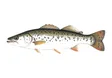
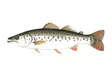
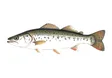
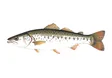
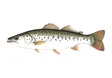
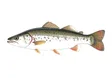
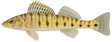
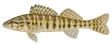
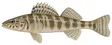
These species profiles show how members of the group differ. Their biology describes each named species, rather than every fish in the group.
The common logperch (Percina caprodes), sometimes simply known as the logperch, is a species of freshwater ray-finned fish, a darter from the subfamily Etheostomatinae, part of the family Percidae, which also contains the perches, ruffes and pikeperches. Like other logperches, it has the typical vertical barring along the flank and a subterminal mouth.
This is the most widespread logperch, commonly found in large parts of the eastern United States and Canada. Like other logperches, they inhabit clear, gravelly streams and lakes, reaching a maximum size of about 18 centimeters (7.1 in) and a maximum age of about 3 years. They play a key role in the reproduction of the snuffbox mussel (Epioblasma triquetra).
Abstract
The common logperch is a darter species naturally occurring as far north as the St. Lawrence River in Canada, as far west as the Great Lakes, and south throughout the Mississippi River down to the Rio Grande. The common logperch is also found as far west as California, where it was introduced in 1953. Logperch are benthic, nonguarding egglayers, whose embryos drift to lentic areas after hatching. The population distribution of the common logperch may be under increased predatory pressure from stocked saugeyes. Dams may also exert stress on the fish, by obstructing migratory pathways and inhibiting gene flow. Percina caprodes have also been found to be extremely susceptible to nitrite poisoning. While the common logperch is not currently listed as a threatened or endangered species, humans should be aware of our negative impact on the species, and the ways in which we can minimize this impact; most notably, by limiting the construction of dams, by increasing oxygen levels in the tailwaters of existing dams, by limiting the number of predatory gamefish stocked (such as saugeye), by decreasing the amount of silt and debris deposited in streams, and by monitoring nitrite levels in common logperch habitats. Also, a monitoring plan should be created, in which a routine census is taken of the fish in each area of its distribution, and in which invasive species that outcompete the common logperch, such as Neogobius melanostomus, are removed.
Geographic distribution of species
The common logperch exhibits a rather large geographic distribution and range. The common logperch occurs naturally as far north as the St. Lawrence River system in Quebec, and as far south as the Rio Grande system in southern Texas and northern Mexico. Westwards, logperch are most heavily distributed in the Mississippi River drainage system, and their range extends eastward in freshwater habitats all the way to the Atlantic Ocean. Currently, however, the range of the common logperch has been artificially extended into California, where it was released into the wild in 1953. The range of the common logperch, while impressive, has nevertheless been reduced due to the construction of dams, the introduction of stocked predatory species such as walleye and sauger, the introduction of invasive competitors (specifically Neogobius melanostomus), and possibly by erosion around drainage systems.
Ecology
The common logperch, like most darter species, dwells in benthic habitats where it forages for food. It prefers clear, swift water with rocky or sandy substrate; however, it may be found in any temperate water in their geographic distribution. Its diet consists primarily of benthic invertebrates, which it hunts by flipping over stones with its snout. It appears that logperches are not especially fastidious when foraging, and that they are actually very opportunistic feeders. That being said, chironomids constitute the largest part of a darter's diet (~54% volumetric contribution), whereas trichopterans and simuliids constituted roughly 15% and 22% volumetric contribution, respectively. However, prey consumption can vary largely by location and season. Some competition surely exists between the common logperch and other benthic species with the same native distribution and diet. It is an invasive species, Neogobius melanostomus (round goby), however, that poses the largest competitive threat to the common logperch. Studies indicate that this is most likely because Neogobius melanostomus better utilizes its space in the environment for shelter, decreasing the range of the common logperch, because Neogobius melanostomus is also a more aggressive than the relatively passive common logperch, and because N. melanostomus reproduces at a higher rate than the common logperch. Natural predators of the common logperch consist most notably of carnivorous piscivores from the Sander, Micropterus, and Esox genera.
Human induced changes that might reduce the abundance of the common logperch include the excess stocking of piscivorous fish species, the damming of rivers, introduction of chemicals into watersheds, and erosion caused from human activities. While the top-down effects the addition of excess predators can cause on prey species are relatively well studied, the effects and mechanisms of the other aforementioned human activities may not be so clear.
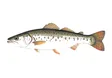 Read the full species guide.
Percina burtoni, the blotchside logperch or blotchside darter, is a small, endangered species of freshwater ray-finned fish, a darter from the subfamily Etheostomatinae, part of the family Percidae, which also contains the perches, ruffes and pikeperches. It is endemic to the United States and classified as vulnerable on the IUCN Red List.
Taxonomy
The blotchside darter was formerly described as a subspecies of Percina caprodes. It was first formally described as P. c. burtoni in 1945 by the American ichthyologist Henry Weed Fowler (1878–1961) with the type locality given as The Swannanoa River near Oteen in Buncombe County, North Carolina. The specific name honors the eminent naturalist who collected the type, Edward Milby Burton (1898–1977), formerly of the Charleston Museum.
Description
The blotchside darter is mostly covered with blotches on the midlateral row of the body. It has prepectoral scales and an orange submarginal band in the first dorsal fin. There are 15–18 dorsal spines, 14–15 dorsal rays, 14–15 pectoral rays, 2 anal spines, 10–12 anal rays, and 6 branchiostegal rays.
The species is olive in color dorsally, cream-colored ventrally, and has a lateral series of 8–10 dark green to black round or oval blotches. There is a distinct black spot at the base of the tail. The head is dark above and white below. In the first dorsal fin is a thin black margin. There is a thin orange submarginal band and a wide diffuse black basal band. The second dorsal and caudal fins have several narrow black bands; other fins are clear or yellow in color.
Distribution and habitat
The blotchside darter is endemic to the United States. It can occasionally be found in the Tennessee River system in Tennessee, Virginia, and North Carolina. It formerly occurred in the Cumberland River system in Kentucky and Tennessee and may still persist in what is known as Little South Fork in Kentucky.
The species lives in swift streams and is usually found over gravel in water 0.5–1 m in depth. It has been observed in clear, moderately large streams in which a variety of fishes occur, indicating that it requires high water quality and ecosystem health. It appears intolerant of reservoir conditions.
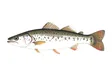 Read the full species guide.
The bigscale logperch (Percina macrolepida) is a rayfinned freshwater fish that is a member of the Percid family and Etheostomatini subfamily (the darters). It was discovered in 1971 by Michael Stevenson and was originally thought to be one with Percina caprodes. This fish is on average 85 mm, but the maximum recorded was 95 mm.
Description
This fish is defined by scales on its nape and breast and a lack of yellow-orange band on the dorsal fin that defines P. caprodes. It generally has large-sized scales, less scales on its lateral line, a more fusiform shape, and a longer caudal peduncle than P. caprodes. This fish differs from other darters by a smaller head size and a unique pattern of lateral bars. This fish has about 20 vertical bars that extend from the dorsal area towards the middle of the lateral section. The central 5-8 bars are darker than the rest, and they continue down the body until reaching the caudal peduncle. P. macrolepida has ctenoid scales on its nape, cheeks, preopercle, and opercle, and both sexes have a scaled stomach. However, females have a mid-ventral line bare of scales, while males have scales on this area. This fish has a terminal mouth with well-developed teeth in multiple rows; the first row of teeth is curved backwards into the mouth. The terminal mouth is characteristic of the Percina genus and infers its ability to eat prey from sides of rocks. P. macrolepida’s vomer, the flat bone on the roof of its mouth, features small prickles.
P. macrolepida are dull-colored and feature dark-colored vertical bars. In adults, the head is dark green while the cheeks and supraoccipital region are yellow-green, and the stomach is cream-colored. Adult caudal fins have V-shaped bars and a dark caudal spot the size of the fish’s pupil. Melanophores are scattered throughout the head, stomach, and pre-pectoral areas. The fish’s dorsal side is dark green and iridescent and its vertical bars are dark black. Reproducing adults have yellow areas around fin bases, opercle, lower lip, and stomach, while breeding males also have yellow-orange at the bases of the dorsal fins, first few dorsal spines, and the caudal fin.
Distribution
P. macrolepida are found in all major river systems in Texas, Sabine River in Louisiana, Pecos River in New Mexico, Red River in Oklahoma, and Rio San Carlos in Coahuila, Mexico. It has also been found in irrigation canals and Baker Lake in Colorado and Red River in Arkansas. This fish was introduced into California waters by the US Fish and Wildlife Service in 1954. They were accidentally mixed in a shipment of other fish and brought to Beale Air Force Base in Yuba County. They are currently found in the Sacramento-San Joaquin watershed, including Feather River, the Sacramento Delta, San Joaquin Valley, Putah Creek, and Cache Creek, as well as Del Valle Reservoir in Alameda County, Berryessa Reservoir in Napa County, and several reservoirs in Southern California. This extensive movement results from P. macrolepida being used as bait for other fish; it is frequently transported by fishermen to new locations. The fish is relatively abundant and is not endangered.
P. macrolepida are typically found in large freshwater rivers, lakes, and streams. It is also found in impounded waters like irrigation canals and ponds. This species is unique in that it tends to avoid turbulence in water. This fish is most common in warm, clear streams or shallow reservoirs and can also survive in irrigation canals.
Life History
This fish spends its time motionless, only moving in short bursts or longer to find food. It digs pits in the substrate with its tail where it sits without moving.
It is an opportunistic feeder, meaning it eats what insects or invertebrates are most common in the environment. Juvenile darters eat small crustaceans like water fleas, plankton, and ostracods. Juveniles are obligate planktivores while their mouth develops, then eat larvae and invertebrates as adults. Adults eat midges, black flies, mayflies, and caddisflies.
 Read the full species guide.