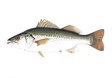
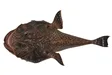
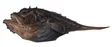
Common names

Types of goosefish

8 species carry goosefish in an English common name. They sit in 1 family, so the group is a name, not a scientific rank.

About goosefish

Goosefishes, sometimes called anglers or monkfishes, form the family Lophiidae of marine ray-finned fishes belonging to the order Lophiiformes, the anglerfishes. The family includes 30 recognized species. These fishes are found in all the world's oceans except for the Antarctic Ocean.

Taxonomy

The goosefish family, Lophiidae, was first proposed as a genus in 1810 by the French polymath and naturalist Constantine Samuel Rafinesque. The Lophiidae is the only family in the monotypic suborder Lophioidei, this is one of 5 suborders of the Lophiiformes. The Lophioidei is considered to be the most basal of the suborders in the order.

Etymology

The goosefish family, Lophiidae, takes its name from its type genus, Lophius. Lophius means "mane" and is presumably a reference to the first 3 spines of the first dorsal fin which are tentacle like, with 3 smaller spines behind them.

Genera

The goosefish family, Lophiidae, contains the following extant genera:

Fossil taxa

The following extinct taxa are also among those included in the family Lophiidae:

Characteristics

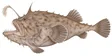
Goosefishes in the family Lophiidae have flattened heads and bodies covered in thin skin and are further characterised by the possession of pelvic fins with the first, spiny dorsal fin having its origin close to the rear of the head and this fin is supported by between one and three spines. The frontmost spine, the illicium, has a flap of flesh, the esca, at its tip and is used as a lure to attract prey to within reach of the cavernous mouth. There are 4 pharyngobranchials, the 4th being toothed, and they have a large pseudobranch. The body has no scales and the frontal bones of the skull are fused. They have a very wide, flattened head, although Sladenia has a more rounded head, with well developed teeth. The lower jaw has a fringe of small flaps along its edge and these extend along the head onto the flanks. The second dorsal fin is supported by between 8 and 12 soft rays while the anal fin contains between 6 and 10 soft rays. Most taxa have 18 or 19 vertebrae, but in Lophius this count is between 26 and 31. The opening to the gills is located to the rear of the pectoral fin base. The largest species in the family is the angler (Lophius piscatorius) which has a maximum published standard length of 200 cm (79 in) while the smallest is Lophiodes fimbriatus with a maximum published standard length of 7.5 cm (3.0 in).

Distribution

The goosefishes, family Lophiidae are found in the temperate, tropical, and subtropical Atlantic Indian and Pacific Oceans.

Habitat and biology

The goosefishes are typically found on soft substrates on the continental margin, most frequently at depths greater than 200 m (660 ft), and there are species which have been found at depths greater than 1,000 m (3,300 ft). A few species, such as the American angler (Lophius americanus) are found in shallower waters, sometimes moving into bays and estuaries with high-salinity water in the winter. At least in the genus Lophius the females release their spawn enclosed in a gelatinous mass, which has been compared to the spawn of toads in appearance, which floats. They have pelagic eggs and larvae with demersal juveniles and benthic adults.

Utilisation

Goosefishes, particularly several of the large species in the genus Lophius, commonly known as monkfishes in northern Europe, are important commercially fished species. The liver of monkfish, known as ankimo, is considered a delicacy in Japan.
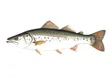
Goosefish species in focus

These species profiles show how members of the group differ. Their biology describes each named species, rather than every fish in the group.

American Angler

Lophius americanus is a goosefish in the family Lophiidae, also called all-mouth, American anglerfish, American monkfish, bellows-fish, devil-fish, headfish, molligut, satchel-mouth, or wide-gape. It is native to the eastern coast of North America.

Description

The American anglerfish is unique in its appearance and has no relatives with which it can be confused in the areas where it is caught. A fish of lesser importance than other food fish in the region, such as cod, its various names suggest its unusual appearance - a very large mouth, more than twice the width of the tail, with several spines and strong teeth, enabling it to snare prey larger than itself. The body is flattened dorsoventrally to allow it to hide on the sea floor. The front of the head carries erectile spines, the primary of which has a flattened end to resemble a small organism or piece of algae. The pectoral fins are like wide fans behind the head, and the pelvic fins are like small hands below the head.

The American anglerfish can grow to a length of 140 cm (55 in), but 100 cm (39 in) is a more usual size. The greatest recorded weight is 22.6 kg (50 lb) and the greatest recorded age is 30 years.

Distribution and habitat

The American anglerfish is found in the western Atlantic from Newfoundland and Quebec south to northern Florida, but is commoner in the more northerly parts of its range, north of Cape Hatteras. It is a demersal fish living close to the seabed at depths down to about 2,000 feet (610 m). It is found on sand bottoms, gravel, shell fragments, mud and clay.

Feeding

The American anglerfish is an ambush predator. It spends most of its time on the seabed partly covered in sediment waiting for suitable prey to pass. It can swim slowly or "walk" with the help of its pectoral fins. Its diet normally consists of fin and ray fish, squids, cuttlefish and occasionally carrion. After storms it has been reported on the sea surface where it has been recorded as catching seabirds. Cannibalism is known to occur among American anglerfish. Incidences of this behavior are more common among larger specimens, and particularly among actively reproducing females.

Read the full species guide.

White Goosefish

Lophiodes beroe, the white goosefish or white anglerfish, is a species of marine ray-finned fish belonging to the family Lophiidae, the goosefishes, monkfishes or anglers. This species is found in deep waters in the western Atlantic Ocean.

Taxonomy

Lophius beroe was first formally described in 1981 by the American ichthyologist John H. Caruso with its type locality given as "Western North Atlantic, 24°24'N, 80°00'W, depth 730-860 meters". The genus Lophiodes is one of 4 extant genera in the family Lophiidae which the 5th edition of Fishes of the World classifies in the monotypic suborder Lophioidei with the order Lophiiformes.

Etymology

Lophiodes beroe has the genus name Lophiodes which means "having the form of Lophius, the type genus of the Lophiidae. Lophius means "mane" and is presumably a reference to the first 3 spines of the first dorsal fin which are tentacle-like, with 3 smaller spines behind them. The specific name, beroe, is the name of a sea nymph from Greek mythology, the daughter of Oceanus and Tethys.

Description

Lophiodes beroe has a wide, flattened head and front of the body with a thinner body behind that. The snout is narrow with a pair of smooth ridges which run from the snout to the eyes and the bone behind the eye has a spine, with another spine at the symphysis of the jaws. The wide mouth is armed with numerous long, sharp teeth. The large gill opening is located behind the base of the pectoral fin but extends to its front too. The dorsal fin is divided into two with the first comprising 3 separate spines in the head with a few spines within a membrane above the pectoral fin while the second is supported by 8 soft rays. The first spine on the head is the angling pole, the illicium, has a flap of flesh, the esca, with a cirrus at its tip and more cirri at its base, this is used as a lure to attract prey to within reach of the large mouth. There is a scattering of skin flaps on the head and body. The overall color is uniformly light brown to dark brown or it may be gray or pale brown blotched with dark brown. There are small white dots on the upper body. The first dorsal fin spine is dark, darkest towards the tip but the esca is pale. This species has a maximum published standard length of 40 cm (16 in), although 23 cm (9.1 in) is more typical.

Read the full species guide.

Atlantic Twospine Goosefish

Sladenia shaefersi, the Atlantic twospine goosefish or Shaefer's anglerfish, is a species of marine ray-finned fish belonging to the family Lophiidae, the goosefishes, monkfishes and anglers. This species is found in the western Atlantic Ocean.

Taxonomy

Sladenia shaefersi was first formally described in 1976 by the American ichthyologists John H. Caruso and Harvey R. Bullis with its type locality given as Point Barú on the Caribbean coast of Colombia. The genus Sladenia is one of 4 extant genera in the family Lophiidae which the 5th edition of Fishes of the World classifies in the monotypic suborder Lophioidei within the order Lophiiformes.

Etymology

Sladenia gardineri has the genus name Sladenia which honors Percy Sladen, the British echinoderm biologist. The holotype of S. gardineri was collected during an expedition funded by his memorial trust. The specific name shaefersi honors Edward A. Schaefers, the former chief of the Exploratory Fishing and Gear Research Branch of the now renamed Bureau of Commercial Fisheries.

Description

Sladenia shaefersi has a rounded, rather than depressed head with a obviously convex nape, the rear of the body and caudal peduncle are compressed rather than flattened. There is a smooth bony ridge from the top of the orbit to the snout. The few spines on the head are low and rounded and are just noticeable beneath the skin. The teeth are rather small and bruistle like, with those in the center of the roof of the mouth being larger than those on the sides. The first dorsal fin has 2 spines on the head, the first spine being the illicium with its esca being filamentous. The third spine is behind the head and the second dorsal fin contains 8 or 9 soft rays and the anal fin has 6 soft rays. The head, lower jave, pectoral fins and caudal fin have many rows and patches of small, pointed cirri over them. The overall color is grey with a network of pale lines and pale rosettes. This species reaches a length of 101 cm (40 in) >

Read the full species guide.

Range

Where goosefish live

How many of the 8 species are recorded in each state.
0
5
How many of the 8 species are recorded in each state.

Species

All 8 goosefish species