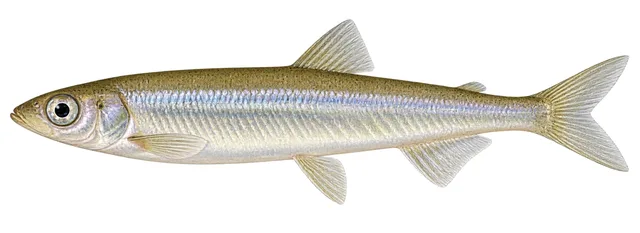
Wakasagi

Hypomesus nipponensis

Osmeridae · freshwater and saltwater and brackish water fish

5 minute read · Species guide

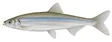
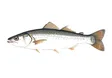
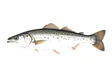
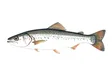
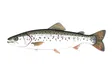
Wakasagi field guide illustration

About Wakasagi

Hypomesus nipponensis (Japanese smelt, in Japanese: wakasagi) is a commercial food fish native to the lakes and estuaries of northern Honshu and Hokkaido, Japan, Korea, and Sakhalin, Khabarovsk Krai, and Primorsky Krai, Russia. It has been introduced in other locations, including the San Francisco Delta of the United States. It is raised in fisheries, and is very similar in appearance to the delta smelt (H. transpacificus).

Genomics

A chromosome-level genome assembly of the Japanese smelt (Hypomesus nipponensis) was published in 2026. The genome size is approximately 708 Mb, with the assembly anchored to 28 chromosomes. The assembly has a BUSCO completeness of 97.3%, and 24,102 protein-coding genes were predicted.

Synonyms

Hypomesus chishimaensis was described as being a new species in the lakes of Kunashir and Iturup in 1997 based on claimed morphological differences. After later studies failed to find these morphological differences, it regarded as an ecotype of H. nipponensis. A 2007 genetic analysis supported this classification, and recommended that H. chishimaensis not be given its own binomial designation.

Introduction to the United States

Native to the lakes and estuaries of Hokkaido, Japan and introduced to the lakes on Honshu and Kyushu, the Japanese wakasagi was introduced to California water reservoirs by the California Department of Fish and Game to provide more prey for stocked rainbow trout after failed attempts to introduce native delta smelt to three foothill reservoirs. At the time, the California-native delta smelt and the Japanese smelt were thought to be separated members of the same species, H. olidus. In 1959 the CDFG imported 3.6 million fertilized eggs attached to palm fiber mats from a population in Suwa Lake, located east of Tokyo; many of these eggs were dead on arrival. The fiber mats were placed in streams feeding into six lakes and reservoirs that appeared to be ecologically suitable for the smelt. It was thought at the time that these reservoirs could be chemically treated to eradicate the fish if they were found to be undesirable. In 1972 and 1973 about 77,000 fish from the Shastina Reservoir were moved to the Almanor Reservoir in Plumas County. All attempts to introduce the fish were successful, except the Dodge and Big Bear Reservoir introductions, the latter of which may have been partially attributable to chemical treatments meant to eradicate stunted crappie and goldfish.

Progression into delta

Although a retrospective analysis of preserved delta smelt samples caught in 1972 and 1982 from the Delta region has shown that wakasagi had been invading the estuaries in undetected quantities since at least the early 1970s, wakasagi expansion from these original introduction sites southward was not tracked until several years later. In 1994 they were detected at the State Water Project pumping plant for the first time, and by 1998 the fish could be found throughout the estuary including the Suisun and San Pablo Bays.

Consequences

Because the two species are very similar in morphology and life history, the wakasagi presents several potential threats to the endangered delta smelt. Besides direct competition for nutritional resources and the possibility that wakasagi may prey on the eggs and larvae of delta smelt, hybridization could either dilute the species or cause population decline due to sterilizing effects. In fact, a few hybrids have been captured in the wild, although all of them were first generation crosses and no evidence of back-crossing has been found, which would suggest that the hybrids were not viable. Misidentification of the species is an additional concern, which could lead to inaccurate assessments critical to making policy decisions; however this problem may be mitigated if genetic markers are used for identification.

In addition to its negative effects on the delta smelt, the wakasagi significantly reduced Kokanee fisheries, but helped increase growth rates of other salmon and trout fisheries.

Article text: Wikipedia contributors, Hypomesus nipponensis (source revision). Licensed under CC BY-SA 4.0. Retrieved 2026-10-11.
Diet and feeding

The FishTraits compilation records these diet categories for this species: fish or frog eggs. These are broad categories, not a claim that every individual consumes every example in a category.

Habitat preferences

Reported habitat associations include streams and small rivers, still-water habitats.

The source records associations with open water. An association indicates reported use, rather than an exclusive requirement.

The species is classified as tolerant of a broad range of salinities. This flag does not specify a salinity range for aquarium care.

Reproduction and parental care

The compilation reports a representative maturity age of 2 years. Its maturity field summarizes mean, median, or modal estimates, usually for females; male estimates can be used when female data are unavailable. It is not a fixed age at which every fish first breeds.

Recorded spawning months are Apr, May for the source’s reporting region (CA). This is a regional calendar, not a range-wide schedule.

Size and recorded longevity

FishTraits reports a maximum total length of 17 centimetres. Some entries use an estimated asymptotic length; this value should not be treated as a certified record catch.

Recorded longevity in the compilation is 4 years. Wild observations were preferred, but captive records were accepted where wild records were unavailable, and unspecified records were assumed wild. The value is not a guaranteed wild lifespan or an aquarium life expectancy.

Spawning movements

The compilation records significant spawning-related movement. Its combined migration flag covers movements within fresh water as well as between rivers and the sea; this flag alone does not establish which migration pattern applies.

Native range

Japan (Page and Burr 1991).

Introduction history

Wakasagi were intentionally introduced in 1959 from Japan by the California Department of Fish and Game as an experimental forage fish for trout (Wales 1962; Moyle 1976b; Dill and Cordone 1997).

Ecological impacts

This species has been found to negatively impact kokanee Oncorhynchus nerka and threadfin shad Dorosoma petenense (Dill and Cordone 1997). It also is known to hybridize with the native and federally endangered delta smelt Hypomesus transpacificus. Hybridization between the two species was suspected by Courtenay et al. (1986), and was later confirmed (Dill and Cordone 1997; Trenham et al. 1998).

Range

Where it lives

Share of 44 GBIF observation records with a state location, across 1 states.
0%
100%
Share of 44 GBIF observation records with a state location, across 1 states.

Share of records by state

Habitat

Water and movement

Water
WoRMS records this species in fresh water, brackish water and the sea.
USGS NAS habitat
Freshwater
US status
Exotic — the USGS Nonindigenous Aquatic Species database lists it as introduced from outside North America.
Migration
Migratory
Pattern
  • Diadromous — moves between fresh water and the sea
  • Anadromous — spawns in fresh water, grows at sea

Classification

Taxonomy

Kingdom
Animalia
Phylum
Chordata
Superclass
Actinopterygii
Class
Teleostei
Order
Osmeriformes
Family
Osmeridae
Genus
Hypomesus
Species
Hypomesus nipponensis
ITIS TSN
162033
WoRMS AphiaID
279421
GBIF key
2410890

Common questions about Wakasagi

What is the scientific name of Wakasagi?
The scientific name is Hypomesus nipponensis, in the family Osmeridae. Classification follows ITIS.
Does Wakasagi live in fresh water or salt water?
WoRMS records this species in fresh water, brackish water and the sea.
Where has Wakasagi been recorded in the United States?
GBIF has observations in 1 states, with the most records in California. The map shows observation records, which do not establish the complete natural range.

Closest relatives

Other Hypomesus species

Same family

More Osmeridae