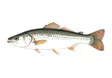
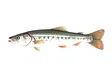
These species profiles show how members of the group differ. Their biology describes each named species, rather than every fish in the group.
The California roach (Hesperoleucus symmetricus, previously Lavinia symmetricus) is a species of freshwater ray-finned fish belonging to the family Leuciscidae, which includes the daces, chubs, Eurasian minnows and related species. This species is native to western North America and abundant in the intermittent streams throughout central California. Once considered a single species, it has recently been split into a number of closely related species and subspecies. It is closely related to the hitch, and together they form a species complex. The California roach derives its common name from its visual similarities to the roach of Europe; however, they are not closely taxonomically related.
Taxonomic subdivision and history
The California roach boasts a complicated history of taxonomic classification and reclassification. It was first described in 1854 as Pogonichthys symmetricus. Later, in 1896 Jordan and Everman grouped the California roach with the superficially similar European roach. In 1913 the California roach was reclassified and the genus Hesperoleucus was created splitting the species into 5 different species based on locality. This split was disputed in later studies in 1945 and 1948 which argued the differences between California roach populations only justified classification as subspecies, and the subspecies were reorganized. A 2019 study on the genomics of samples from the California roach/ hitch species complex was able to identify each evolutionary lineage from the genus to population level and led to the reclassification of the California roach into four species and four subspecies.
A complete taxonomic breakdown of the California roach/hitch species complex
Description and physical traits
These fishes have a small, stout body shape with a large conical head and large eyes, but a small slightly subterminal or inferior mouth. Some individuals exhibit a "chisel lip", which is a cartilaginous plate on the lower jaw. Most adults do not reach 100 mm (3.9 in) in total length but some have been observed as long as 150 mm (5.9 in). Additionally, their caudal tails are characteristically deeply forked and connect to the body with narrow peduncles. They sport a darkly colored upper half of their bodies with shades ranging from dark gray to steely blue, and a dull silver or white underside. Their scales are small and can range from 47 to 62 total scales along the lateral line. They have short dorsal and anal fins with 8–10 and 7–9 rays respectively. The dorsal fin is positioned behind the pelvic fins. Some individuals are occasionally observed with more fin rays, however these are most often hybrids with Hitch or Chub species. The different species and subspecies of the California roach species complex can be easily confused for each other. The prevalence of certain features, such as the chisel lip, are more common or pronounced in some species over others, but are difficult to differentiate with certainty. Ultimately the most accurate way to differentiate these species is genetically, or with the knowledge of which watershed they are from. During the breeding season, red-orange patches appear on the chin, operculum, and at the bases of pectoral, pelvic, and anal fins.
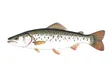
The steeply forked tail, narrow peduncle, large conical head, slightly subterminal mouth, and placement of the dorsal fin behind the pelvic fins shown in this image are the most characteristic universal features of the California roach. Additionally this individual exhibits the orange patches on its chin, operculum, and base of its pectoral, pelvic, and anal fins that indicate this sample was photographed during its breeding season.
Diet
California roaches are omnivores and mainly bottom feeders. Filamentous algae are the main part of their diet, followed by aquatic insects and crustaceans which make up 25–30% of their diet. Crustaceans and chironomid (non-biting) midge larvae are especially important aspects of the diet of smaller roach. Larger individuals eat insects roughly in proportion to their abundance. Because California roach primarily feed from the silty bottoms of streams their stomachs fill with detritus and debris. Some lab experiments suggest this detritus is retained by mucus secreted from epithelial cells and gill rakers suggesting it may have nutritional value. They are eaten by other fish, in particular green sunfish and pikeminnows being among their most common predators.
 Read the full species guide.
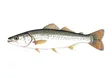
The common rudd (Scardinius erythrophthalmus) is a bentho - pelagic freshwater ray-finned fish belonging to the family Leuciscidae. This species is widely spread in Europe and central Asia, around the basins of the North, Baltic, Black, Caspian and Aral seas.
Identification
Morphologically, this species is very similar to the roach (Rutilus rutilus), with which it can be easily confused. It can be identified by the yellow eye colour. The eye of the roach has a big red spot above the pupil, that can be more or less conspicuous. The rudd has an upturned mouth allowing it to feed easily at the top of the water. The placement of the dorsal fin is more to the rear which is even visible in very young fish. There are normally only one or two scales between the tip of the pelvic fins and the anal fins, while on the roach there are five. Also the skin of the rudd is yellowish green, while the roach is bluish on the flanks. Also the upturned mouth is visible even in young fish. Furthermore, the rudd's number of soft rays in the dorsal fin (8–9 compared to 10–12). There can be confusion with the ide also, which has smaller scales however.
There is a variety of the common rudd, popular among pond -keepers, known as the golden rudd, which has a gold-coloured body.
Invasive species and artificial introduction
It has been artificially introduced to Ireland, United States, Morocco, Madagascar, Norway, Tunisia, New Zealand, Canada, and Spain.
Rudd have been found in the US states of Alabama, Arkansas, Colorado, Connecticut, Georgia, Illinois, Indiana, Kansas, Massachusetts, Maine, Missouri, Nebraska, New Jersey, New York, Oklahoma, Pennsylvania, South Dakota, Texas, Vermont, Virginia, West Virginia, and Wisconsin. This list may not include all states containing an introduced population of rudd.
Possession of rudd in the US
Rudd were reported in the United States at least as early as 1925. It is unlawful to possess or transport live specimens in the US state of Tennessee. No person, firm, corporation, partnership nor association shall possess, sell, offer for sale, import, bring, release or cause to be brought or imported into the State of Alabama any species of fish "rudd"(Scardinius erythrophthalmus) or"roach" (Rutilus rutilus) nor any hybrids of either species. This species was reported in Alabama from First Creek in Lauderdale County c. 1987.
 Read the full species guide.
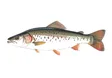
Hesperoleucus mitrulus, the northern roach or pit roach, is a species of freshwater ray-finned fish belonging to the family Leuciscidae, which includes the daces, chubs, Eurasian minnows and related species. This species is found in the Western United States in California and Oregon.
Taxonomy
Hesperoleucus mitrulus was first formally described in 1913 by the American ichthyologist John Otterbein Snyder with its type locality given as Drew Creek, Drews Valley in Lake County, Oregon. This taxon was previously considered to be a synonym of the California roach (H. symmetricus) but in 2019 it was shown to be a valid species. Thie genus Hesperoleucus is classified within the subfamily Laviniinae, the Western chubs, within the family Leuciscidae.
Etymology
Hesperoleucus mitrulus is classified within the genus Hesperoleucus, this name combines the Latin word Hesperus, which means "western", and leucos, which is thought to be a shortening of Myloleucus, a synonym of Gila. This name reflects that the species in this genus are found in Western North America and their similarity to Gila. The specific name is an unnecessary masculization of mitrula, which means "turban". Snyder did not explain why this epithet was chosen but it may be an allusion to the convex shape of the scales, which could be said to resemble a turban.
Description
Hesperoleucus mitrulus are small fishes in which the adults have a typical total length of 5 to 10 cm (2.0 to 3.9 in). Like the California roach, the Pit roach has a bronzy body color and has a robust body with a deep caudal peduncle and a rounded snout. It can be told apart from the California roach by its short rounded fins and the convex scales. They have 7 dorsal fin rays and 8 anal fin rays and the pectoral fins of the males are relatively longer than those of the females.
 Read the full species guide.