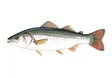
Common names

Types of mullet

6 species carry mullet in an English common name. They sit in 2 families, so the group is a name, not a scientific rank.

About mullet

The mullets or grey mullets are a family (Mugilidae) of ray-finned fish found worldwide in coastal temperate and tropical waters, and some species in fresh water. Mullets have served as an important source of food in Mediterranean Europe since Roman times. In ancient Egypt, people ate pickled and dried mullet called fesikh. The family includes about 78 species in 26 genera.

Mullets are distinguished by the presence of two separate dorsal fins, small, triangular mouths, and the absence of a lateral line organ. They feed on detritus, and most species have unusually muscular stomachs and a complex pharynx to help in digestion.

Classification and naming

Taxonomically, the family is placed in the order Mugiliformes, which is named after it. Until recently, it was considered the only member of Mugiliformes, but more recent taxonomic treatments suggest that they are closely related to the Asiatic glassfishes (Ambassidae), which are now also placed in the group. The presence of fin spines clearly indicates membership in the superorder Acanthopterygii, and in the 1960s, they were classed as primitive perciforms, while others have grouped them in Atheriniformes.

In North America, "mullet"by itself usually refers to the Mugilidae. In Europe, the word"mullet"is usually qualified, the"grey mullets"being Mugilidae and the"red mullets"or"surmullets"being Mullidae, notably members of the genus Mullus. Outside Europe, the Mullidae are often called"goatfish". Fish with common names including the word "mullet" may be a member of one family or the other, or even unrelated, such as the freshwater Catostomus commersonii.

However, recent taxonomic work has reorganised the family and the following genera make up the Mugilidae:

The oldest known fossil mullet is † Mugil princeps from the latest Oligocene -aged Aix-en-Provence Formation of France.

Behaviour

A common noticeable behaviour in mullet is the tendency to leap out of the water. Two types of leaps are distinguishable - a straight, clean slice out of the water to escape predators and a slower, lower jump while turning to its side that results in a larger, more distinguishable splash. The reasons for this lower jump are disputed, but are thought to be to gain oxygen-rich air for gas exchange in a small organ above the pharynx.

Development

The ontogeny of mugilid larvae has been well studied, with the larval development of Mugil cephalus in particular being studied intensively due to its wide range of distribution and interest to aquaculture. The previously understudied osteological development of M. cephalus was investigated in a 2021 study, with four embryonic and six larval developmental steps being described in aquaculture-reared and wild-caught specimens. These descriptions provided clarification of questionable characters of adult mullets and revealed informative details with potential implications for phylogenetic hypotheses, as well as providing an overdue basis of comparison for aquaculture-reared mullets to enable recognition of malformations.

History

Mullet have historical significance globally, with record of consumption in ancient Rome and Egypt. Indigenous communities in Florida, Hawaii, and North Carolina also fished and consumed the fish from as far back as the 15th century. Early American commercial fishers in the 19th century dismissed mullet as a "trash fish"due to its low market value, and the fish fell out of fashion. In the 1960s, Florida state officials attempted to revive mullet through a marketing campaign to rename mullet as"lisa".
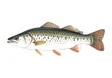
Mullet species in focus

These species profiles show how members of the group differ. Their biology describes each named species, rather than every fish in the group.

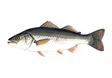
Blotched Snakehead

The blotched snakehead (Channa maculata) is a species of snakehead. It is one of four species of the genus Channa native to China. It is also native to northern Vietnam and Taiwan, but has been widely introduced to other countries, where it is an invasive species. This predatory species typically grows to a length of 20–30 cm (7.9–11.8 in), but it has been confirmed at 33 cm (13 in) and some suggest it may reach a far larger size.

Read the full species guide.

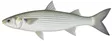
Black Mullet

The striped mullet (Mugil cephalus) is an important food fish species in the mullet family Mugilidae. It is found in coastal temperate, subtropical, and tropical waters worldwide. Its length is typically 30 to 75 centimetres (12 to 30 in). It is known with numerous English names, including the flathead mullet, flathead grey mullet, striped mullet, black mullet, bully mullet, common mullet, grey mullet, sea mullet, and mullet.

The striped mullet is a mainly diurnal coastal species that often enters estuaries and rivers. It usually schools over sand or mud bottoms, feeding on zooplankton, dead plant matter, microalgae, and detritus. The adult fish normally feed on algae in fresh water. The species is euryhaline, meaning they can acclimate to different levels of salinity.

Etymology

The generic name Mugil is from Latin: mūgil: "mullet". The specific name cephalus is from Ancient Greek: κέφαλος képhalos: "mullet". Thus, the binomial term Mugil cephalus literally means "Mullet mullet".

Description

The back of the fish is olive-green; the sides are silvery and shade to white towards the belly. The fish may have six or seven distinctive, lateral, horizontal stripes. Lips are thin. The mullet has no lateral line. A common length is about 50 cm (20 in) and its maximum length is 100 cm (39 in). It can reach a maximum weight of 8 kg (18 lb).

Distribution

The striped mullet is cosmopolitan in coastal waters of the tropical, subtropical, and temperate zones of all seas, as far north as the Bay of Biscay and Nova Scotia in the Atlantic Ocean. It occupies fresh, brackish and marine habitats in depths ranging from 0–120 metres (0–394 ft) and with temperatures between 8 and 24 °C (46 and 75 °F).

In Australia, this fish is widespread, from Far North Queensland, around southern Australia to the Kimberley region of Western Australia. It also occurs in the Bass Strait area of Tasmania. It lives in tropical and temperate, coastal marine and estuarine waters, but are also often found in the lower reaches of rivers. It is able to live in a wide range of salinity, so may also be found in lagoons, lakes, and far into estuaries, but migrate back to the sea to spawn.

Read the full species guide.

Silver Mullet

The white mullet or silver mullet (Mugil curema) is a tropical and subtropical marine fish of the family Mugilidae. It is commonly about 30 cm (12 in) long.

Note that silver mullet is also a common name used for fantail mullet (Mugil trichodon).

Distribution and habitat

The white mullet is an Atlantic and Pacific fish mainly found on American coasts. In the Western Atlantic it ranges from Argentina to Cape Cod and, rarely, even up to Nova Scotia. In the Eastern Atlantic it occurs from Namibia to Senegal, and in the Eastern Pacific from Chile to the Gulf of California.

The white mullet is found along sandy coasts and in littoral pools, but also occurs in brackish lagoons and estuaries on muddy substrates and sometimes even in rivers. Juveniles in particular invade estuaries and coastal lagoons. Adults occur in schools.

Atlantic USA

In the US, owing to their small size (less than 12 in (300 mm)), white mullets are primarily used for bait. In some parts of Florida and southern Alabama, they are occasionally eaten in the place of the much larger striped mullet (or flathead mullet) (Mugil cephalus). Adult white and striped mullet consume the mud found on the bottom of estuarine waters, digesting the algae, plankton, and plant and animal detritus therein. These mullets are unique in having a muscular gizzard. They are an important part of the ecologies of estuarine and coastal waters of the Gulf and Atlantic coasts of America.

Read the full species guide.

Range

Where mullet live

How many of the 6 species are recorded in each state.
0
5
How many of the 6 species are recorded in each state.

Taxonomy

Families in this group

Species

All 6 mullet species