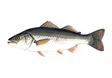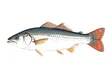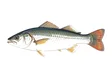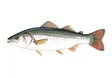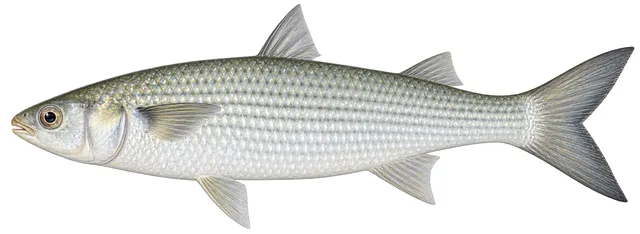
Note that silver mullet is also a common name used for fantail mullet (Mugil trichodon).
Distribution and habitat
The white mullet is an Atlantic and Pacific fish mainly found on American coasts. In the Western Atlantic it ranges from Argentina to Cape Cod and, rarely, even up to Nova Scotia. In the Eastern Atlantic it occurs from Namibia to Senegal, and in the Eastern Pacific from Chile to the Gulf of California.
The white mullet is found along sandy coasts and in littoral pools, but also occurs in brackish lagoons and estuaries on muddy substrates and sometimes even in rivers. Juveniles in particular invade estuaries and coastal lagoons. Adults occur in schools.
Atlantic USA
In the US, owing to their small size (less than 12 in (300 mm)), white mullets are primarily used for bait. In some parts of Florida and southern Alabama, they are occasionally eaten in the place of the much larger striped mullet (or flathead mullet) (Mugil cephalus). Adult white and striped mullet consume the mud found on the bottom of estuarine waters, digesting the algae, plankton, and plant and animal detritus therein. These mullets are unique in having a muscular gizzard. They are an important part of the ecologies of estuarine and coastal waters of the Gulf and Atlantic coasts of America.
Additional field notes
Silver mullet is also called white mullet. Its familiar coastal silhouette includes a sturdy body, a small mouth, and two short dorsal fins separated by a wide gap.
Sources: Mugil curema species account
Field identification notes
The back is olive to blue, the flanks silvery, and the underside pale. A dark patch covers the upper part of the pectoral-fin base, while a golden patch may be visible on the gill cover. A transparent fatty eyelid covers much of the eye. These details are more useful than silver color alone.
Sources: Mugil curema species account
Habitat and range notes
The Smithsonian account places this mullet in mangrove estuaries, brackish lagoons, and clear near-surface water. It specifically distinguishes adults from freshwater occurrences. Its broad geographic treatment includes tropical shores on both sides of the Americas and western Africa.
Sources: Mugil curema species account
Feeding and life-history notes
Its recorded foods include detritus, microscopic algae, plankton, and small bottom animals. Genetic work summarized by the account recognizes several lineages within the name Mugil curema. A wide published range under that name should not be taken to mean that every population is genetically identical.
Sources: Mugil curema species account
Guide sources
Research reviewed 2026-10-17.
- Mugil curema species account — Smithsonian Tropical Research Institute
Article text: Wikipedia contributors, Mugil curema (source revision). Licensed under CC BY-SA 4.0. Retrieved 2026-10-11.