Common names

Types of jobfish

5 species carry jobfish in an English common name. They sit in 1 family, so the group is a name, not a scientific rank.

About jobfish

The green jobfish (Aprion virescens), also known as the gray jobfish, gray snapper, or slender snapper, and in Hawaiian as uku, is a species of marine ray-finned fish, a snapper belonging to the family Lutjanidae. It is found in the Indo-Pacific region. This species inhabits various reef environments at depths from near the surface to 120 metres (390 ft). It is a very important species for local commercial fisheries and is popular as a game fish, though it has been reported to cause ciguatera poisoning. This species is the only known member of its genus.

Description

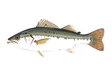
The green jobfish is a robust fish with has an elongate body which is cylindrical in cross-section. The head is also elongate with a blunt snout, with an obvious longitudinal groove running from the snout to the eye and it has a deeply forked caudal fin. The teeth in the jaws are arranged in bands with 2 distinct canines at the front. The vomerine teeth are set out in a crescent shaped patch. The dorsal fin contains 10 spines and 11 soft rays while the anal fin has 3 spines and 8 soft rays. The overall colour of the body is dark green to bluish, fading towards the abdomen. The spiny part of the dorsal fin has black spots at the base of the five rearmost spines. This species attains a maximum total length of 112 cm (44 in), although 90 cm (35 in) is more typical, and a maximum published weight of 15.4 kg (34 lb).

Distribution

The green jobfish has a wide Indo-Pacific distribution. It extends from the Red Sea and the eastern coast of Africa as far south as northeastern South Africa and across the Indian Ocean into the Pacific Ocean where it is found north to southern Japan, south to Australia and Rapa Iti and east to Hawaii. In Australia it occurs from Australian waters from northwestern Australia the Ningaloo Reef to Rowley Shoals, Scott Reef and Ashmore and Cartier Islands in the Timor Sea and from the northern Great Barrier Reef of Queensland south to Wooli in New South Wales. It is also found at Lord Howe Island, Middleton Reef, Christmas Island and Cocos (Keeling) Island.

Habitat and biology

The green jobfish is a benthopelagic fish of open waters of deep lagoons, channels, or seaward reefs at depths from the surface down to 120 m (390 ft). It is typically encountered singly but they may aggregate into small schools. It diet is dominated by fishes but it is also known to feed on crustaceans, cephalopods and zooplankton. This species has been observed to spawn in May to October off Hawaii and it is known that they are multiple spawners. They reach sexual maturity at 4.5 years, when the females are around 40 cm (16 in) in length.

Taxonomy

The green jobfish was first formally described in 1830 by the French zoologist Achille Valenciennes with the type locality given as the Seychelles. It is the only species in the genus Aprion. The generic name Aprion is a compound of a meaning "without"and prion meaning" saw", a reference to the unserrated preoperculum. The specific name virescens means "greenish" referring to the overall colour of the body.

Fisheries

The green jobfish is considered to have good quality flesh and is an important part of some subsistence fisheries. It is commonly sold fresh in many fish markets, but also preserved by drying and salting. In Hawaii it is one of the four most important species of snapper for fisheries, one of the prime quarry fish for the handlines bottom fishery and it is managed as part of the bottom fish management unit. It is one of the most important quarry species throughout its range and in 2010 the catch was 2,350 t (2,310 long tons; 2,590 short tons). Larger individuals can be dangerous to eat because they are known to be a cause of ciguatera poisoning in humans. it is also a popular quarry in sports fishing and is sometimes found in the aquarium trade.
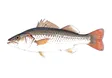
Jobfish species in focus

These species profiles show how members of the group differ. Their biology describes each named species, rather than every fish in the group.

Rosy Snapper

Pristipomoides filamentosus, also known as the crimson jobfish, rosy snapper, bluespot jobfish, crimson snapper, king emperor, king snapper or rosy jobfish, is a species of ray-finned fish, a snapper belonging to the family Lutjanidae. It is found in the Indian Ocean and in the Pacific Ocean as far east as Hawaii and Tahiti. This species is very important to local commercial fisheries and is sought out as a game fish --one of the Deep Seven species of Hawaiʻi.

Taxonomy

Pristipomoides filamentosus was first formally described as Serranus filamentosus in 1830 by the French zoologist Achille Valenciennes with the type locality given as Saint-Denis on Réunion. The specific name filamentosus means "filamentous" and refers to the filament-like last soft rays in the dorsal and anal fins.

Description

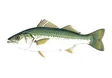
Pristipomoides filamentosus has an elongated, robust body with a depth of roughly a third of its standard length. The space between the eyes is flat, and has a slightly protruding lower jaw. In both upper and lower jaws, there is an outer row of conical and canine-like teeth, the front pair of canines is not highly enlarged, and an inner band of bristle-like teeth. The vomerine teeth are arranged in a triangular patch, and there are no teeth on the tongue. The dorsal fin has ten spines and 12 soft rays, while the anal fin contains three spines and eight soft rays. The bases of the dorsal and anal fins lack scales, and the last soft ray of each of these fins is extended into a short filament. The pectoral fin extend long as far as the anus and contain 15 or 16 rays. The caudal fin is forked. This species has an overall colour which may be brownish to pinkish, lavender or reddish-purple marked with slender yellow lines and blue spots on its snout and the flat space between its eyes. The dorsal and caudal fins are pale blue to lavender and have reddish-orange margins. This species attains a maximum total length of 100 cm (39 in), although 50 cm (20 in) is more typical, and a maximum published weight of 8.2 kg (18 lb).

Distribution and habitat

Pristipomoides filamentosus has a wide Indo-Pacific distribution. It occurs along the eastern African coast from the Gulf of Suez and Gulf of Aqaba in the northern Red Sea to South Africa and across the Indian Ocean archipelagos and coasts into the Pacific, where its range extends east as far as Hawaii and Tahiti, north to Japan and south to Australia. In Australia it is found from Leeman, Western Australia, northwards into the Timor Sea off Darwin, Northern Territory, and east to the Great Barrier Reef off Queensland south at least as far as Seal Rocks, New South Wales, although larvae have been recorded as far south as Sydney. It also occurs at Lord Howe Island in the Tasman Sea. It is a benthopelagic species which is found at depths between 40 and 360 m (130 and 1,180 ft) over rocky substrates and rocky reefs.

Read the full species guide.

Goldflag Snapper

Pristipomoides auricilla, the goldflag jobfish or the yellow flower snapper, is a species of ray-finned fish, a snapper belonging to the family Lutjanidae. It is found in the Indo-Pacific region.

Taxonomy

Pristipomoides auricilla Was first formally described in 1927 by David Starr Jordan, Barton Warren Evermann and Shigeho Tanaka with the type locality given as Honolulu. The specific name auricilla means "gold tail", a reference to the yellow upper caudal fin lobe.

Description

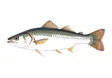
Pristipomoides auricilla has an elongated but robust body. The space between the eyes is flattened, the jaws are roughly equal in length, although sometimes the lower protrudes slightly. There is an outer row of conical and canine teeth and an inner band of bristle-like teeth on each jaw. There is a triangular patch of vomerine teeth but there are no teeth on tongue. The caudal fin is forked. The dorsal fin contains 10 spines and 11 soft rays while the anal fin has 3 spines and 8 soft rays, the final ray on each of these fins is extended into a filament. The long pectoral fins extend as far as the anus. The overall colour of the body is purple to brownish purple marked with many yellow spots and in distinct yellow chevrons. The upper lobe of the caudal fin is yellow and the dorsal fin is yellowish. This fish attains a maximum total length of 45 cm (18 in), although 25 cm (9.8 in) is more typical.

Distribution

Pristipomoides auricilla Has a wide Indo-Pacific distribution which extends from the Comoros Islands in the east to Hawaii, south to Australia and New Caledonia and north to Japan.

Read the full species guide.

Green Jobfish

The green jobfish (Aprion virescens), also known as the gray jobfish, gray snapper, or slender snapper, and in Hawaiian as uku, is a species of marine ray-finned fish, a snapper belonging to the family Lutjanidae. It is found in the Indo-Pacific region. This species inhabits various reef environments at depths from near the surface to 120 metres (390 ft). It is a very important species for local commercial fisheries and is popular as a game fish, though it has been reported to cause ciguatera poisoning. This species is the only known member of its genus.

Description

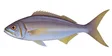
The green jobfish is a robust fish with has an elongate body which is cylindrical in cross-section. The head is also elongate with a blunt snout, with an obvious longitudinal groove running from the snout to the eye and it has a deeply forked caudal fin. The teeth in the jaws are arranged in bands with 2 distinct canines at the front. The vomerine teeth are set out in a crescent shaped patch. The dorsal fin contains 10 spines and 11 soft rays while the anal fin has 3 spines and 8 soft rays. The overall colour of the body is dark green to bluish, fading towards the abdomen. The spiny part of the dorsal fin has black spots at the base of the five rearmost spines. This species attains a maximum total length of 112 cm (44 in), although 90 cm (35 in) is more typical, and a maximum published weight of 15.4 kg (34 lb).

Distribution

The green jobfish has a wide Indo-Pacific distribution. It extends from the Red Sea and the eastern coast of Africa as far south as northeastern South Africa and across the Indian Ocean into the Pacific Ocean where it is found north to southern Japan, south to Australia and Rapa Iti and east to Hawaii. In Australia it occurs from Australian waters from northwestern Australia the Ningaloo Reef to Rowley Shoals, Scott Reef and Ashmore and Cartier Islands in the Timor Sea and from the northern Great Barrier Reef of Queensland south to Wooli in New South Wales. It is also found at Lord Howe Island, Middleton Reef, Christmas Island and Cocos (Keeling) Island.

Habitat and biology

The green jobfish is a benthopelagic fish of open waters of deep lagoons, channels, or seaward reefs at depths from the surface down to 120 m (390 ft). It is typically encountered singly but they may aggregate into small schools. It diet is dominated by fishes but it is also known to feed on crustaceans, cephalopods and zooplankton. This species has been observed to spawn in May to October off Hawaii and it is known that they are multiple spawners. They reach sexual maturity at 4.5 years, when the females are around 40 cm (16 in) in length.

Read the full species guide.

Range

Where jobfish live

How many of the 5 species are recorded in each state.
0
4
How many of the 5 species are recorded in each state.

Species

All 5 jobfish species