Yellow Bass

Morone mississippiensis

Moronidae · freshwater water fish

4 minute read · Species guide

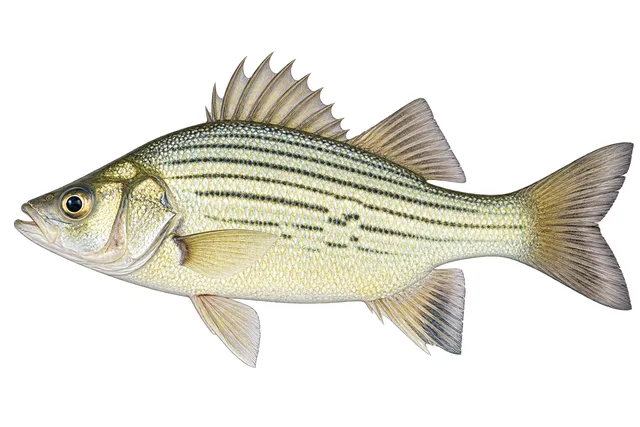
Yellow Bass field guide illustration

About Yellow Bass

The yellow bass (Morone mississippiensis) is a freshwater ray-finned fish of the family Moronidae (temperate bass) native to the Mississippi River catchment of North America.

Description

The yellow bass is a deep bodied fish that possesses five to seven dark stripes laterally along the sides, the lowest few of these are often broken or disrupted anterior to the origin of the anal fin. It is somewhat similar to two other sister species in the genus Morone, the white bass and the striped bass, and is distinguishable from both of these species by having the offset lateral stripes above the anal fin, and from not possessing tooth patches on the tongue. The yellow bass differs further from the white bass by having nine to ten anal rays in comparison to eleven or thirteen. The back of the fish is usually a dark olive green, and the abdomen and sides are often a silvery yellow.

Distribution

The yellow bass may be found in somewhat clear waters of the Mississippi River from Minnesota to Louisiana and may also be found in the Trinity River and the Tennessee River. It can also be found in lakes surrounding these rivers, especially in areas with dense vegetation and low turbidity, and may migrate into brackish estuaries.

Diet

Food exploited by juvenile yellow bass include small aquatic invertebrates such as copepods and aquatic insects. The juvenile yellow bass feed almost exclusively on aquatic invertebrates, and once they reach adulthood they feed primarily on other small fishes; the rest of their diet consists of small crustaceans.

Reproduction and life cycle

The reproductive biology of the yellow bass is similar to that of the white bass, where spawning occurs during the spring with fish swimming into the tributaries to make spawning runs. Spawning usually occurs in moderately shallow waters during which the female lies on her side and exposes the eggs as the male fertilizes from above. The larvae of the yellow bass school together to avoid predation and they grow fairly quickly in size. Yellow bass have average lifespan of about six years.

Relationship to humans

Because of its smaller size, the yellow bass is not as popular a game fish as either the white bass or the striped bass. It is usually caught by anglers fishing with crappie jigs or minnows, and may also be caught in large numbers because of the abundant populations. It is edible and is commonly taken as a food fish in its range.

The International Game Fish Association (IGFA) world record yellow bass, caught in the Morse Reservoir in Indiana in 2023, weighed 1.96 kg (4 lb 5 oz), beating a 2000 record from the same lake of 1.34 kg (2.95 lb). The IGFA record for a hybrid yellow bass (crossed with a white bass) stands at 1.81 kg (4 lb 0 oz), caught from Lake Fork Reservoir, Texas in 2023.

Etymology

The specific name, mississippiensis, comes from the Mississippi River.

Article text: Wikipedia contributors, Yellow bass (source revision). Licensed under CC BY-SA 4.0. Retrieved 2026-10-11.
Diet and feeding

The FishTraits compilation records these diet categories for this species: invertebrates or larval fish; larger animal prey (a source category covering fish, crayfish, crabs, or frogs). These are broad categories, not a claim that every individual consumes every example in a category.

Reported feeding positions include surface or water-column feeding. The compilation combines published observations; diets can vary with age, locality, and available food.

Habitat preferences

Reported habitat associations include medium to large rivers, still-water habitats.

The source records associations with gravel, cobble, bedrock, open water. An association indicates reported use, rather than an exclusive requirement.

Reproduction and parental care

The compilation reports a representative maturity age of 3 years. Its maturity field summarizes mean, median, or modal estimates, usually for females; male estimates can be used when female data are unavailable. It is not a fixed age at which every fish first breeds.

Recorded spawning months are Apr, May for the source’s reporting region (MS). This is a regional calendar, not a range-wide schedule.

The reproductive-guild classification includes spawning on open substrates without guarding the brood.

Size and recorded longevity

FishTraits reports a maximum total length of 46 centimetres. Some entries use an estimated asymptotic length; this value should not be treated as a certified record catch.

Recorded longevity in the compilation is 6 years. Wild observations were preferred, but captive records were accepted where wild records were unavailable, and unspecified records were assumed wild. The value is not a guaranteed wild lifespan or an aquarium life expectancy.

Native range

Lake Michigan and Mississippi River basins from Wisconsin and Minnesota south to Gulf; east to western Indiana and eastern Tennessee, and west to western Iowa and eastern Oklahoma. On Gulf Slope in lower Mobile Bay drainage, Alabama, and from Pearl River drainage, Louisiana, to Galveston Bay drainage, Texas (Page and Burr 1991).

Introduction history

Yellow Bass are intentionally stocked for sportfishing. They have gained access to the upper Tombigbee River through the Tennessee-Tombigbee Waterway (Boschung 1992). A recent collection from Browning Oxbow, Kansas, may be a result of migration from stocked Lake Icaria, Iowa (Mosher, personal communication). Dallmier (2005) suggested that presence in Queen City Lake was the result of an illegal stocking by anglers.

Ecological impacts

When stocked in the native range of the white bass M. chrysops these two species hybridize (Fries and Harvey 1989).

Record fish

State records in 4 states

  • Wisconsin2 lbs. 13.8 oz.

    Lake Mendota · Dane · 04/22/2025

  • Alabama2 lb 8 oz

    Guntersville Reservoir, Jackson Co. · 4/12/2000 · Dennis M. Woebbeking, Pisgah

  • Arkansas2 lbs., 4 oz.

    Lake Ouachita · 01/26/2022 · Craig Viscardis, Hot Springs, AR · rod and reel

  • Minnesota1 lb 3 oz

    Clear Lake · Jackson · 5/11/2024 · Dennis Dagel, Lakefield

Each figure is the state agency’s own certified record. The site holds record tables for 11 states so far, so a state missing here has not been read yet. It is not a state where this fish holds no record.

Range

Where it lives

Share of 5,936 GBIF observation records with a state location, across 19 states. The orange dots are USGS stream-survey sites where this species was caught.
0%
58.6%
Share of 5,936 GBIF observation records with a state location, across 19 states. The orange dots are USGS stream-survey sites where this species was caught.

A blank area on the dot layer usually means nobody sampled there, not that the fish is absent. Turn on “every survey site” to see where the survey looked.

The USGS stream survey caught it at 46 of its sites, in 13 states. That survey and the GBIF records are two different counts of two different things, so the site keeps them apart.

Habitat

Water and movement

Water
WoRMS records this species in fresh water.
USGS NAS habitat
Freshwater
US status
Native transplant — native to part of the United States, moved to other waters inside it.
Migration
Migratory
Pattern

Classification

Taxonomy

Kingdom
Animalia
Phylum
Chordata
Superclass
Actinopterygii
Class
Teleostei
Order
Perciformes
Family
Moronidae
Genus
Morone
Species
Morone mississippiensis
ITIS TSN
167683
WoRMS AphiaID
422561
GBIF key
2394610
Outside the US
ITIS also files it in Canada.

Common questions about Yellow Bass

What is the scientific name of Yellow Bass?
The scientific name is Morone mississippiensis, in the family Moronidae. Classification follows ITIS.
Does Yellow Bass live in fresh water or salt water?
WoRMS records this species in fresh water.
Where has Yellow Bass been recorded in the United States?
GBIF has observations in 19 states, with the most records in Texas, Michigan, Illinois. The map shows observation records, which do not establish the complete natural range.

Closest relatives

Other Morone species

Same family

More Moronidae