White Bass

Morone chrysops

Moronidae · freshwater water fish

7 minute read · Species guide

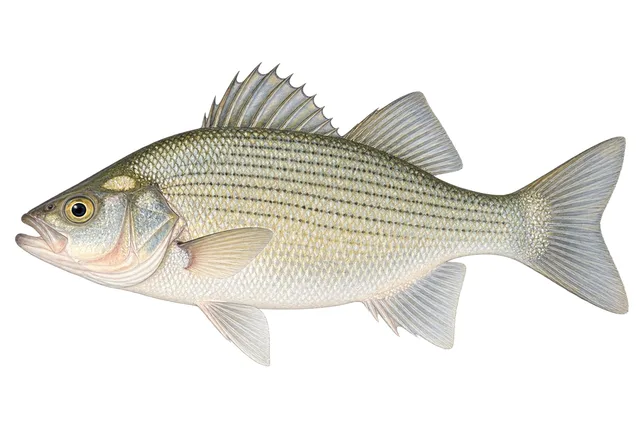
White Bass field guide illustration

About White Bass

The white bass, silver bass, or sand bass (Morone chrysops) is a freshwater fish of the temperate bass family Moronidae, and is commonly around 12–15 inches long. The species' main color is silver-white to pale green. Its back is dark, with white sides and belly, and with narrow dark stripes running lengthwise on its sides. It has large, rough scales and two dorsal fins. They are widely distributed across North America, inhabiting large reservoirs and rivers. When mating in the spring, they are more often found in shallow rivers, creeks, and streams. They have been introduced in some places as sport fish and also to predate on nuisance fish, such as gizzard shad. It is the state fish of Oklahoma.

Range

White bass are distributed widely across the United States, especially in the Midwest. They are very abundant in Pennsylvania and the area around Lake Erie. Some native ranges of the white bass are the Arkansas River, western Lake Erie, the Detroit River, and Lake Poinsett in South Dakota; they are abundant in the Winnebago lakes system of Wisconsin; and they are also very abundant in Oklahoma. White bass have also been found in rivers that flow to the Mississippi. Native to many northern habitats, they have been introduced in many different waters around the United States, particularly in southern locations. They were also successfully introduced to Manitoba starting in the 1960s, where they have gained importance as a sport fish.

Description

The species' main color is silver-white to pale green. Its back is dark, with white sides and belly, and with narrow dark stripes running lengthwise on its sides. It has large, rough scales and two dorsal fins. The more anterior dorsal fin is much harder and appears to have spines on it. Although these are not true spines, this type of fin is called a spinous ray. The more posterior of the two dorsal fins is much softer, and is thus called a soft-ray. White bass can be distinguished from white perch (Morone americana) by having separated anterior and posterior dorsal fins; the spinous-ray and soft-ray portions of the dorsal fin of white perch are united and both are erected together when the spinous portion is extended. Because the vertebrae do not extend into the tail, the white bass has what is called a homocercal tail. The body is deep and compressed laterally. Most grow to a length between 10 and 12 inches (25 and 30 cm), though they can reach 17 inches (43 cm) or more. Because the dorsal and ventral portions of its tail angle inward toward a point to create a clear angle, the tail is said to be notched.

The record size for white bass caught on fishing tackle, per The International Game Fish Association, is 3.09 kilograms (6 lb 13 oz) shared by fish caught in 1989 in Orange Lake, Orange, Virginia, and in 2010 in Amite River, Louisiana.

Diet

White bass are carnivores. They have four main taxa in their diet: calanoid copepods, cyclopoid copepods, daphnia, and leptodora. They are visual feeders. When not frightened, they will bite readily at live bait such as worms and minnows. Only the largest fish will feed on other fish, and as the summer season progresses, there is an overall trend towards eating fewer fish. Fish that are able to accumulate lipids over the summer are better able to survive cold winters. When looking at midwestern white bass, particularly in South Dakota, diet overlap occurs between the bass and the walleye. As seasons progress through the summer and fall, the amount of diet overlap decreases as a result of both fish increasing in length.

Habitat

White bass are found in high densities in the upstream segment of rivers. This portion of the river becomes the most degraded, as a number of different kinds of fish live in this segment, as well.

Reproduction

The spawning season for the white bass is mid-March to late May. The optimal water temperatures are 12 to 20 °C (54 to 68 °F). They are known to find their home spawning ground even if it is moved to a different part of the same lake. They often spawn in moving water in a tributary stream, but they will spawn in windswept lake shores. They spawn during daylight. Females release 242,000 to 933,000 eggs which stick to the surface of objects. Eggs are laid in clear, relatively shallow water on plants, submerged logs, gravel, or rocks. The parents move to deeper water and do not care for the young fish. The young fish live in shallow water for a while until they move to deeper water.

When trying to find a female with whom to mate, males will bump against a female's abdominal area. The female will then rise closer to the surface and begin spinning and releasing eggs. Several males that have stayed in the area will be able to fertilize the eggs the female releases.

Hybrids with other bass

White bass have also been hybridized with striped bass (Morone saxatilis) to produce hybrid striped bass also known as wiper, whiterock bass, sunshine bass, palmetto bass, and Cherokee bass. These hybrids have been stocked in many freshwater areas across the US. White bass have one tooth patch on the back of their tongue, unlike hybrid striped bass and striped bass, which both have two patches there.

Article text: Wikipedia contributors, White bass (source revision). Licensed under CC BY-SA 4.0. Retrieved 2026-10-11.
Diet and feeding

The FishTraits compilation records these diet categories for this species: invertebrates or larval fish; larger animal prey (a source category covering fish, crayfish, crabs, or frogs). These are broad categories, not a claim that every individual consumes every example in a category.

Reported feeding positions include surface or water-column feeding. The compilation combines published observations; diets can vary with age, locality, and available food.

Habitat preferences

Reported habitat associations include medium to large rivers, still-water habitats.

The source records associations with gravel, cobble, bedrock, open water. An association indicates reported use, rather than an exclusive requirement.

Reproduction and parental care

The compilation reports a representative maturity age of 2 years. Its maturity field summarizes mean, median, or modal estimates, usually for females; male estimates can be used when female data are unavailable. It is not a fixed age at which every fish first breeds.

Recorded spawning months are Mar, Apr for the source’s reporting region (NC). This is a regional calendar, not a range-wide schedule.

The reproductive-guild classification includes spawning on open substrates without guarding the brood.

Size and recorded longevity

FishTraits reports a maximum total length of 45 centimetres. Some entries use an estimated asymptotic length; this value should not be treated as a certified record catch.

Recorded longevity in the compilation is 7 years. Wild observations were preferred, but captive records were accepted where wild records were unavailable, and unspecified records were assumed wild. The value is not a guaranteed wild lifespan or an aquarium life expectancy.

Spawning movements

The compilation records significant spawning-related movement. Its combined migration flag covers movements within fresh water as well as between rivers and the sea; this flag alone does not establish which migration pattern applies.

Native range

St. Lawrence-Great Lakes, Hudson Bay (Red River), and Mississippi River basins from Quebec to Manitoba and south to Louisiana (Page and Burr 1991). Widespread throughout the Ohio and Mississippi drainages, the Great Lakes region, and southward to the Red River Basin (Hubbs et al. 1991).

Introduction history

Intentionally stocked for sportfishing. In California, white bass were initially intentionally stocked for sport fishing in Lake Nacimiento, an area that was managed to support them and where they would not pose a threat to other vulnerable species. However, the fish mysteriously appeared in Lake Kaweah. Apparently the fish had been transported and stocked illegally. The fish then gained access to the Tulare Lake basin when Lake Kaweah flooded in 1982 and 1983 (Dill and Cordone 1997).

Ecological impacts

When stocked in the native range of the yellow bass Morone mississippiensis these two species hybridize (Fries and Harvey 1989). In Utah Lake, Utah, white bass dominate all other fish species; because they are so abundant they severely deplete the food supply (Sigler and Sigler 1987). Once white bass were in the Tulare Lake basin they could potentially reach the Delta region where several threatened and endangered fishes and important sport and commercial species could be at risk from this "voracious predator" (Dill and Cordone 1997). The state opted to conduct a chemical treatment to eradicate the bass from Lake Kaweah and downstream waters. This was one the most extensive chemical treatments ever conducted in the United States. The cost of the project was about $7.5 million (Dill and Cordone 1997). The state may need to spend several million dollars more to treat other lakes linked to the Delta. This has been a controversial issue and is still on hold due to the controversy and finances (Dill and Cordone 1997). There is now no limit to the number of white bass that may be kept by an angler. Regulations also make it illegal to possess or transport live white bass and require immediate killing of any retained fish or the immediate return of any unwanted fish into the water body from which it was taken (Dill and Cordone 1997).

Record fish

State records in 10 states

  • Arkansas5 lbs., 6 oz.

    Mississippi River · 10/27/2005 · Bill Nelson, Memphis, TN · rod and reel

  • Wisconsin5 lbs. 3.8 oz.

    Mississippi River · Vernon · 05/05/2019

  • Georgia5 lb, 1 oz

    Lake Lanier · June 16, 1971 · J.M. Hobbins

  • Oklahoma5 lbs 1.00 ozs

    Verdigris River · 04/01/1976 · R.R. Karch · rod and line

  • Florida4.69 lb

    Apalachicola River · Gadsden County · 4/9/1982 · Richard Davis

  • Alabama4 lbs 9 oz

    Warrior River · 2/14/1987 · Ben DeMott, Bessemer

  • Minnesota4 lb 8 oz

    Vadnais Lake · Ramsey · 10/10/2016

  • Utah4 lbs. 1 oz.

    Utah Lake · 1970 · John R. Welcker

  • Montana2.8 lbs.

    Missouri River South of Bainville · 10/13/07 · Vernon Pacovsky

  • Texaslength record

    San Marcos River · Mar 3, 2018 · Jason R. Hennesey · Fly Rod, Hennesey's Tranny Clouser

  • Texaslength record

    San Marcos River · Mar 3, 2018 · Jason R. Hennesey · Fly Rod, Hennesey's Tranny Clouser

Each figure is the state agency’s own certified record. The site holds record tables for 11 states so far, so a state missing here has not been read yet. It is not a state where this fish holds no record.

Statute

The official state fish of Oklahoma

A state fish is chosen by statute. It says nothing about how common the fish is in the state. See every official state fish.

Range

Where it lives

Share of 12,435 GBIF observation records with a state location, across 37 states. The orange dots are USGS stream-survey sites where this species was caught.
0%
20.9%
Share of 12,435 GBIF observation records with a state location, across 37 states. The orange dots are USGS stream-survey sites where this species was caught.

A blank area on the dot layer usually means nobody sampled there, not that the fish is absent. Turn on “every survey site” to see where the survey looked.

The USGS stream survey caught it at 666 of its sites, in 29 states. That survey and the GBIF records are two different counts of two different things, so the site keeps them apart.

Habitat

Water and movement

Water
WoRMS records this species in fresh water.
USGS NAS habitat
Freshwater;Marine
US status
Native transplant — native to part of the United States, moved to other waters inside it.
Migration
Migratory
Pattern
Disagreement
4 published references do not agree on the pattern: Anadromous, Potamodromous. The site shows every assignment rather than picking one.

Classification

Taxonomy

Kingdom
Animalia
Phylum
Chordata
Superclass
Actinopterygii
Class
Teleostei
Order
Perciformes
Family
Moronidae
Genus
Morone
Species
Morone chrysops
ITIS TSN
167682
WoRMS AphiaID
422560
GBIF key
2394598
Outside the US
ITIS also files it in Canada, Caribbean Territories.

Common questions about White Bass

What is the scientific name of White Bass?
The scientific name is Morone chrysops, in the family Moronidae. Classification follows ITIS.
Does White Bass live in fresh water or salt water?
WoRMS records this species in fresh water.
Where has White Bass been recorded in the United States?
GBIF has observations in 37 states, with the most records in Texas, Georgia, Oklahoma. The map shows observation records, which do not establish the complete natural range.

Closest relatives

Other Morone species

Same family

More Moronidae