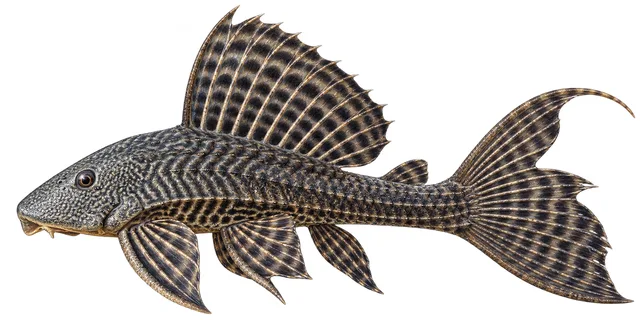
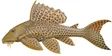
Pterygoplichthys disjunctivus is typically found in floodplain lakes, swamps, and borrow pits in water with a low concentration of oxygen. As such, it is a facultative air-breather that appears to use its specialized stomach as an accessory respiratory organ, and it is known to typically rely on breathing air for long periods of time. The species is very large for a loricariid, reaching 70 cm (28 in) in total length. It is an introduced species in India, Indonesia, Japan, Mexico, the Philippines, Puerto Rico, Singapore, Taiwan, Turkey, and the United States, and it is likely responsible for ecological and environmental damage.
Article text: Wikipedia contributors, Pterygoplichthys disjunctivus (source revision). Licensed under CC BY-SA 4.0. Retrieved 2026-10-11.
Diet and feeding
The FishTraits compilation records these diet categories for this species: algae or phytoplankton; detritus or unidentified plant material; invertebrates or larval fish. These are broad categories, not a claim that every individual consumes every example in a category.
Reported feeding positions include bottom feeding. The compilation combines published observations; diets can vary with age, locality, and available food.
Habitat preferences
Reported habitat associations include medium to large rivers, streams and small rivers, creeks, still-water habitats.
The source records associations with muck, vegetation. An association indicates reported use, rather than an exclusive requirement.
Reproduction and parental care
The compilation reports a representative maturity age of 4.5 years. Its maturity field summarizes mean, median, or modal estimates, usually for females; male estimates can be used when female data are unavailable. It is not a fixed age at which every fish first breeds.
Recorded spawning months are Apr, May, Jun, Jul, Aug, Sep for the source’s reporting region (Zzz). This is a regional calendar, not a range-wide schedule.
The reproductive-guild classification includes guarding eggs or young at a spawning substrate or nest.
Size and recorded longevity
FishTraits reports a maximum total length of 39.9 centimetres. Some entries use an estimated asymptotic length; this value should not be treated as a certified record catch.
Recorded longevity in the compilation is 10 years. Wild observations were preferred, but captive records were accepted where wild records were unavailable, and unspecified records were assumed wild. The value is not a guaranteed wild lifespan or an aquarium life expectancy.
Identification and appearance
The dorsal pattern consists of light spots that become chevrons posteriorly. The abdominal pattern has dark and light vermiculations of equal width (Howells 2005).
Pterygoplichthys and other suckermouth armored catfishes (family Loricariidae) can be distinguished from native North American catfishes (Ictaluridae) by the presence of flexible bony plates (absent in ictalurids) and a ventral suctorial mouth (terminal in ictalurids). Pterygoplichthys is often confused with Hypostomus: these genera can be distinguished by the number of dorsal fin rays (7-8 in Hypostomus vs. 9-14 in Pterygoplichthys).
Native range
Tropical America. The Madeira River drainage, Amazon Basin, South America (Weber 1992).
Habitat and ecology
Gibbs et al. (2008) examined the reproductive morphology and strategy of an introduced population of P. disjunctivus in Volusia Blue Spring, Florida. Females exhibited an increase in gonadosomatic index between May and September, indicating a summer breeding season. Multiple size classes of oocytes and a lack of completely spent ovaries suggest that this species is an asynchronous, multiple spawner (Gibbs et al. 2008).
Introduction history
In Florida, probably originally introduced through fish farm escapes or releases, although aquarium releases cannot be ruled out. Aquarium releases in other areas.
Ecological impacts
Male members of the genus Pterygoplichthys dig out river banks to create burrows in which an attracted female will lay and guard her eggs. In large numbers, this burrowing behavior by Pterygoplichthys contributes to problems with siltation. In addition, the burrows potentially destabilize the banks, leading to an increased rate of erosion (Nico et al. 2009a).