Suckermouth Catfish

Hypostomus plecostomus

Loricariidae · freshwater water fish

7 minute read · Species guide

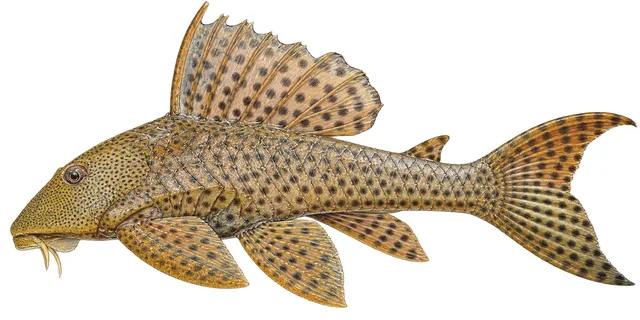
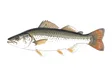
Suckermouth Catfish field guide illustration

About Suckermouth Catfish

Hypostomus plecostomus, also known as the suckermouth catfish or spotted pleco, is a tropical freshwater fish belonging to the armored catfish family (Loricariidae), named for the longitudinal rows of armor -like scutes that cover the upper parts of the head and body (the lower surface of head and abdomen is naked soft skin). They grow up to 50 cm (19.7 in) standard length, and live for 7–8 years in the wild, or 10–15 in captivity. Although the name Hypostomus plecostomus is often used to refer to common plecostomus sold in aquarium shops, most are actually members of other genera than Hypostomus.

Suckermouth catfish are of little or no value as a food fish, although they are at least occasionally consumed over their native range. A demand exists for them, however, as a bottom cleaner in the aquarium trade.

Distribution and habitat

This species' native range is tropical northeastern South America; it naturally occurs in northeastern Brazil, the Guianas, and Trinidad and Tobago. Confusingly, the name Hypostomus plecostomus (or Plecostomus plecostomus) has sometimes been incorrectly used for several more-or-less similar loricariid catfishes, both in the popular and scientific literature. For example, it has sometimes been suggested that it occurs in southern Central America, but this is a different species, Hemiancistrus aspidolepis (also known under another synonym, Hypostomus panamensis).

Some Loricariidae species have been widely introduced to several countries around the world and reported as H. plecostomus, but this is incorrect, and the concerned species belong to the genus Pterygoplichthys (either P. pardalis, P. disjunctivus, P. anisitsi, or P. multiradiatus). In the United States, a Pterygoplichthys species has been introduced to some regions in the South, most likely released by aquarists into the local waters. For example, they are present in a lake in the neighborhood of Hammock Trace Preserve in Melbourne, Florida. In Texas, reproducing populations occur in spring-influenced habitats of the San Antonio River (Bexar County), Comal Springs (Comal County), San Marcos River (Hays County), and San Felipe Creek (Val Verde County), as well as in drainage canals in the Rio Grande Valley and Houston.

The same identification issues have spread in the literature regarding the invasive catfishes in Taiwan, with H. plecostomus being one of the numerous names used to designate the species: DNA studies showed the alien fishes were actually P. pardalis and P. disjunctivus (that hybridise extensively).

H. plecostomus prefers to live in water between 22 and 30 °C (72 and 86 °F), with a pH between 6.5 and 7.5.

Diet

Hypostomus plecostomus is named for its sucker-like mouth, which allows it to adhere to a surface, as well as to hold and rasp at food, including newly hatched and baby golden apple snails and Malaysian trumpet snails. This omnivorous species also feeds on algae, aquatic plants, and small crustaceans.

Physiology

Hypostomus plecostomus is one of many species of fishes that are able to breathe air. Hypostomus plecostomus relies on its gills for respiration in normal and slightly hypoxic water, and the less oxygen present in the water, the more frequently it surfaces to breathe air. The air is taken to the stomach where the oxygen is absorbed, and the air can be kept in the stomach to increase buoyancy, which may help it to feed on vegetation.

In the aquarium

H. plecostomus is one of a number of species commonly referred to as "plecostomus"or"common pleco" by aquarists. These fish are sold when they are young and small, but in the wild, they can grow to be a maximum size of 50 cm (20 in). In captivity, however, a full-grown H. plecostomus only reaches 15 in (38 cm) on average, which could be explained by the subpar oxygen levels in most home aquaria and other practices of bad fish husbandry. In the aquarium trade, this dark-colored, bottom-feeding, nocturnal catfish is often purchased for its ability to clean algae from fish tanks, but it also contributes waste to the nitrogen cycle. It is difficult for other fish to harass, both due to the semiaggressive nature of the fish and its thick armor.

Invasive species

In Bangladesh, the species, among some other suckermouth catfishes, has become invasive. The government is currently on its way to impose a ban on the farming, hatchling production, breeding, marketing, and trading of the fish. It has also raised serious concern in India, Malaysia, Indonesia and Sri Lanka. In September 2024, the Selangor state government in Malaysia allocated RM50,000 (approximately US$11,533) as an incentive to capture 50,000 kg of the fish in the Langat River.

In the Philippines, two very similar species, Pterygoplichthys disjunctivus and P. pardalis, were initially misidentified as H. plecostomus due to them sharing the local common names of "janitor fish"and"pleco". They were introduced in the 1970s by the aquarium trade and have since become highly invasive in the Laguna de Bay (including the tributaries Marikina River) and Agusan Marsh.

Common names

A large variety of common names is used to describe H. plecostomus, where plecostomus and the shortened "pleco" are interchangeable in all common names. The names include:

Taxonomy

The species' scientific name, Hypostomus plecostomus, is derived from the Greek words hupó (ὑπό 'under'), stóma (στόμα 'mouth'), and plékō (πλέκω 'fold').

Many of the common names used to identify H. plecostomus are also used for other species, which augments the confusion surrounding H. plecostomus and other Loricariidae such as H. punctatus, Pterygoplichthys multiradiatus and P. pardalis. In 2012, Weber, Covain, and Fisch-Muller showed the type series of Carl Linnaeus was heterogenous and comprised two species: H. plecostomus (for which the authors designate a lectotype) and H. watwata.

Article text: Wikipedia contributors, Hypostomus plecostomus (source revision). Licensed under CC BY-SA 4.0. Retrieved 2026-10-11.
Diet and feeding

The FishTraits compilation records these diet categories for this species: algae or phytoplankton. These are broad categories, not a claim that every individual consumes every example in a category.

Reported feeding positions include bottom feeding. The compilation combines published observations; diets can vary with age, locality, and available food.

Habitat preferences

Reported habitat associations include medium to large rivers, streams and small rivers, creeks, still-water habitats.

The source records associations with gravel, cobble, vegetation. An association indicates reported use, rather than an exclusive requirement.

Reproduction and parental care

The compilation reports a representative maturity age of 1 years. Its maturity field summarizes mean, median, or modal estimates, usually for females; male estimates can be used when female data are unavailable. It is not a fixed age at which every fish first breeds.

Recorded spawning months are Apr, May, Jun, Jul, Aug, Sep for the source’s reporting region (Zzz). This is a regional calendar, not a range-wide schedule.

The reproductive-guild classification includes guarding eggs or young at a spawning substrate or nest.

Size and recorded longevity

FishTraits reports a maximum total length of 50 centimetres. Some entries use an estimated asymptotic length; this value should not be treated as a certified record catch.

Recorded longevity in the compilation is 10 years. Wild observations were preferred, but captive records were accepted where wild records were unavailable, and unspecified records were assumed wild. The value is not a guaranteed wild lifespan or an aquarium life expectancy.

Identification and appearance

The genus Hypostomus is the largest in the family Loricariidae, containing over 130 species and many undescribed forms (Armbruster 2004). Several apparently different Hypostomus species have been collected in the United States but have not been definitively identified to species (Page and Burr 1991; Courtenay and Stauffer 1990). Distinguishing characteristics of the genus and a key to loricariid genera were provided by Burgess (1989) and Armbruster (1997); a rediscription of the genus and list of included species was presented in Armbruster (2004). Highlighting the serious need for additional taxonomic and systematic work, Armbruster (1997, 2004) concluded that it is difficult to identify most species in the genus, and that there is no unique characters to diagnose the genus. Photographs appeared in Burgess (1989) and Ferraris (1991). Hypostomus has officially replaced the generic name Plecostomus. The genus was included in the key to Texas fishes of Hubbs et al. (1991); several identifying traits were also given by Page and Burr (1991), although in a later edition (Page and Burr 2011) those authors indicate the difficulty of identifying specimens to species.

Native range

South America: Guyana, Surniame and French Guiana, between the Essequibo and Oyapock River basins (Weber et al. 2012).

Habitat and ecology

Occurs in quiet, slow-moving waters and swamps of the lower reaches of rivers between the lower falls and the estuarine zone (Weber et al. 2012). Primarily consumes detritus, with algae and plankton comprising a minor dietary role (Pound et al. 2011).

Introduction history

Aquarium release or escape from aquaculture facilities.

Ecological impacts

In Texas, Hubbs et al. (1978) reported possible local displacement of algae-feeding native fishes such as Campostoma anomalum by Hypostomus, and López-Fernández and Winemiller (2005) suggest that reductions in Dionda diaboli abundance in portions of San Felipe Creek are the result of population increases of Hypostomus. Because of their abundance in Hawaii, introduced Hypostomus, Pterygoplichthys, and Ancistrus may compete for food and space with native stream species (Devick 1989; Sabaj and Englund 1999).

Range

Where it lives

Share of 45 GBIF observation records with a state location, across 3 states.
0%
62.2%
Share of 45 GBIF observation records with a state location, across 3 states.

Share of records by state

Habitat

Water and movement

Water
WoRMS records this species in fresh water.
USGS NAS habitat
Freshwater
US status
Exotic — the USGS Nonindigenous Aquatic Species database lists it as introduced from outside North America.

Classification

Taxonomy

Kingdom
Animalia
Phylum
Chordata
Superclass
Actinopterygii
Class
Teleostei
Order
Siluriformes
Genus
Hypostomus
Species
Hypostomus plecostomus
ITIS TSN
164342
WoRMS AphiaID
862544
GBIF key
5202178

Common questions about Suckermouth Catfish

What is the scientific name of Suckermouth Catfish?
The scientific name is Hypostomus plecostomus, in the family Loricariidae. Classification follows ITIS.
Does Suckermouth Catfish live in fresh water or salt water?
WoRMS records this species in fresh water.
Where has Suckermouth Catfish been recorded in the United States?
GBIF has observations in 3 states, with the most records in Texas, Florida, Ohio. The map shows observation records, which do not establish the complete natural range.

Same family

More Loricariidae