Taxonomy
The tench was first formally described in as Cyprinus tinca by Carl Linnaeus in 1758 in the 10th edition of Systema Naturae with its type locality given as "European lakes". In 1764 François Alexandre Pierre de Garsault proposed the new monospecific genus Tinca, with Cyprinus tinca as the type species by absolute tautonymy. The 5th edition of Fishes of the World classified Tinca in the subfamily Tincinae, alongside the genus Tanichthys, while other authorities classified both these genera in the subfamily Leuciscinae with other Eurasian minnows, but more recent phylogenetic studies have supported it belonging to its own family Tincidae. The Tincidae was first proposed as a name in 1878 by David Starr Jordan.
Evolution
The Tincidae have a rather comprehensive fossil record in Europe. They first appear during the Late Oligocene with the fossil genera † Tarsichthys Troschel, 1854 and the potentially synonymous † Palaeotinca Obrhelová, 1969.
For the extant Tinca, the fossil species † Tinca furcata Agassiz, 1832 is known from Late Miocene -aged deposits near Ohningen, and the contemporaneous † Tinca micropygoptera Agassiz, 1839 is known from near Steinheim am Albuch. The extinct species † Tinca sayanica Sytche vskaya, 1989 is known from the Late Miocene or Early Pliocene of Mongolia. † Tinca pliocenica Gaudant, 1998 is known from the Pliocene of Germany. From the Late Miocene onwards, Tinca remains are overall widespread in freshwater deposits of Europe and West Asia, although they are usually not assignable to species. The earliest remains of the modern Tinca tinca are from the late Pliocene of the Netherlands.
Ecology
The tench is most often found in still waters with a clay or muddy substrate and abundant vegetation. This species is rare in clear waters across stony substrate, and is absent altogether from fast-flowing streams. It tolerates water with a low oxygen concentration, being found in waters where even the carp cannot survive.
Tench feed mostly at night with a preference for animals, such as chironomids, on the bottom of eutrophic waters and snails and pea clams in well-vegetated waters.
Breeding takes place in shallow water usually among aquatic plants where the sticky green eggs can be deposited. Spawning usually occurs in summer, and as many as 300,000 eggs may be produced. Growth is rapid, and fish may reach a weight of 0.11 kg (0.25 lb) within the first year.
Morphology
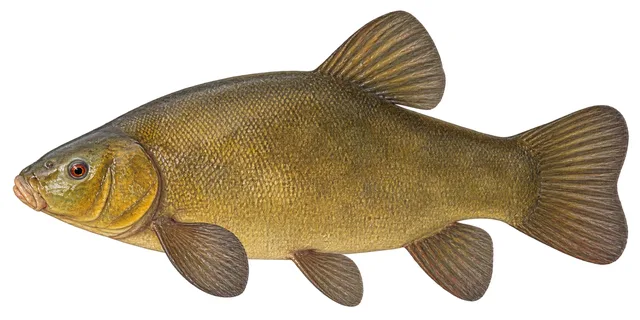
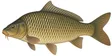
Tench have a stocky, carp-like shape and olive-green skin, darker above and almost golden below. The tail fin is square in shape. The other fins are distinctly rounded in shape. The mouth is rather narrow and provided at each corner with a very small barbel.
Maximum size is 70 cm (28 in), though most specimens are much smaller. A record fish caught in 2001 in England had a weight of 15 lb 3.4 oz (6.899 kg). The eyes are small and red-orange in colour. Females can reach weights of around 7 kg (15 lb), although 4 kg (8.8 lb) is considered large. Males rarely reach over 3 kg (6.5 lb). Sexual dimorphism is strong, males can be recognised by having larger, more curved pelvic fins extending beyond the anus and noticeable muscles around the base of these fins generally absent in females. Males also possess a very thick and flattened outer ray to the ventral fins. Adult females may have a more convex ventral profile when compared with males.
The tench has very small scales, which are deeply embedded in a thick skin, making it as slippery as an eel. Folklore has it that this slime cured any sick fish that rubbed against it, and from this belief arose the name doctor fish.
Golden tench
An artificially bred variety of tench called the golden tench is a popular ornamental fish for ponds. This form varies in colour from pale gold through to dark red, and some fish have black or red spots on the flanks and fins. Though somewhat similar to the goldfish, because these fish have such small scales, their quality is rather different.
Economic significance
Tench are edible, working well in recipes that would otherwise call for carp, but are not commonly consumed. They are shoaling fish that are popular quarries for coarse angling in rivers, lakes and canals. Tench, particularly golden tench, are also kept as ornamental fish in ponds as they are bottom feeders that help to keep the waterways clean and healthy.
Angling
Large tench may be found in gravel pits or deep, slow-moving waters with a clay or silt bottom and copious aquatic vegetation. The best methods and bait to catch tench are float fishing and ledgering with a swim feeder using maggots, sweetcorn, pellets, bread, and worms. Fish over 1 kg (2 lb) in weight are very strong fighters when caught on a rod.
Article text: Wikipedia contributors, Tench (source revision). Licensed under CC BY-SA 4.0. Retrieved 2026-10-11.
Diet and feeding
The FishTraits compilation records these diet categories for this species: algae or phytoplankton; aquatic or other vascular plants; detritus or unidentified plant material; invertebrates or larval fish; larger animal prey (a source category covering fish, crayfish, crabs, or frogs); fish or frog eggs. These are broad categories, not a claim that every individual consumes every example in a category.
Reported feeding positions include bottom feeding. The compilation combines published observations; diets can vary with age, locality, and available food.
Habitat preferences
Reported habitat associations include medium to large rivers, still-water habitats.
The source records associations with muck, clay or silt, vegetation, organic debris. An association indicates reported use, rather than an exclusive requirement.
Reproduction and parental care
The compilation reports a representative maturity age of 3.5 years. Its maturity field summarizes mean, median, or modal estimates, usually for females; male estimates can be used when female data are unavailable. It is not a fixed age at which every fish first breeds.
Recorded spawning months are May, Jun, Jul, Aug for the source’s reporting region (CA). This is a regional calendar, not a range-wide schedule.
The reproductive-guild classification includes spawning on open substrates without guarding the brood.
Size and recorded longevity
FishTraits reports a maximum total length of 64 centimetres. Some entries use an estimated asymptotic length; this value should not be treated as a certified record catch.
Recorded longevity in the compilation is 9 years. Wild observations were preferred, but captive records were accepted where wild records were unavailable, and unspecified records were assumed wild. The value is not a guaranteed wild lifespan or an aquarium life expectancy.
Identification and appearance
Characteristics typically used distinguish tench include:
Body Shape and Size: Stocky, robust, and laterally-compressed body similar to carp Adult can grow to 70 cm (~28 in) standard length Adults can grow to 7.5 kg (16 lbs) Triangular head Terminal mouth with well-developed barbel at both corners of mouth 96-115 scales along lateral line
Coloration: varying shades of olive-green to black on their upper body a paler, golden color underside red-orange eyes
Fins: 4 dorsal spines with 8-9 dorsal soft spines 3-4 anal spines with 6-8 soft spines Caudal fin has 19 rays with a deep and short peduncle (i.e. tail fin base)
Native range
Most of Europe, including the British Isles, and parts of western Asia (Berg 1949).
Habitat and ecology
FOOD WEB: Tench is primarily a benthic generalist feeding primarily on benthic aquatic invertebrates. Diet analysis of adult tench indicates that they will consume a wide variety of prey items from over 60 different taxa, primarily. Chromatid larvae (non-biting midges) usually make up a large part of tench diets, along with caddisflies, mayflies, beetles, dragonflies, and mollusks (Weatherley 1959; Scott and Crossman 1973; Ranta and Nuutinen 1984; Michel and Oberdorff 1995; Perrow et al. 1996; González et al. 2000; Alas et al. 2010; USFWS ERSS 2014; Bezmaternykh and Shcherbina 2018). During the early years of their life, tench primarily feed on zooplankton, with a preference for larger-bodied cladocerans. Tench will also consume plant material, some which include seeds that are viable after being ingested, and might be an important vector for plant dispersal (Boedeltje et al. 2019). Tench mainly feed from May to September, peaking in August (Bezmaternykh and Shcherbina 2018). They are primarily crepuscular and nocturnal feeders, using their sensitive barbels to locate food items on the lake or pond bottom (Perrow et al. 1996; Bezmaternykh and Shcherbina 2018).
LIFE HISTORY: Tench have a relatively long lifespan, often reaching 10 to 15 years or more in the wild. They are known for their slow growth rate. Sexual maturity is usually achieved at around 3 to 4 years of age, depending on environmental conditions (Yilmaz 2002). Tench are oviparous, spawning during the late spring and early summer when water temperatures rise (Avlijaš et al. 2018).
Introduction history
This species was imported into North America from Germany by the U.S. Fish Commission in 1877 apparently for use as a food and sport fish (Baird 1879). The Commission apparently spent several years learning to culture tench, for it was not until well into the 1880s that the agency started to seriously distribute the species in the United States. According to Baughman (1947), the Commission planted more than 138,000 tench across North America during the period 1886 to 1896. By the end of that period, the Commission had provided tench to at least 36 different states. Shortly thereafter, the agency discontinued working with tench and turned over their hatchery ponds to the rearing of bass (Baughman 1947). The U.S. Fish Commission stocked tench into lakes and ponds in the Pacific states, including Idaho, Oregon, and Washington, in 1895 (Smith 1896). Additional introductions occurred in Washington when tench exhibited at the 1909 Worlds Fair, held in Seattle, were dumped into a large pond on the University of Washington campus. Some of these fish later were transferred to Lake Washington; the population eventually spread to Lake Union (Wydoski and Whitney 2003). Although most tench introductions were the result of intentional stockings, some introductions were the result of escape from holding facilities. In 1889, many of the fish, including an estimated 25 tench, held in federal ponds in Washington, D.C., escaped into the Potomac River during a flood (McDonald 1893). However, tench had been introduced to the Potomac River prior to that date. For instance, Smiley (1889) recorded the taking of tench from that river during March 1887. Evermann and Kendall (1895) reported the escape of tench from the Neosho fish hatchery into Spring Branch near Neosho in southwestern Missouri. Baughman (1947) discussed the escape of tench into the Olentangy River of Ohio after the banks of an artificial lake collapsed in 1898. Schwartz (1964) stated that tench had escaped from commercial ponds into creeks in Maryland. Tench were first brought to California in 1922. At that time, specimens obtained in Italy were illegally released into a private reservoir near Half Moon Bay, San Mateo County; the species was later spread to other California waters by ranchers (Shapovalov 1944; Dill and Cordone 1997).
Ecological impacts
For the most part, unknown. In the 1940s this species was reported to be a nuisance because of high abundance in certain parts of Maryland and Idaho (Baughman 1947). The diet consists mainly of aquatic insect larvae and molluscs (Scott and Crossman 1973). Moyle (2002) considered it a potential competitor for food with sport fishes and native cyprinids. In their discussion of tench introduced to Africa, de Moor and Bruton (1988) noted that the species is known to stir up bottom sediments, possibly affecting water quality, but not to the extent of common carp Cyprinus carpio.