Distribution
This species has a circumtropical distribution; it can be found in the tropical waters from the Atlantic Ocean, the Indian Ocean and the Pacific Ocean.
Habitat
This filefish can be observed in lagoons, coral and rocky reefs, seaweed fields, pinnacles, wrecks and also in open water.
Description
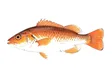
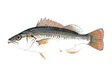
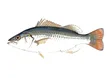
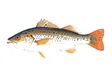
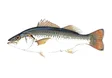
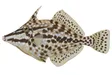
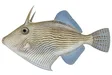
Aluterus scriptus is a medium size fish which can grow up to 110 cm (3.6 ft) in length. The body shape looks like an elongated oval, strongly compressed. Its background body coloration is olive-brown or grey depending on its surrounding environment, irregular blue lines and spots are distributed on the body mixed with some black spots mainly on the head. The colors may quickly vary depending on background similar to an octopus's. Fish observed in the Virgin Islands might lie flat on the sand and become pure white or change to any of the other representative colors. The mouth is small and at the end of its pointed snout. Like all the Tetraodontiformes, it has no pelvic fin but has two particular dorsal spines; the first anterior one is long, slender and erectile, located just over the eyes, the second is small and not easy to see but it locks the first one when it is erected. The rounded caudal fin is quite long and can be displayed as a fan.
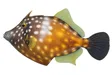
The juveniles have a yellow with black spots body coloration.
Feeding
Aluterus scriptus is omnivorous and have a large choice for its meals like small crustaceans, algae, gorgonians, sea anemones, tunicates, fire coral, seagrasses and hydrozoans.
Behaviour
Aluterus scriptus is diurnal and is demersal. It is solitary and shy with divers and is rarely seen with others.
Toxin
It contains palytoxin, which is 50 times more toxic than tetrodotoxin, the poison of puffer fish.
Additional field notes
Young scrawled filefish and adults can occupy very different settings.
Sources: Aluterus scriptus species summary
From drifting weeds to reef slopes
FishBase describes juveniles traveling with floating weed rafts in the open ocean, sometimes remaining there long enough to reach a substantial size. An offshore juvenile is therefore not necessarily lost from a nearby reef. Floating vegetation is part of the recorded habitat used during this stage.
Adults are more often encountered along coastal slopes and outer reef drop-offs, with observations around 20 metres deep. The distinction between a drifting juvenile and a reef-associated adult helps explain why accounts include both open water and bottom-associated habitats. The summary also records lagoons and seaward reefs; no single depth or reef zone describes every life stage.
Sources: Aluterus scriptus species summary
Article text: Wikipedia contributors, Aluterus scriptus (source revision). Licensed under CC BY-SA 4.0. Retrieved 2026-10-11.