Muskellunge

Esox masquinongy

Esocidae · freshwater water fish

11 minute read · Species guide

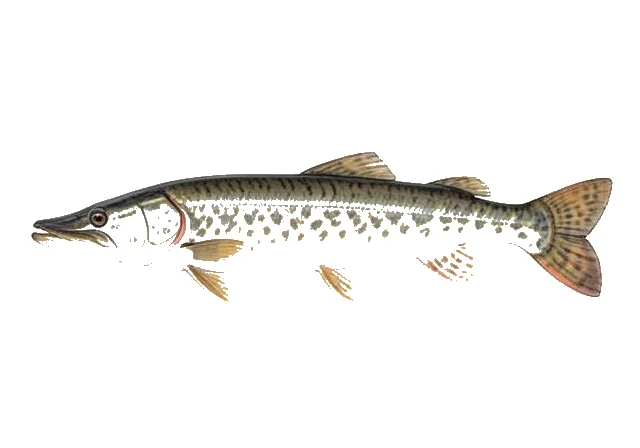
Muskellunge field guide illustration

About Muskellunge

The muskellunge (Esox masquinongy), often shortened to muskie, musky, ski, or lunge, is a species of large freshwater predatory fish native to North America. It is the largest member of the pike family, Esocidae.

Etymology

The name "muskellunge"originates from the Ojibwe word maashkinoozhe, meaning"ugly pike". The Algonquin word maskinunga is borrowed into the Canadian French words masquinongé or maskinongé. In English, before settling on the common name "muskellunge", there were at least 94 common names applied to this species, including but not limited to: muskelunge, muscallonge, muskallonge, milliganong, maskinonge, maskalonge, mascalonge, maskalung, muskinunge and masquenongez.

Subspecies and hybrids

Though interbreeding with other pike species can complicate the classification of some individuals, zoologists usually recognize up to three subspecies of muskellunge.

The tiger muskellunge (E. masquinongy × lucius or E. lucius × masquinongy) is a hybrid of the muskie and northern pike. Hybrids are sterile, although females sometimes unsuccessfully engage in spawning motions. Some hybrids are artificially produced and planted for anglers to catch. Tiger muskies grow faster than pure muskies, but do not attain the ultimate size of their pure relatives, as the tiger muskie does not live as long.

Description

Muskellunge closely resemble other esocids such as the northern pike (Esox lucius) and American pickerel (E. americanus) in both appearance and behavior. Like the northern pike and other aggressive pikes, the body plan is typical of ambush predators with an elongated body, flat head, and dorsal, pelvic, and anal fins set far back on the body. Muskellunge are typically 70–120 cm (28–48 inches) long and weigh 7–16.5 kg (15–36 lb), though some have reached up to 1.8 m (6 ft) and almost 30 kg (70 lb). Martin Arthur Williamson caught a muskellunge with a weight of 27.8 kg (61.25 pounds) in November 2000 on Georgian Bay. The fish are a light silver, brown, or green, with dark vertical stripes on the flank, which may tend to break up into spots. In some cases, markings may be absent altogether, especially in fish from turbid waters. This is in contrast to northern pike, which have dark bodies with light markings. A reliable method to distinguish the two similar species is by counting the sensory pores on the underside of the mandible. A muskie will have seven or more per side, while the northern pike never has more than six. The lobes of the caudal (tail) fin in muskellunge come to a sharper point, while those of northern pike are more generally rounded. In addition, unlike pike, muskies have no scales on the lower half of their opercula.

Anglers seek large muskies as trophies or for sport. In places where muskie are not native, such as in Maine, anglers are encouraged not to release the fish back into the water because of their negative impact on native populations of trout and other smaller fish species.

Habitat

Muskellunge are found in oligotrophic and mesotrophic lakes and large rivers from Michigan, Wisconsin, and Minnesota through the Great Lakes region, Chautauqua Lake in western New York, north into Canada, throughout most of the St Lawrence River drainage, and northward throughout the upper Mississippi valley, although the species also extends as far south as Chattanooga in the Tennessee River valley. Also, a small population is found in the Broad River in South Carolina. Several North Georgia reservoirs also have healthy stocked populations of muskie. They are also found in the Red River drainage of the Hudson Bay basin. Muskie were introduced to western Saint John River in the late 1960s and have now spread to many connecting waterways in northern Maine. The Pineview Reservoir in Utah is one of three Utah locations where the hybrid Tiger muskellunge is found.

They prefer clear waters where they lurk along weed edges, rock outcrops, or other structures to rest. A fish forms two distinct home ranges in summer: a shallow range and a deeper one. The shallow range is generally much smaller than the deeper range due to shallow water heating up. A muskie continually patrols the ranges in search of available food in the appropriate conditions of water temperature.

Diet

Muskies are ambush predators who will swiftly bite their prey and then swallow it head first. Muskellunge are the top predator in any body of water where they occur and they will eat larger prey than most other freshwater fish. They eat all varieties of fish present in their ecosystem (including other muskellunge), along with the occasional insect, muskrat, rat, mouse, frog, or duck. They are capable of taking prey up to two-thirds of their body length due to their large stomachs. There have even been reports of large muskellunge attacking small dogs and even humans, although most of these reports are greatly exaggerated.

Length and weight

As muskellunge grow longer they increase in weight, but the relationship between length and weight is not linear. The relationship between them can be expressed by a power-law equation:

The exponent b is close to 3.0 for all species, and c is a constant for each species. For muskellunge, b = 3.325, higher than for many common species, and c = 0.000089 pounds per cubic inch or 0.0025 g/cm.

According to the International Game Fish Association (IGFA) the largest muskellunge on record was caught by Cal Johnson in Lac Courte Oreilles (recognized as Lake Courte Oreilles by the association), Hayward, Wisconsin, United States, on July 24, 1949. The fish weighed 30.5 kg (67 lb 8 oz) and was 153 cm (60.25 inches) in length, and 84–86 cm (33–34 inches) in girth.

Behavior

Muskellunge are sometimes gregarious, forming small schools in distinct territories. Muskellunge feeding behavior is directly synchronized with the lunar cycle. During both full and new moons, an increase in feeding activity can be attributed to the increase of moonlight, as it most similarly simulates daytime feeding. They spawn in mid- to late spring, somewhat later than northern pike, over shallow, vegetated areas. A rock or sand bottom is preferred for spawning so the eggs do not sink into the mud and suffocate. The males arrive first and attempt to establish dominance over a territory. Spawning may last from five to 10 days and occurs mainly at night. The eggs are negatively buoyant and slightly adhesive; they adhere to plants and the bottom of the lake. Soon afterward, they are abandoned by the adults. Those embryos which are not eaten by fish, insects, or crayfish hatch within two weeks. The larvae live on yolk until the mouth is fully developed, when they begin to feed on copepods and other zooplankton. They soon begin to prey upon fish. Juveniles generally attain a length of 30 cm (12 inches) by November of their first year.

Predators

Adult muskellunge are apex predators where they occur naturally. Only humans and (rarely) large birds of prey such as bald eagles (Haliaeetus leucocephalus) pose a threat to an adult. But juveniles are consumed by other muskies, northern pike, bass, trout, and occasionally birds of prey. The muskellunge's low reproductive rate and slow growth render populations highly vulnerable to overfishing. This has prompted some jurisdictions to institute artificial propagation programs in an attempt to maintain otherwise unsustainably high rates of angling effort and habitat destruction.

Attacks on humans

Although very rare, muskie attacks on humans do occur on occasion.

Article text: Wikipedia contributors, Muskellunge (source revision). Licensed under CC BY-SA 4.0. Retrieved 2026-10-11.
Diet and feeding

The FishTraits compilation records these diet categories for this species: invertebrates or larval fish; larger animal prey (a source category covering fish, crayfish, crabs, or frogs). These are broad categories, not a claim that every individual consumes every example in a category.

Reported feeding positions include surface or water-column feeding. The compilation combines published observations; diets can vary with age, locality, and available food.

Habitat preferences

Reported habitat associations include medium to large rivers, still-water habitats.

The source records associations with gravel, cobble, boulders, organic debris, large woody material. An association indicates reported use, rather than an exclusive requirement.

Reproduction and parental care

The compilation reports a representative maturity age of 4 years. Its maturity field summarizes mean, median, or modal estimates, usually for females; male estimates can be used when female data are unavailable. It is not a fixed age at which every fish first breeds.

Recorded spawning months are Apr, May for the source’s reporting region (NC). This is a regional calendar, not a range-wide schedule.

The reproductive-guild classification includes spawning on open substrates without guarding the brood.

Size and recorded longevity

FishTraits reports a maximum total length of 183 centimetres. Some entries use an estimated asymptotic length; this value should not be treated as a certified record catch.

Recorded longevity in the compilation is 30 years. Wild observations were preferred, but captive records were accepted where wild records were unavailable, and unspecified records were assumed wild. The value is not a guaranteed wild lifespan or an aquarium life expectancy.

Spawning movements

The compilation records significant spawning-related movement. Its combined migration flag covers movements within fresh water as well as between rivers and the sea; this flag alone does not establish which migration pattern applies.

Identification and appearance

Muskellunge, Esox masquinongy, are characterized by their elongate, moderately compressed and slightly flattened body. Oblique stripes, spots or blotches overlay the silver colored body, the belly is white in color with small spots. Fins are green or red-brown with dark blotches. The top of the head is unscaled and the snout is long and duckbill-like. The Muskellunge has a large mouth with strong canine teeth in its lower jaw and on the roof of its mouth. Its tongue features short, sharp brush-like teeth (Becker 1983). Three subspecies are sometimes recognized: Esox masquinongy masquinongy, a spotted form which occurs in the St. Lawrence River and the Great Lakes and their tributaries; Esox masquinongy immaculatus, a form with either no pattern or barring which occurs in Wisconsin, Minnesota, northwestern Ontario, and southeastern Manitoba; and Esox masquinongy ohioensis, a form with bars or diffuse spots and blotches which occurs in the Ohio River and its tributaries (Becker 1983). While similar in appearance to the Northern pike (Esox lucius), Muskellunge can often be distinguished from pike based on coloration. Additionally, Muskellunge have 6-9 sensory pores on each side of their lower jaw whereas Northern pike have 5 or less pores. Muskellunge also have relatively pointed tail fins relative to a Northern pike (Minnesota DNR 2017). The hybrid Tiger muskie (Esox masquinongy x lucius) is also present in the Great Lakes region, these grow faster and larger than either of the parent species, are characterized by dark stripes on a lighter background, have 5-6 sensory pores and are otherwise intermediate between the two parents in shape and coloring.

Native range

St. Lawrence River-Great Lakes and Mississippi River basins, from Quebec to southeastern Manitoba; south in the Appalachians to Georgia and in the west to Iowa (Page and Burr 1991). Crossman (1978) gave a distribution map. Although never reported from Mississippi, considering the fact that Muskellunge are (or were) native to the main Tennessee River, the species almost certainly historically entered the extreme northeastern part of that state (Gilbert, personal communication).

Habitat and ecology

Muskellunge spawn in the spring in shallow bays. Ideal temperature for spawning is 12.7°C. Eggs are scattered in shallow waters over submerged woody debris or over vegetation. Females produce 22,000-180,000 eggs which take 8-14 days to hatch. Young Muskellunge absorb the yolk sac after hatching and begin to prey on other organisms. Growth is rapid in the first three years, growth rate vary depending on water temperatures and available food. Females tend to grow faster and larger than males. As they grow larger, growth rates begin to level off.. Individuals can live up to 30 years or more (Michigan DNR 2012). Natural hybridization between the Muskellunge and Northern Pike occurs in waters where both species are present resulting in the Tiger Muskellunge. Male hybrids are sterile and females are frequently fertile. Reproduction can be limited by water temperatures below 10°C, fluctuating water temperatures, low oxygen, predation by fish and invertebrates on eggs and fry, prey availability, and hybridization with the Northern pike (Michigan DNR 2012; Becker 1983).

After hatching Muskellunge feed on other fish species including minnows and smaller Muskies. As they get larger, Muskellunge begin to prey on frogs, ducklings, and crayfish. Adult Muskellunge will consume fish up to a third their own length and prefer longer, cylindrical fish to spiny, deep bodied panfish. This preference is attributed to their metabolism which favors a single, large meal instead of multiple small ones (Michigan DNR 2012). Northern Pike, Yellow Perch, Walleye, Smallmouth Bass, Largemouth Bass, Rock Bass, sunfish, and other Muskellunge will prey on young Muskellunge. In hatcheries, giant water bugs, diving beetles, and large larvae of some insects were seen to be significant predators of recently hatched Muskellunge.

Introduction history

Intentionally stocked for sportfishing. According to Pflieger (1997) this species was first stocked in Missouri reservoirs in 1966 for the purpose of providing another trophy-sized fish and a large predator capable of preying on the many Gizzard shad and other forage fish too large to be eaten by Largemouth bass. Muskellunge found in one Missouri creek had escaped from hatchery ponds (Pflieger 1997).

Ecological impacts

This species likely has impacts similar to that of northern pike, namely reducing the numbers of small fish by way of predation. Muskellunge and young largemouth bass M. salmoides frequent the same habitats, brush piles and beds of vegetation. In two Wisconsin lakes, this resulted in the decline of the largemouth bass population (Becker 1983).

Record fish

State records in 4 states

  • Wisconsin69 lbs. 11 oz.

    Chippewa Flowage · Sawyer · 10/20/1949

  • Minnesota55 lb 14 oz

    Mille Lacs Lake · Mille Lacs · 11/22/2021

  • Georgia38 lb

    Lake Blue Ridge · June 1957 · Rube Golden

  • Alabama19 lbs 8 oz

    Wilson Dam tailwater · 12/31/1972 · Steve Leatherwood , Haleyville

  • Alabama19 lbs 8 oz

    Wilson Dam tailwater · 12/31/1972 · Steve Leatherwood , Haleyville

Each figure is the state agency’s own certified record. The site holds record tables for 11 states so far, so a state missing here has not been read yet. It is not a state where this fish holds no record.

Statute

The official state fish of Wisconsin

A state fish is chosen by statute. It says nothing about how common the fish is in the state. See every official state fish.

Range

Where it lives

Share of 7,265 GBIF observation records with a state location, across 25 states. The orange dots are USGS stream-survey sites where this species was caught.
0%
36.8%
Share of 7,265 GBIF observation records with a state location, across 25 states. The orange dots are USGS stream-survey sites where this species was caught.

A blank area on the dot layer usually means nobody sampled there, not that the fish is absent. Turn on “every survey site” to see where the survey looked.

The USGS stream survey caught it at 87 of its sites, in 16 states. That survey and the GBIF records are two different counts of two different things, so the site keeps them apart.

Habitat

Water and movement

Water
WoRMS records this species in fresh water.
USGS NAS habitat
Freshwater
US status
Native transplant — native to part of the United States, moved to other waters inside it.
Migration
Migratory
Pattern

Classification

Taxonomy

Kingdom
Animalia
Phylum
Chordata
Superclass
Actinopterygii
Class
Teleostei
Order
Esociformes
Family
Esocidae
Genus
Esox
Species
Esox masquinongy
ITIS TSN
162144
WoRMS AphiaID
1021830
GBIF key
2346634
Outside the US
ITIS also files it in Canada.

Common questions about Muskellunge

What is the scientific name of Muskellunge?
The scientific name is Esox masquinongy, in the family Esocidae. Classification follows ITIS.
Does Muskellunge live in fresh water or salt water?
WoRMS records this species in fresh water.
Where has Muskellunge been recorded in the United States?
GBIF has observations in 25 states, with the most records in Wisconsin, Pennsylvania, Minnesota. The map shows observation records, which do not establish the complete natural range.

Closest relatives

Other Esox species

Same family

More Esocidae