Grass Pickerel

Esox americanus

Esocidae · freshwater and brackish water fish

4 minute read · Species guide

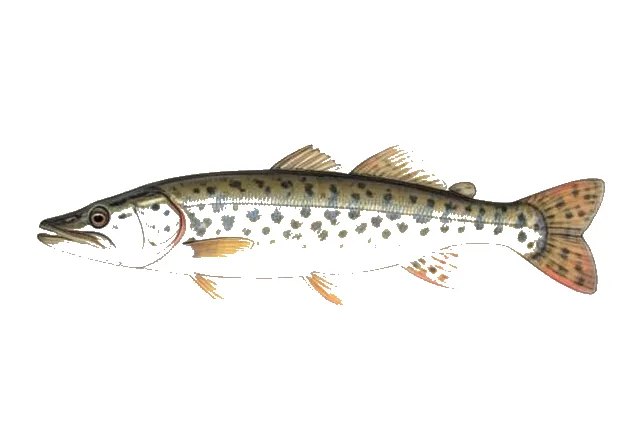
Grass Pickerel field guide illustration

About Grass Pickerel

The American pickerel (Esox americanus) is a medium-sized species of North American freshwater predatory fish belonging to the pike family. The genus Esox is placed in the family Esocidae (in the order Esociformes).

Lesueur originally classified the grass pickerel as E. vermiculatus, but it is now considered a subspecies of E. americanus.

There is no widely accepted English common collective name for the two E. americanus subspecies; "American pickerel" is a translation of the French systematic name brochet d'Amérique.

Description

The two subspecies are very similar, but the grass pickerel lacks the redfin's distinctive orange to red fin coloration. The former's fins have dark leading edges and amber to dusky coloration. In addition, the light areas between the dark bands are generally wider on the grass pickerel and narrower on the redfin pickerel. Record size grass and redfin pickerels can weigh around 2 pounds (0.91 kg) and reach lengths of around 13 inches (33 cm). Redfin and grass pickerels are typically smaller than chain pickerels, which can be much larger.

Distribution and habitats

The redfin and grass pickerels occur primarily in sluggish, vegetated waters of pools, lakes and wetlands, and are carnivorous predators feeding on smaller fish. However, larger fishes, such as the striped bass (Morone saxatilis), bowfin (Amia calva) and gray weakfish (Cynoscion regalis), prey on the pickerels in turn when the latter venture into larger rivers or estuaries.

The pickerels reproduce by scattering spherical, sticky eggs in shallow, heavily vegetated waters. The eggs hatch in 11 – 15 days; the adult pickerels guard neither the eggs nor the young.

Both subspecies are native to the freshwater bodies of North America, and are not to be confused with their more aggressive big cousin, the northern pike. The redfin pickerel's range extends from the Saint Lawrence basin in Quebec down to the Gulf Coast, from Mississippi to Florida; while the grass pickerel's range is further west, extending from the Great Lakes Basin, from Ontario to Michigan, down to the western Gulf Coast, from eastern Texas to Mississippi.

Fishing

The E. americanus subspecies are not as highly prized as a game fish as their larger cousins, the northern pike and muskellunge, but they are nevertheless caught by anglers. McClane's Standard Fishing Encyclopedia describes ultralight tackle as a sporty if overlooked method to catch these small but voracious pikes.

Article text: Wikipedia contributors, American pickerel (source revision). Licensed under CC BY-SA 4.0. Retrieved 2026-10-11.
Diet and feeding

The FishTraits compilation records these diet categories for this species: invertebrates or larval fish; larger animal prey (a source category covering fish, crayfish, crabs, or frogs). These are broad categories, not a claim that every individual consumes every example in a category.

Reported feeding positions include surface or water-column feeding. The compilation combines published observations; diets can vary with age, locality, and available food.

Habitat preferences

Reported habitat associations include medium to large rivers, streams and small rivers, creeks, still-water habitats.

The source records associations with vegetation. An association indicates reported use, rather than an exclusive requirement.

Reproduction and parental care

The compilation reports a representative maturity age of 2.5 years. Its maturity field summarizes mean, median, or modal estimates, usually for females; male estimates can be used when female data are unavailable. It is not a fixed age at which every fish first breeds.

Batch or serial spawning has been reported somewhere in the species’ range. This does not establish the same spawning pattern for every population.

Recorded spawning months are Feb, Mar, Aug, Sep for the source’s reporting region (NC). This is a regional calendar, not a range-wide schedule.

The reproductive-guild classification includes spawning on open substrates without guarding the brood.

Size and recorded longevity

FishTraits reports a maximum total length of 37.6 centimetres. Some entries use an estimated asymptotic length; this value should not be treated as a certified record catch.

Recorded longevity in the compilation is 7 years. Wild observations were preferred, but captive records were accepted where wild records were unavailable, and unspecified records were assumed wild. The value is not a guaranteed wild lifespan or an aquarium life expectancy.

Native range

Atlantic Slope from the St. Lawrence River drainage, Quebec, to Lake Okeechobee, Florida; Gulf drainages east to the Brazos River, Texas; Mississippi River and Great Lakes basins north to Nebraska, Wisconsin, Michigan, and southern Ontario (range for the species). Redfin Pickerel E. a. americanus occur on the Atlantic Slope to southern Georgia and intergrade with grass pickerel E. a. vermiculatus in the Gulf Slope drainages west to the Pascagoula River. Grass pickerel occupy the rest of the range (Page and Burr 1991). Crossman (1978) gave a distribution map of the subspecies and intergrades.

Introduction history

This species was stocked intentionally and possibly accidentally; it was stocked illegally in Oregon. Probably introduced into Washington as misidentified northern pike E. lucius (Chapman 1942); it is also possible that grass pickerel were introduced into Idaho along with northern pike, and that the former species later reached Washington by "some devious means" (Wydoski and Whitney 1979).

Record fish

State records in 4 states

  • Georgia2 lb, 10 oz

    Lewis Pond · July 7, 1982 · Gene Brantley

  • Florida1.06 lb

    New River · Bradford County · 6/6/1993 · Mike Milkerson

  • Alabama0 lbs 14 oz

    Bassett Creek, Wash. Co. · 9/4/2017 · Henry Merritt, Deer Park

  • Alabama0 lbs 13 oz

    Armstrong Creek, Wash. Co. · 7/7/2014 · Frank Lambert Dickey, Chatom

  • Oklahoma0 lbs 7.00 ozs

    Beaver Creek · 03/17/1995 · Barry Bryant · rod and line

Each figure is the state agency’s own certified record. The site holds record tables for 11 states so far, so a state missing here has not been read yet. It is not a state where this fish holds no record.

Range

Where it lives

Share of 13,799 GBIF observation records with a state location, across 37 states. The orange dots are USGS stream-survey sites where this species was caught.
0%
13.1%
Share of 13,799 GBIF observation records with a state location, across 37 states. The orange dots are USGS stream-survey sites where this species was caught.

A blank area on the dot layer usually means nobody sampled there, not that the fish is absent. Turn on “every survey site” to see where the survey looked.

The USGS stream survey caught it at 2,612 of its sites, in 32 states. That survey and the GBIF records are two different counts of two different things, so the site keeps them apart.

Habitat

Water and movement

Water
WoRMS records this species in fresh water and brackish water.
USGS NAS habitat
Freshwater
US status
Native transplant — native to part of the United States, moved to other waters inside it.
Migration
Migratory
Pattern

Classification

Taxonomy

Kingdom
Animalia
Phylum
Chordata
Superclass
Actinopterygii
Class
Teleostei
Order
Esociformes
Family
Esocidae
Genus
Esox
Species
Esox americanus
ITIS TSN
162140
WoRMS AphiaID
1021987
GBIF key
4284046
Outside the US
ITIS also files it in Canada.

Common questions about Grass Pickerel

What is the scientific name of Grass Pickerel?
The scientific name is Esox americanus, in the family Esocidae. Classification follows ITIS.
Does Grass Pickerel live in fresh water or salt water?
WoRMS records this species in fresh water and brackish water.
Where has Grass Pickerel been recorded in the United States?
GBIF has observations in 37 states, with the most records in Florida, Texas, North Carolina. The map shows observation records, which do not establish the complete natural range.

Closest relatives

Other Esox species

Same family

More Esocidae