Chain Pickerel

Esox niger

Esocidae · freshwater water fish

7 minute read · Species guide

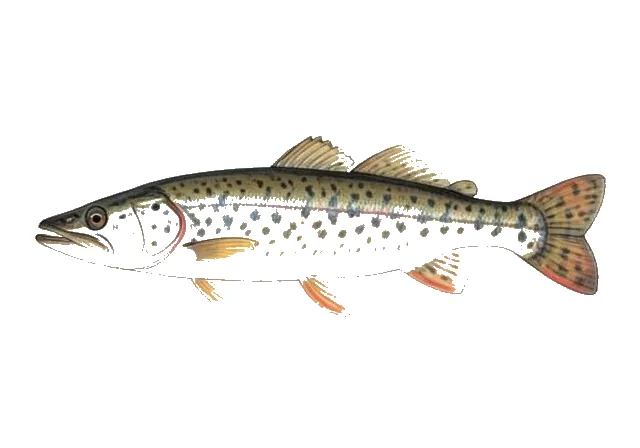
Chain Pickerel field guide illustration

About Chain Pickerel

The chain pickerel (Esox niger), also known as Jackfish, Mud Pike, or Southern Pike is a species of freshwater fish in the pike family (family Esocidae) of order Esociformes. The chain pickerel and the American pickerel (E. americanus) belong to the Esox genus of pike.

Taxonomy

French naturalist Charles Alexandre Lesueur described the chain pickerel in 1818. Its species name is the Latin word niger "black".

Nicknames include the "southern pike", "grass pike", "jack", "jackfish", "gunny"and"eastern pickerel". In central Florida the chain pickerel is known locally as "Gatorfish"

Description

The chain pickerel has a distinctive, dark, chain-like pattern on its greenish sides. There is a vertical dark marking underneath the eye, which helps to distinguish the chain pickerel from redfin pickerel (Esox americanus americanus) and grass pickerel (E. a. vermiculatus), in which the mark curves posteriorly. Its body outline resembles that of the northern pike (E. lucius). Unlike northern pike, however, the opercles and cheeks of chain pickerel are entirely scaled. It may reach up to 78.7 centimetres (31.0 in) long only on rare occasions. The average size for chain pickerel, however, is 24 in (61 cm) and 3 lb (1 1/2 kg). (The average chain pickerel caught by fishermen is under 2 lb.) It lives around 8 yr. In some places the pickerel is known as a "gunfish", "gunny"or"slime dart", due to its characteristic slime coating.

A blue color morph lacking the usual reticulated pattern has been described in a New York population.

Distribution

Its range is along the eastern coast of North America from southern Canada to Florida, and west to Texas. In the New England, the species occurs in Maine and New Hampshire. The fish inhabits fresh and brackish water from the Mississippi Valley. It also is commonly found in Lake Michigan and the lower portion of the Great Lakes. In the Canadian Maritimes, chain pickerel is known from New Brunswick and Nova Scotia.

Chain pickerel is considered an invasive species in Nova Scotia, where native fish stocks have been severely impacted by the effects of its introduction, primarily through its role as a voracious predator. Historical angling destinations in the province's mainland, like Kejimkujik National Park, have been heavily impacted by the illegal introduction of this fish to the area.

Habitat

Chain pickerel live in a variety of habitats, including pools within creeks or rivers, lakes with vegetation cover, swamps and other wetlands. Chain pickerel are tolerant of brackish water with salinity levels of up to 22 ppt. They are also acid tolerant to a pH of 3.8.

Diet

Like the northern pike, the chain pickerel feeds primarily on smaller fish, until it grows large enough to ambush large fish from cover with a rapid lunge and to secure it with its sharp teeth. Chain pickerel are also known to eat frogs, snakes, worms, mice, other small mammals, crayfish, other small crustaceans, insects, and a wide variety of other foods. It is not unusual for pickerel to leap out of the water at flying insects, or even at dangling fishing lures. Raney (1942) studied chain pickerel in a New York pond and found that golden shiners were found in the stomachs of 47.3% of the 234 chain pickerel examined. Brown bullheads were found in 13.8%, and pumpkinseed sunfish were found in 13.2%. Crayfish of the genus Cambarus were present in 42% of the chain pickerel.

Reproduction

Spawning occurs in flooded vegetation at the end of winter or beginning of spring when the water temperature is between 2–22 °C (36–72 °F). A secondary fall spawning has been reported in Pennsylvania. Fertilization is external and eggs and sperm are mixed by the adults' tail movements. Up to 50,000 eggs may be released by the female. No parental care is provided, and the eggs hatch between six and twelve days after they are laid. The fry possess adhesive glands on their snouts that they use to attach to vegetation. It takes six to eight days for the fry to absorb their yolk sac, at which point they begin to actively hunt.

Angling

The chain pickerel is a popular sport fish. It is an energetic fighter when hooked. Anglers have success with live minnows, spinnerbaits, spoons, topwater lures, plugs, and flies, usually tied with some kind of feather or bucktail material. If the angler intends to release a fish, it is advisable use pliers to flatten the barbs on the lure's hooks. Chain pickerel can swallow an entire lure, so it will be much easier to free a deeply hooked fish and get it back into the water as soon as possible.

Practically any bass lure can be effective for pickerel, although like most pike, they seem to be particularly susceptible to flashy lures which imitate small forage fish. Dragging a plastic worm, lizard, frog, or other soft imitation can also be extremely effective. A Texas rig method is recommended with these soft baits for productive fishing in the weeds.

A steel leader is necessary for sharp-toothed and active fish at two to three pounds. The angler would also do well to use 12- to 17-lb-test line on an open-faced spinning reel. Methods are similar to those for bass, such as dragging a lure through weeds in shallow water and jerking it side-to-side to give it the look of injured prey. Chain pickerel are voracious and opportunistic feeders, and will attack most any fodder that moves into their range of vision.

The International Game Fish Association (IGFA) all-tackle world record chain pickerel is a 4.25 kg (9.4 lb) fish, caught in Homerville, Georgia on February 17, 1961 by angler Baxley McQuaig, Jr., while the IGFA all-tackle length world record is 65 centimetres (26 in) long, caught in Henderson Harbor, Lake Ontario, New York on November 4, 2019 by angler Burnie Haney.

Article text: Wikipedia contributors, Chain pickerel (source revision). Licensed under CC BY-SA 4.0. Retrieved 2026-10-11.
Diet and feeding

The FishTraits compilation records these diet categories for this species: invertebrates or larval fish; larger animal prey (a source category covering fish, crayfish, crabs, or frogs). These are broad categories, not a claim that every individual consumes every example in a category.

Reported feeding positions include surface or water-column feeding. The compilation combines published observations; diets can vary with age, locality, and available food.

Habitat preferences

Reported habitat associations include medium to large rivers, streams and small rivers, creeks, still-water habitats, springs or subterranean waters.

The source records associations with vegetation, large woody material. An association indicates reported use, rather than an exclusive requirement.

Reproduction and parental care

The compilation reports a representative maturity age of 2 years. Its maturity field summarizes mean, median, or modal estimates, usually for females; male estimates can be used when female data are unavailable. It is not a fixed age at which every fish first breeds.

Batch or serial spawning has been reported somewhere in the species’ range. This does not establish the same spawning pattern for every population.

Recorded spawning months are Feb, Mar for the source’s reporting region (NC). This is a regional calendar, not a range-wide schedule.

The reproductive-guild classification includes spawning on open substrates without guarding the brood.

Size and recorded longevity

FishTraits reports a maximum total length of 99 centimetres. Some entries use an estimated asymptotic length; this value should not be treated as a certified record catch.

Recorded longevity in the compilation is 9 years. Wild observations were preferred, but captive records were accepted where wild records were unavailable, and unspecified records were assumed wild. The value is not a guaranteed wild lifespan or an aquarium life expectancy.

Identification and appearance

The chain pickerel is named for the dark chain-like patterns on its greenish sides, with a long, slim body somewhat resembling that of a northern pike. Further identification details can be found in Pflieger (1975); Page and Burr (1991); Etnier and Starnes (1993); Jenkins and Burkhead (1994).

Native range

Primarily the Atlantic slope from southwest Maine to southern Florida, but some populations exist above the Fall Line (Lee et al. 1980); Gulf Coast west to Sabine and Red drainages, Texas; Mississippi River basin north to Kentucky and Missouri (mostly Former Mississippi Embayment, but also upland streams in southeastern Missouri) (Page and Burr 1991). Hubbs et al. (1991) list as native to eastern Texas. For a detailed description of the distribution and range map, see Lee et al. (1980). Crossman (1978) also has a distribution map.

Habitat and ecology

This species feeds primarily on smaller fish until it grows large enough to ambush larger prey from cover. Aggressive in their feeding habits, chain pickerel have been reported to eat a wide variety of bait, and are a popular sport fish that is an energetic fighter when hooked (Scott and Crossman 1973).

Introduction history

Intentional stocking in most areas; may have gained access to south Florida through artificial canals.

Ecological impacts

This species has been documented to naturally hybridize with E. lucius (Herke et al. 1990).

Record fish

State records in 5 states

  • Georgia9 lb, 6 oz

    Homerville · February 1961 · Baxley McQuaig, Jr.

  • Arkansas7 lbs., 10 oz.

    Little Red River · 01/06/1979 · Abe Vogel, Heber Springs, AR · rod and reel

  • Florida6.96 lb

    Lake Talquin · Gadsden County · 6/11/2004 · Jep Dove

  • Alabama6 lbs 6 oz

    Dyas Creek, Baldwin County · 6/24/1976 · Michael P. Ryan, Bay Minette

  • Oklahoma2 lbs 10.00 ozs

    Mt. Fork River · 04/22/1982 · Eric Lowe · rod and line

  • Lake Talquin · Gadsden County · 7/5/1971 · Jimmy James · uncertified

Each figure is the state agency’s own certified record. The site holds record tables for 11 states so far, so a state missing here has not been read yet. It is not a state where this fish holds no record.

Range

Where it lives

Share of 15,425 GBIF observation records with a state location, across 28 states. The orange dots are USGS stream-survey sites where this species was caught.
0%
30.8%
Share of 15,425 GBIF observation records with a state location, across 28 states. The orange dots are USGS stream-survey sites where this species was caught.

A blank area on the dot layer usually means nobody sampled there, not that the fish is absent. Turn on “every survey site” to see where the survey looked.

The USGS stream survey caught it at 1,185 of its sites, in 24 states. That survey and the GBIF records are two different counts of two different things, so the site keeps them apart.

Habitat

Water and movement

Water
WoRMS records this species in fresh water.
USGS NAS habitat
Freshwater
US status
Native transplant — native to part of the United States, moved to other waters inside it.
Migration
Migratory
Pattern

Classification

Taxonomy

Kingdom
Animalia
Phylum
Chordata
Superclass
Actinopterygii
Class
Teleostei
Order
Esociformes
Family
Esocidae
Genus
Esox
Species
Esox niger
ITIS TSN
162143
WoRMS AphiaID
888530
GBIF key
2346629
Outside the US
ITIS also files it in Canada.

Common questions about Chain Pickerel

What is the scientific name of Chain Pickerel?
The scientific name is Esox niger, in the family Esocidae. Classification follows ITIS.
Does Chain Pickerel live in fresh water or salt water?
WoRMS records this species in fresh water.
Where has Chain Pickerel been recorded in the United States?
GBIF has observations in 28 states, with the most records in Pennsylvania, New Jersey, Florida. The map shows observation records, which do not establish the complete natural range.

Closest relatives

Other Esox species

Same family

More Esocidae