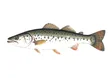
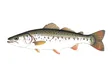
About stoneroller
Campostoma, the stonerollers, is a genus of freshwater ray-finned fish in the family Leuciscidae, the shiners, daces and minnows. The fishes in this genus are found in North America.
Common names
5 species carry stoneroller in an English common name. They sit in 1 family, so the group is a name, not a scientific rank.
Campostoma, the stonerollers, is a genus of freshwater ray-finned fish in the family Leuciscidae, the shiners, daces and minnows. The fishes in this genus are found in North America.
These species profiles show how members of the group differ. Their biology describes each named species, rather than every fish in the group.
 Central Stoneroller
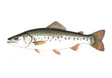
The central stoneroller, or Ohio stoneroller (Campostoma anomalum), is a species of freshwater ray-finned fish in the family Leuciscidae, the shiners, daces and minnows. This fish is found in North America.
Stonerollers have a rounded snout overhanging a crescent-shaped mouth, a hard ridge of cartilage on the lower lip, and irregular patches of dark colored scales on the sides of the body. Breeding males have orange colored fins with a black band on the dorsal fin and often on the anal fin; breeding tubercles (keratinized growths) also cover the head, back, and sides of the body.
The central stoneroller is widespread in freshwater streams throughout a large portion of the eastern, central, and midwestern United States. It is present in the Atlantic Ocean, Great Lakes, Mississippi River, and Hudson Bay basins in the US, from New York west to North Dakota and Wyoming and south to South Carolina and Texas. Isolated populations are also found in Canada and Mexico. The central stoneroller is benthopelagic, inhabiting either the midwaters or bottom of freshwater streams and rivers. It requires some current and is most commonly found in riffles and pools of moderate to high gradient streams with a gravel substrate bottom. However, it is a very tolerant species and can be found in almost any stream system with adequate food, leading to its widespread distribution.
The central stoneroller is generally herbivorous, feeding primarily on algae scraped from rocks and logs with the cartilaginous ridge on its lower jaw. Young fish feed on rotifers, filamentous algae, and microcrustaceans. It also feeds on detritus, diatoms, and occasionally aquatic insects. It is classified as a grazing minnow in its feeding behavior, and large schools of these fish often feed together. Central stonerollers may consume up to 27 percent of their body weight in benthic algae per day. One Kansas study found that algae contributed most (47 percent) to the diet of central stonerollers, followed by detritus (30 percent), animal matter (21 percent), and terrestrial vegetation (2 percent). Some human-induced factors that reduce the abundance of the central stoneroller are altered flow regimens, habitat fragmentation, impacts to aquatic and riparian habitat associated with agricultural practices, and increased siltation and aquatic vegetation.
 Largescale Stoneroller
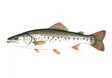
The largescale stoneroller (Campostoma oligolepis) is a species of freshwater ray-finned fish in the family Leuciscidae, the shiners, daces and minnows. This fish is found in the eastern United States.
The largescale stoneroller is found natively in many of North American streams, rivers, lakes, and creeks. It is native to the Upper Mississippi River and Lake Michigan drainages of Wisconsin, eastern Minnesota, eastern Iowa, and northern Illinois; Ozarkian streams of central and southern Missouri, and northern Arkansas; Mobile Bay drainage, Georgia, Alabama, and eastern Mississippi; parts of Green, Cumberland, and Tennessee River drainages of Kentucky, Tennessee, Georgia, and Alabama It has also been introduced into other areas in North America like the Illinois River in Oklahoma. It is thought that the reason for their introduction into the Oklahoma is due to the fact that it is a popular baitfish, and has effects on this area in ways that have not been noticed by scientist and researchers. The largescale stoneroller ranges from Alabama to Oklahoma.
The largescale stoneroller inhabits well-oxygenated waters with temperatures around 46–32 °F (8–0 °C), with low turbulence and a reduced flow of water. It prefers upland habitats above the Fall Line. It is a herbivorous fish which eats diatoms, green algae, and blue-green bacteria, with a tendency to ingest less sand and silt than the central stoneroller. The largescale stoneroller's predators include large and smallmouth bass, the spotted bass, sauger, and the walleye. It is a popular baitfish so anglers also catch them for fishing. The largescale stoneroller can tolerate waters that are polluted and therefore it does not have many competing species.
Largescale stoneroller generally reach sexual maturity at one to four years of age. The breeding process starts with the males constructing the nest in gravel bars and rocks in the late winter. The females then come in the spring and lay the eggs while the males fertilize them. A female can lay anywhere from four hundred to four thousand eggs at one time. After breeding, both male and female leave the nest unattended and let the fry hatch and fend for themselves. The fry stay together and form a school and eat and protect one another. The largescale stoneroller has a life expectancy of around five years.
 Mexican Stoneroller
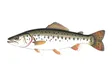
The Mexican stoneroller (Campostoma ornatum) is a species of freshwater ray-finned fish in the family Leuciscidae, the shiners, daces and minnows. This fish is found in Arizona and Texas in the United States and parts of adjacent Mexico. The other species in this genus, Campostoma are morphologically similar.
The Mexican stoneroller has a very stout body with a very large head and snout. The mouth is unique in that its teeth have cartilaginous sheaths, while the size of its mouth is usually very small. The fish's mature length can range anywhere from 3 to nearly 6 inches, however 6 inches is rare, and the average is about 3.5 inches. They have small scales that run along the lateral line, much like the Gila longfin dace and the Yaqui longfin dace. The scales of the Mexican stoneroller can sometimes form arches on its back. Sexual selection has dictated exaggerated male characteristics, which include larger heads and pre-dorsal areas in more successful males. These fish have color patterns with lighter bottoms and darker backs, with a distinct black stripe along the lateral line. They also have a somewhat blotched appearance.
The Mexican stoneroller has been found as far as south as the Rio Yaqui drainage in Mexico and tributaries of the Rio Grande near the Big Bend region of Texas. The habitat of the Mexican stoneroller ranges in elevation between 2600 and 6500 feet.
The Mexican stoneroller prefers shallow waters near gravel and stone substrates, and larger adults can be found in sandy-bottomed streams. They will use under-covered banks to protect themselves from predators and humans. The biotic community of the fish is primarily the Montane Conifer Forest in the Chiricahua Mountains. They are restricted to higher elevations because of their restricted diet of detritus and algae that thrive in colder waters. Aquatic insects are also part of the fish's diet, if these primary sources are not available due to droughts.
Range
Species