Common names

Types of stickleback

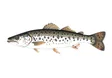
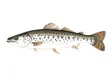
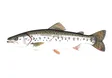
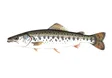
5 species carry stickleback in an English common name. They sit in 1 family, so the group is a name, not a scientific rank.

About stickleback

The sticklebacks are a family of ray-finned fishes, the Gasterosteidae which have a Holarctic distribution in fresh, brackish and marine waters. They were thought to be related to the pipefish and seahorses but are now thought to be more closely related to the eelpouts and sculpins.

Taxonomy

The stickleback family, Gasterosteidae, was first proposed as a family by the French zoologist Charles Lucien Bonaparte in 1831. It was long thought that the sticklebacks and their relatives comprise a suborder, the Gasterosteoidei, of the order Gasterostiformes with the sea horses and pipefishes making up the suborder Syngnathoidei. More recent phylogenetic work has shown that the Gaterosteoidei are more closely related to the Zoarcoidei and the Cottoidei, which would mean that this taxon would belong in the order Scorpaeniformes. However, in other phylogenetic classifications it is treated as the infraorder Gasterosteales within the suborder Cottoidei or as a sister clade to the Zoarcales in the order Zoarciformes.

FishBase recognises 16 species in the family, grouped in five genera. However, several of the species have a number of recognised subspecies, and the taxonomy of the family is thought to be in need of revision.

Description

Sticklebacks are endemic to the temperate zone and are most commonly found in the ocean, but some can be found in fresh water. The freshwater taxa were trapped in Europe, Asia and North America after the last Ice Age 10,000–20,000 years ago and have evolved features different from those of the marine species.

Sticklebacks are carnivorous, feeding on small animals such as insects, crustaceans and fish larvae.

Sticklebacks are characterised by the presence of strong and clearly isolated spines in their dorsal fins. An unusual feature of sticklebacks is that they have no scales, although some species have bony armour plates.

Sizes

The maximum size of the best-known species, the three-spined stickleback (Gasterosteus aculeatus), is about 4 inches, but few of them are more than 3 inches long. They mature sexually at a length of about 2 inches. Most other stickleback species are roughly similar in size or somewhat smaller. The only exception is the far larger fifteen-spined stickleback (Spinachia spinachia), which can reach 22 cm (approx. 8.8 inches). Body form varies with habitat: sticklebacks in shallow lakes have developed a deep body specialized to enable feeding on benthic invertebrates, whilst those in deep oligotrophic lakes have adapted to feed on plankton and have slimmer bodies.

Personality

Research has shown that individual sticklebacks display distinct personality traits, specifically in the area of taking a risk, and can be considered bold or shy. These personality traits were determined to directly influence if they would lead, and, if discouraged, attempt to lead again.

Mating

All stickleback species show similar, unusual mating behaviour. Freshwater males develop a red colouration, and although this may be seen in oceanic and benthic species these tend to remain dull-coloured. The male then constructs a nest from weeds held together by spiggin, a kidney secretion, then attract females to the nest. Females signal their readiness to mate with solitary rather than shoaling behaviour, a head-up posture; their bellies are also obviously distended with eggs. Courtship typically involves a zig-zag 'dance' where the male approaches the female in an erratic side-to-side pattern, and dorsal pricking of the female's abdomen. A female lays her eggs inside the nest, where the male fertilises them. The male then guards the eggs until they hatch 7–14 days later (depending on temperature), and may continue to guard the fry after they hatch. This large investment in both the nesting site and guarding of the eggs limits the number of females a male can mate with however males spawn multiple times. This introduces the ability for selection to favor male mate choice. Some males die following spawning.

Mating choice

Typically, the sex with the greatest parental investment has the strongest mate preferences. Stickleback species exhibit mutual mate choice in which both the male and female have strong mate preferences. This is due in part to the strong parental investment on behalf of the male in guarding the eggs.

Female mate choice

Female sticklebacks show a strong preference to male stickleback with bright red coloration under their throats. Females mate both more often with males with brighter red coloration and give on average, larger eggs to be fertilized by these males. This preference has led to brighter red coloring. This association is possible because the red coloration can only be produced by males that are free of parasites. This is referred to in the Hamilton–Zuk hypothesis.

However, there is also evidence that attractive male red coloration may be a faulty signal of male quality. Male sticklebacks that are more attractive to females due to carotenoid colorants may under-allocate carotenoids to their germline cells. Since carotinoids are beneficial antioxidants, their under-allocation to germline cells can lead to increased oxidative DNA damage to these cells. Therefore, female sticklebacks may risk fertility and the viability of their offspring by choosing redder, but more deteriorated partners with reduced sperm quality.

Female mate choice has also been seen to be condition dependent. Females are almost always the more choosy sex in most species. Female sticklebacks though, have been found to be less choosy of mates when in poor physical condition and inversely, more choosy in good condition.

Male mate choice

In some species, such as the three-spined stickleback, the large investment in both nesting site and guarding of eggs by males limits the number of females a male can mate with. This introduces the ability for selection to favor male mate choice. Male mate choice is rarely studied or observed in many species but multiple studies have confirmed male mate choice within stickleback species. Males show a choosiness similar to females as to what female they are willing to court and mate. Male sticklebacks have been observed to show preference towards female sticklebacks that are larger and longer. This is believed to be because larger females on average produce larger eggs, which leads to a greater offspring survival and fitness. In addition, male sticklebacks have also been observed to prefer females with more distended or bloated stomachs. The benefits of this is also due to larger eggs and thus offspring survival and fitness.

Inbreeding avoidance

Female three-spined sticklebacks adjust their courting behaviour to the risk of inbreeding. When gravid females are given the choice between a courting unfamiliar non-sibling and a familiar brother, they prefer to mate with the non-sibling and thus avoid the disadvantages that accompany incest. Eggs from inbred matings have a lower rate of fertilization and hatching than those from outbred matings and fewer progeny survive to reproductive age.

Use in science

Niko Tinbergen's studies of the behaviour of this fish were important in the early development of ethology as an example of a fixed action pattern. More recently, the fish have become a favourite system for studying the molecular genetics of evolutionary change in wild populations and a "supermodel" for combining evolutionary studies at molecular, developmental, population genetic, and ecological levels. The nearly complete genome sequence of a reference freshwater stickleback was described in 2012, along with set of genetic variants commonly found in 21 marine and freshwater populations around the world. Some variants, and several chromosome inversions, consistently distinguish marine and freshwater populations, helping identify a genome-wide set of changes contributing to repeated adaptation of sticklebacks to marine and freshwater environments. The adaptations seen in oceanic threespine sticklebacks make them an ideal organism for the study of parallel evolution.

In culture

There is a sculpture in Kronstadt dedicated to stickleback, which saved thousands of city residents from starvation during the Leningrad Siege of World War II.
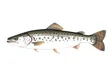
Stickleback species in focus

These species profiles show how members of the group differ. Their biology describes each named species, rather than every fish in the group.

Alaskan Stickleback

The three-spined stickleback (Gasterosteus aculeatus) is a fish native to most inland and coastal waters north of 30°N. It has long been a subject of scientific study for many reasons. It shows great morphological variation throughout its range, ideal for questions about evolution and population genetics. Many populations are anadromous (they live in seawater but breed in fresh or brackish water) and very tolerant of changes in salinity, a subject of interest to physiologists. It displays elaborate breeding behavior (defending a territory, building a nest, taking care of the eggs and fry) and it can be social (living in shoals outside the breeding season) making it a popular subject of inquiry in fish ethology and behavioral ecology. Its antipredator adaptations, host-parasite interactions, sensory physiology, reproductive physiology, and endocrinology have also been much studied. Facilitating these studies is the fact that the three-spined stickleback is easy to find in nature and easy to keep in aquaria.

Evolution

The three-spined stickleback appears to be a rather old species that has remained morphologically unchanged for more than 10 million years. The oldest record of the species is from the Alta Mira Shale of the Monterey Formation of California, which preserves an articulated skeleton that appears essentially identical to the modern G. aculeatus complex. A slightly younger specimen is known from diatomite deposits from Lompoc that also belong to the Monterey Formation. Both specimens are known from marine deposits, suggesting a marine or anadromous lifestyle. The presence of the three-spined stickleback in the Miocene suggests that the three-spined stickleback complex must have diverged from the blackspotted stickleback prior to this point.

The iconic evolutionary traits of the three-spined stickleback, including rapid evolution in isolated environments, reduction of armor and pelvis, and ecological divisions into different niches, appear to have been a longstanding tendency of the Gasterosteus lineage. These traits are all present in a fossil stickleback, Gasterosteus doryssus, known from Miocene-aged freshwater deposits of the Truckee Formation in Nevada, US, which saw rapid evolution and morphological change over a period of several thousand years.

Description

This species can occasionally reach lengths of 8 cm (3.1 in), but lengths of 3–4 centimetres (1.2–1.6 in) at maturity are more common. The body is laterally compressed. The base of the tail is slender. The caudal fin has 12 rays. The dorsal fin has 10–14 rays; in front of it are the three spines that give the fish its name (though some individuals may have only two or four). The third spine (the one closest to the dorsal fin) is much shorter than the other two. The back of each spine is joined to the body by a thin membrane. The anal fin has eight to eleven rays. The pelvic fins consist of just a spine and one ray. All spines can be locked in an erect position, making the fish extremely hard to swallow by a predator. The pectoral fins are large, with 10 rays. The body bears no scales, but is protected by bony plates on the back, flanks, and belly. Only one ventral plate is present, but the number of flank plates varies greatly across the distribution range and across habitat types (see below); it is normally higher in marine populations (some freshwater populations may in fact lack lateral plates altogether).

Dorsal coloration varies, but tends towards a drab olive or a silvery green, sometimes with brown mottling. The flanks and belly are silvery. In males during the breeding season, the eyes become blue and the lower head, throat, and anterior belly turn bright red. The throat and belly of breeding females can turn slightly pink. A few populations, however, have breeding males which are all black or all white.

Habitat and distribution

The three-spined stickleback is found only in the Northern Hemisphere, where it usually inhabits coastal waters or freshwater bodies. It can live in either fresh, brackish, or salt water. It prefers slow-flowing water with areas of emerging vegetation. It can be found in ditches, ponds, lakes, backwaters, quiet rivers, sheltered bays, marshes, and harbours.

In North America, it ranges along the East Coast from Chesapeake Bay to the southern half of Baffin Island and the western shore of Hudson Bay, and along the West Coast from southern California to the western shore of Alaska and the Aleutian Islands. It can be found throughout Europe between 35 and 70°N. Locally present in the Volga River basin. In Asia, the distribution stretches from Japan and the Korean peninsula to the Bering Straits.

Read the full species guide.

Blackspotted Stickleback

The blackspotted stickleback (Gasterosteus wheatlandi) is species of ray-finned fish belonging to the family Gasterosteidae, the sticklebacks. This fish is found in the western Atlantic from the coasts of Newfoundland (Canada) to Massachusetts (United States). This is a benthopelagic species of marine and brackish waters, rarely entering freshwater, which remains near the shore. It is frequently associated with floating vegetation. The male builds a nest, in which the females deposit eggs and the male guards and aerates them. It is a small fish which reaches a maximum published total length of 7.6 cm (3.0 in), although 3.5 cm (1.4 in) is more typical. The specific name honors Richard H. Wheatland who was the Cabinet Keeper (and collector of fishes and reptiles), for the Essex County Natural History Society of Salem, Massachusetts and who collected type of this species in 1859.

Read the full species guide.

Ninespine Stickleback

The ninespine stickleback (Pungitius pungitius), also called the ten-spined stickleback, is a freshwater species of fish in the family Gasterosteidae that inhabits temperate waters. It is widely but locally distributed throughout Eurasia and North America. Despite its name, the number of spines can vary from 8 to 12.

Description

The ninespine stickleback is a small fish, reaching a maximum size of around 12.5 cm. It reaches an age of about 3 years. The body of the ninespine stickleback tapers to a very narrow caudal peduncle and the caudal fin is fan-shaped. The body is less deep and more elongated than that of the three-spined stickleback with a thinner and longer caudal peduncle, but the best way of distinguishing these two species is the number of spines in front of the dorsal fin which, for this species, varies from seven to twelve although nine is the commonest number. This species does not have scales but there is a group of small bony plates on the narrowest part of the caudal peduncle at the lateral line. The mouth points upwards in this species. It is generally greyish or olive-brown with silvery flanks irregularly barred or blotched with darker colour. During the breeding season, the males develop a black area around the pelvis and the pelvic spines become white. The eyes are dark with a gold ring around the pupils.

The ninespine stickleback lives in streams, lakes, ponds and rivers and favors thick submerged vegetation, as its small spines do not offer much protection. Like the three spined stickleback, they have a series of scutes or bony plates along the lateral line but, in freshwater populations, these are frequently reduced in number with a gap between the anterior and posterior plates.

Distribution

The species occurs in freshwater systems draining into the Arctic Ocean and the Atlantic across Canada, Alaska, and south to New Jersey. It is present on the North American Pacific coast of Alaska and in the Great Lakes basin. It can also be found throughout most of Eurasia, including the United Kingdom, Greenland, Turkey and the Far East.

Behaviour

During the breeding season (April to July), the male builds a nest suspended on a piece of waterweed, about an inch or so above the substrate at the bottom. The female is attracted by the male and she lays eggs inside the nest, but then departs, leaving parental care to the male. The male guards these eggs and the young fry when they hatch. Then, when they have their spines, he drives them away to look after themselves.

Read the full species guide.

Range

Where stickleback live

How many of the 5 species are recorded in each state.
0
5
How many of the 5 species are recorded in each state.

Species

All 5 stickleback species