Diet
Not much is known about its feeding habits but what is known is that they feed mainly on zooplankton and zoobenthos. Cannibalism has been reported among smaller juveniles.
Habitat
The bay whiff lives along the bottom of coastal waters in depths from forty fathoms to twenty fathoms. They have a high salinity tolerance and have been found near freshwater areas as low as 0.9 psu to coastal waters exceeding 35 psu.
Reproduction and life cycle
Spawning season for C. spilopterus vary with location. Water temperature is a main reason for this reason for this variation. Populations in Brazil spawn from March to May and November, the North Carolina season is restricted to February and March, and Puerto Rico fishes spawn from November to May, and the peak of spawning occurs in both winter and spring in Louisiana. In Florida, the large presence of juveniles in May suggests a spring spawning season.
Distribution
They are found throughout the western Atlantic from New Jersey through the Caribbean to Brazil. They are distributed throughout the Gulf of Mexico and move into the bays and shallow waters during the warmer months of the year.
Other species mistaken for the bay whiff
Three similarly-sized species of Citharichthys have been found and are similar to the bay whiff. The Gulf Stream flounder, C. arctifrons; the sand whiff, C. arenaceus; and the spotted whiff, C. macrops.
Additional field notes
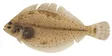
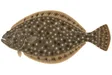
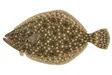
The bay whiff is a small flatfish associated with soft estuarine bottoms. Its mottled upper surface and flattened outline can make it inconspicuous against sand or mud.
Field identification notes
Both eyes lie on the left side of the head, close together with only a narrow bony ridge between them. The mouth reaches beneath the lower eye. The upper side is brown with lighter and darker spots, and a dark mark may appear near the tail base. The Smithsonian account lists a length of 20 cm.
Habitat and range notes
The regional range runs from New Jersey to southern Brazil. Bay whiff occupy soft bottoms in estuaries, including brackish and unusually salty water. They are not confined to the same salinity as the open coast, and their estuarine association is central to understanding where they occur.
Feeding and life-history notes
Small fishes, bottom-dwelling crustaceans, and worms are listed as foods. The Smithsonian life-history categories record pelagic eggs and larvae. Identification should use the position of the eyes and the fins as well as the variable spotting.
Guide sources
Research reviewed 2026-10-17.
- Citharichthys spilopterus species account — Smithsonian Tropical Research Institute
Article text: Wikipedia contributors, Bay whiff (source revision). Licensed under CC BY-SA 4.0. Retrieved 2026-10-11.