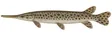
Shortnose Gar

Lepisosteus platostomus

Lepisosteidae · freshwater water fish

7 minute read · Species guide

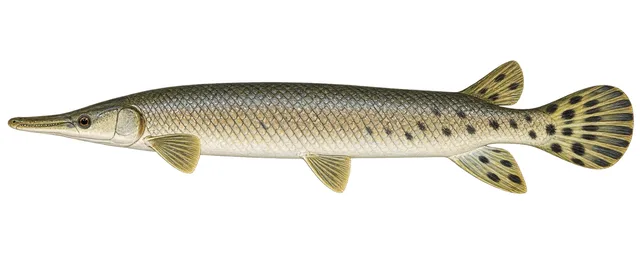
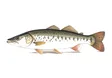
Shortnose Gar field guide illustration

About Shortnose Gar

The shortnose gar (Lepisosteus platostomus) is a primitive freshwater fish of the family Lepisosteidae. It is native to the United States where its range includes the Mississippi and Missouri River basins, ranging from Montana to the west and the Ohio River to the east, southwards to the Gulf Coast. It inhabits calm waters in large rivers and their backwaters, as well as oxbow lakes and large pools. It is a long, slender fish, brown or olive green above and whitish below. It typically grows to about 60 cm (24 in) and is armored by rows of interlocking, rhomboidal ganoid scales.

The shortnose gar is an ambush predator, feeding mostly on fish, but also consuming crustaceans, insects, and other invertebrates. Breeding takes place in spring when females, often accompanied by several males, attach their eggs to clumps of submerged vegetation. The eggs, which are toxic to man, hatch after a week or so. After consuming their yolk sac, the young fish feed on insect larvae and small crustaceans, maturing at an age of about three years.

Description

Shortnose gar have a prehistoric-looking appearance. Like many other "lie-in-wait" predators, they have an elongated, torpedo-like body with an elongated head containing one row of sharp, conical teeth. Similar to many Paleozoic and Mesozoic actinopterygians, their bodies are covered in rows of interlocking, rhomboidal ganoid scales that create an exceptionally protective, yet flexible armor around the fish. The dorsal fin is located posterior nearly directly above the anal fin and very near the large caudal fin. Shortnose gar vary in color, changing from brown/olive green on the dorsal surface to yellow on the sides and white on the underbelly. Shortnose gar can be discerned from other gar species in that they lack the upper jaw of the alligator gar, the long snout of the longnose gar, and the markings of the spotted gar. The shortnose gar reaches up to 88 cm (35 in), but a more common length is 62.5 cm (24.6 in).

Habitat

Shortnose gar generally inhabit calm waters in large rivers and their backwaters, as well as oxbow lakes and large, quiet pools, typically around vegetation or downed logs. Gar have the ability to survive in environments with very little oxygen and especially turbid conditions because of their specialized gas bladder. Gar gas bladders have the ability to function like a lung to extract and use oxygen from swallowed air in addition to regulating buoyancy.

Reproduction and lifecycle

Shortnose gar typically spawn in the spring during April, May, and June, when water temperatures are between 16 and 21 °C (61 and 70 °F). Often accompanied by more than one male, females scatter large, yellowish-green eggs in quiet, shallow water among submerged vegetation or other underwater structures. A sticky adhesive holds the eggs together in clumps, where they hatch after eight to 9 days. The eggs are poisonous to birds and mammals, including humans. The young remain in the yolk sac for another week, then they feed on insect larvae and small crustaceans. Young gar typically lead solitary lives and sexual maturity is achieved around three years of age when the gar reaches about 15 in (380 mm) in length.

Diet and habits

Shortnose gar are efficient, fierce, ambush predators. They feed mainly on fish, but they are very opportunistic and also eat crayfish, insects, and other invertebrates. During seasonal flooding, Shortnose gar have been observed exploiting newly accessible floodplains to reach terrestrial prey, such as insects and amphibians, thereby broadening their dietary opportunities. Despite feeding mainly on whatever fish are available, Shortnose gar eat more invertebrates than any other gar and have even been found to exhibit territorial defense behaviors around favorable pools while foraging on high numbers of periodical cicadas.

Distribution

Shortnose gar today are only located in North America. Located mainly in the central United States, they occupy much of the Mississippi and Missouri River basins ranging from Montana (in the west) to the Ohio River (in the east) in the north and the Gulf Coast from Louisiana and Alabama to parts of Texas in the south.

Importance to humans

Shortnose gar help maintain ecosystem equilibrium by feeding on minnows that are destructive to game fish and other fish populations. They are popular aquarium fish, and are frequently found in public aquariums across the country.

Conservation status

With very few natural predators able to cope with a gar's thick ganoid scale armor, shortnose gar are generally plentiful. One exception is in Montana, where they are considered a fish of special concern due to restricted distribution and limited population sizes. In Ohio, they are an endangered species because of limited range (primarily the Ohio River and lower Scioto and Great Miami Rivers).

Etymology of name

In Greek, Lepisosteus translates to "bony scale", and platostomus translates to "broad mouth".

Article text: Wikipedia contributors, Shortnose gar (source revision). Licensed under CC BY-SA 4.0. Retrieved 2026-10-11.
Diet and feeding

The FishTraits compilation records these diet categories for this species: invertebrates or larval fish; larger animal prey (a source category covering fish, crayfish, crabs, or frogs). These are broad categories, not a claim that every individual consumes every example in a category.

Reported feeding positions include surface or water-column feeding. The compilation combines published observations; diets can vary with age, locality, and available food.

Habitat preferences

Reported habitat associations include medium to large rivers, streams and small rivers, still-water habitats.

The source records associations with gravel, bedrock, vegetation. An association indicates reported use, rather than an exclusive requirement.

Reproduction and parental care

The compilation reports a representative maturity age of 3 years. Its maturity field summarizes mean, median, or modal estimates, usually for females; male estimates can be used when female data are unavailable. It is not a fixed age at which every fish first breeds.

Recorded spawning months are May, Jun for the source’s reporting region (TN). This is a regional calendar, not a range-wide schedule.

The reproductive-guild classification includes spawning on open substrates without guarding the brood.

Size and recorded longevity

FishTraits reports a maximum total length of 88 centimetres. Some entries use an estimated asymptotic length; this value should not be treated as a certified record catch.

Recorded longevity in the compilation is 20 years. Wild observations were preferred, but captive records were accepted where wild records were unavailable, and unspecified records were assumed wild. The value is not a guaranteed wild lifespan or an aquarium life expectancy.

Identification and appearance

Lepisosteus platostomus is a long, slender fish with rows of interlocking rhomboidal ganoid scales. It is brown or olive green along its back, which fades to yellowish sides and a whitish belly. The dorsal fin is located to the posterior, almost directly above the anal fin, and is close to the large caudal fin. Shortnose gar can be discerned from other gar species in that they lack the upper jaw of the alligator gar, the long snout of the longnose gar, and the markings of the spotted gar. For further identification details, see Suttkus (1963); Becker (1983); Page and Burr (1991); Etnier and Starnes (1993).

Native range

Mississippi River basin from south-central Ohio, northern Indiana and Wisconsin to Montana and south to northern Alabama and Louisiana (Page and Burr 1991).

Habitat and ecology

Shortnose gar typically spawn in the spring during April, May and June, when water temperatures are between 16 and 21 °C. Females scatter large, yellowish-green eggs in quiet, shallow water among submerged vegetation or other underwater structures. A sticky adhesive holds the eggs together in clumps where they hatch after eight to nine days. The eggs are poisonous to birds and mammals, including humans (Montana Field Guide, 2019). The young remain in the yolk sac for another week, where they feed on insect larvae and small crustaceans. Young gar typically lead solitary lives and sexual maturity is achieved around three years of age when the gar reaches about 15 in (380 mm) in length (Montana Field Guide, 2019).

The diet of the shortnose gar is primarily composed of fish, though crayfish and insects are also utilized (Brown 1971). Young gar are known to feed on small insects and zooplankton, with fish entering the diet when gar are 1.25 inches in length. Gar are known as fierce predators of smaller fish, using ambush as a primary hunting technique.

Gar have the ability to survive in environments with very little oxygen and especially turbid conditions because of their specialized gas bladder, which have the ability to function like a lung to extract and use oxygen from swallowed air in addition to regulating buoyancy (Montana Field Guide, 2019).

Introduction history

This species likely reached Lake Winnebago via the Wisconsin-Fox Canal, a canal connection from the Mississippi River basin to the Fox River in the Great Lakes basin (Priegel 1963).

Range

Where it lives

Share of 1,819 GBIF observation records with a state location, across 24 states. The orange dots are USGS stream-survey sites where this species was caught.
0%
21.2%
Share of 1,819 GBIF observation records with a state location, across 24 states. The orange dots are USGS stream-survey sites where this species was caught.

A blank area on the dot layer usually means nobody sampled there, not that the fish is absent. Turn on “every survey site” to see where the survey looked.

The USGS stream survey caught it at 430 of its sites, in 20 states. That survey and the GBIF records are two different counts of two different things, so the site keeps them apart.

Habitat

Water and movement

Water
WoRMS records this species in fresh water.
USGS NAS habitat
Freshwater
US status
Native transplant — native to part of the United States, moved to other waters inside it.
Migration
Undetermined
Pattern

Classification

Taxonomy

Kingdom
Animalia
Phylum
Chordata
Superclass
Actinopterygii
Class
Holostei
Order
Lepisosteiformes
Genus
Lepisosteus
Species
Lepisosteus platostomus
ITIS TSN
161096
WoRMS AphiaID
1017720
GBIF key
2346740

Common questions about Shortnose Gar

What is the scientific name of Shortnose Gar?
The scientific name is Lepisosteus platostomus, in the family Lepisosteidae. Classification follows ITIS.
Does Shortnose Gar live in fresh water or salt water?
WoRMS records this species in fresh water.
Where has Shortnose Gar been recorded in the United States?
GBIF has observations in 24 states, with the most records in Illinois, Missouri, Oklahoma. The map shows observation records, which do not establish the complete natural range.

Closest relatives

Other Lepisosteus species

Same family

More Lepisosteidae