Florida Gar

Lepisosteus platyrhincus

Lepisosteidae · freshwater water fish

5 minute read · Species guide

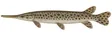
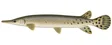
Florida Gar field guide illustration

About Florida Gar

The Florida gar (Lepisosteus platyrhincus) is a species of gar found in the US from the Savannah River and Ochlockonee River watersheds of Georgia and throughout peninsular Florida. Florida gar can reach a length over 3 ft (91 cm). The young feed on zooplankton and insect larvae, as well as small fish. Adults mainly eat fish, shrimp, and crayfish. Although edible, they are not popular as food. The roe is highly toxic to many animals, including humans and birds.

Appearance

This is a mid-sized species of gar. It measures from 51.7 to 132.2 cm (20.4 to 52.0 in) long and typically weighs 1.36 to 4.36 kg (3.0 to 9.6 lb). According to the IGFA, the record weight for this species is 10 lb (4.5 kg). This species has irregular round, black spots on the top of its head and over the entire body including the anal fin. The distance of the eyes is less than two-thirds the length of the snout. Also, it has a shorter, broad snout with a single row of irregularly spaced sharp teeth on the upper and lower jaws. No bony scales are on the throat. Their color is olive-brown on the back and upper sides, with a white to yellow belly. The young may have dark stripes on the back and sides.

Environment

They can be found in the Ochlockonee River and waters east and in peninsular Florida in medium to large lowland streams, canals, and lakes with muddy or sandy bottoms near underwater vegetation. They are often found in medium to shallow waters. They use an air bladder to breathe air which helps them survive in poorly oxygenated water. They sometimes will hide in weeds in 4–10 feet. Usually when you find them here, they will have their head in the weeds and will only show a small portion of the body. Some times they will be sitting on the edge of a weed bed. Here they will be about 3–8 inches below the surface. Usually the bottom will be 3 feet or more. It is also common to find them sitting in a marshy shoreline, these gar are typically 2 feet or more in length, with the bottom being no deeper than 6 inches. Larger specimens are rare, but are commonly found in swampy parts of lakes. These areas are never deeper than 6–8 feet.

Reproduction

This occurs in late winter and early spring, with spawning typically occurring between February and March. Groups of both sexes come together in shallow, weedy water where the females discharge their adhesive eggs among the aquatic plants. Female's eggs are typically fertilized by multiple males. The hatched young possess an adhesive organ on the end of their snouts and stay attached to vegetation until about 0.8 in (2 cm) long. Following spawning in the late winter and early spring, male Florida gars undergo a decrease in their reproductive parameters throughout the summer. This includes a decrease in reproductive hormone levels and gonad maturation.

Behavior

During the dry season, Florida gars burrow into the sediments of the marshes they inhabit and aestivate through the dry season. Aestivation, similar to hibernation in other species, lowers the animal's metabolic rate. This allows the Florida gar to withstand the high temperatures and dry conditions of their habitats during the summer.

Feeding habits

Adult Florida gar are ambush predators; they stalk their prey and utilize a lateral lunge of their long heads in order to strike and catch their prey. These strikes are very short and fast, typically lasting for only 25 to 40 milliseconds in length. Upon catching their prey, the gar thrash their head from side to side to manipulate the prey before repositioning it to swallow it head first. Adult Florida gar tend to feed on fish, shrimp and crayfish, while young gar feed on zooplankton and insect larvae.

Article text: Wikipedia contributors, Florida gar (source revision). Licensed under CC BY-SA 4.0. Retrieved 2026-10-11.
Diet and feeding

The FishTraits compilation records these diet categories for this species: invertebrates or larval fish; larger animal prey (a source category covering fish, crayfish, crabs, or frogs). These are broad categories, not a claim that every individual consumes every example in a category.

Reported feeding positions include surface or water-column feeding. The compilation combines published observations; diets can vary with age, locality, and available food.

Habitat preferences

Reported habitat associations include medium to large rivers, streams and small rivers, still-water habitats.

Reproduction and parental care

The compilation reports a representative maturity age of 6 years. Its maturity field summarizes mean, median, or modal estimates, usually for females; male estimates can be used when female data are unavailable. It is not a fixed age at which every fish first breeds.

Batch or serial spawning has been reported somewhere in the species’ range. This does not establish the same spawning pattern for every population.

Recorded spawning months are Apr, May, Jun, Jul, Aug, Sep, Oct for the source’s reporting region (FL). This is a regional calendar, not a range-wide schedule.

The reproductive-guild classification includes spawning on open substrates without guarding the brood.

Size and recorded longevity

FishTraits reports a maximum total length of 132 centimetres. Some entries use an estimated asymptotic length; this value should not be treated as a certified record catch.

Recorded longevity in the compilation is 20 years. Wild observations were preferred, but captive records were accepted where wild records were unavailable, and unspecified records were assumed wild. The value is not a guaranteed wild lifespan or an aquarium life expectancy.

Record fish

The Florida state record

  • Florida9.44 lb

    Lake Lawne · Orange County · 3/25/2001 · Patric A. McDaniel

Each figure is the state agency’s own certified record. The site holds record tables for 11 states so far, so a state missing here has not been read yet. It is not a state where this fish holds no record.

Range

Where it lives

Share of 6,299 GBIF observation records with a state location, across 4 states. The orange dots are USGS stream-survey sites where this species was caught.
0%
99.1%
Share of 6,299 GBIF observation records with a state location, across 4 states. The orange dots are USGS stream-survey sites where this species was caught.

A blank area on the dot layer usually means nobody sampled there, not that the fish is absent. Turn on “every survey site” to see where the survey looked.

The USGS stream survey caught it at 94 of its sites, in 2 states. That survey and the GBIF records are two different counts of two different things, so the site keeps them apart.

Habitat

Water and movement

Water
WoRMS records this species in fresh water.
USGS NAS habitat
Freshwater
US status
Native transplant — native to part of the United States, moved to other waters inside it.
Migration
Not migratory

Classification

Taxonomy

Kingdom
Animalia
Phylum
Chordata
Superclass
Actinopterygii
Class
Holostei
Order
Lepisosteiformes
Genus
Lepisosteus
Species
Lepisosteus platyrhincus
ITIS TSN
161098
WoRMS AphiaID
1017721
GBIF key
2346698

Common questions about Florida Gar

What is the scientific name of Florida Gar?
The scientific name is Lepisosteus platyrhincus, in the family Lepisosteidae. Classification follows ITIS.
Does Florida Gar live in fresh water or salt water?
WoRMS records this species in fresh water.
Where has Florida Gar been recorded in the United States?
GBIF has observations in 4 states, with the most records in Florida, Georgia, South Carolina. The map shows observation records, which do not establish the complete natural range.

Closest relatives

Other Lepisosteus species

Same family

More Lepisosteidae