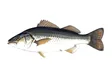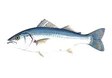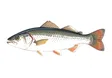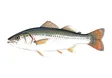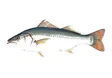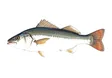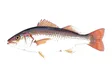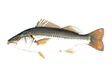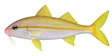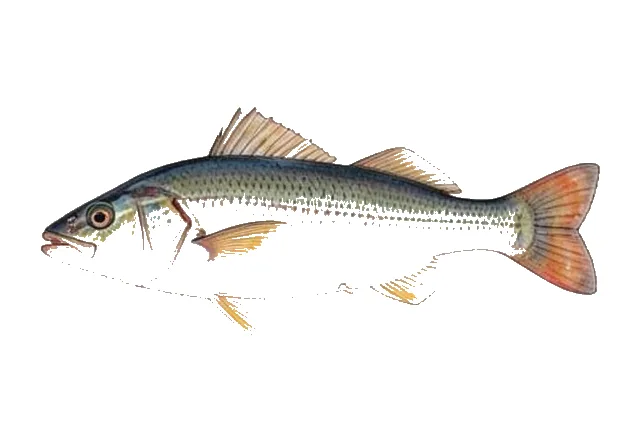
Its Hawaiian name is moano-nui-ka-lehua (meaning "great moano of the lehua"), and the juveniles are called 'ahua or 'ohua (meaning "seedling"). Moano in Hawaiian means pale-red color.
Description
A recognizable feature of the goatfish is their chin whiskers. Some common features are yellow or blue accents on the edges of scales, dark spots around the eyes, dark spots around the base of the pectoral fin, and white and dark bars. Some common color variations include: red with black spots; light red with no spots; black with yellow spot near the tail; and purple-red with yellow and black spots. Males of this species can reach a length of 35 centimetres (14 in) TL while females only reach 17.9 centimetres (7.0 in) SL. Their reproductive size is 7 inch (17.8 cm). The heaviest recorded moano was 453 g (0.9987 lb). The life history of the moano has a pelagic larval duration of 24 – 28 days in captivity.
Ecology
Moano are common reef fish found in shallow water environments, reef flats, and outside reefs. They spend a lot of their time in the benthic zone. They can be found at depths 0 – 161 m deep (0 – 528 ft).
They are endemic in three regions: Hawaiʻi, Marquesas, and the Indo-Polynesian Province.
Diet
They are diurnal consumers that prey on crustaceans and small fishes. They can be omnivores.
Fishing regulations
In Hawaiʻi, it is common to catch moano using nets / traps, spears, and pole/line. In Hawaiʻi, the minimum size requirement is seven inches, and eight inches on the island of Maui.
Human uses
Moano are game fish that can be eaten raw, broiled, or baked. This is a commercially important species, and can be found in the aquarium trade.
Additional field notes
Common goatfish feed by day across reef flats, lagoons, and adjacent bottom habitats.
Food and habitat details
FishBase identifies small crabs and shrimp as the main foods, with bottom-dwelling fish eggs, mollusks, and foraminiferans also recorded. The fish therefore take several kinds of animal prey rather than relying on one crustacean. Habitat includes sand patches, rubble, and consolidated limestone as well as coral bottoms. Individuals sometimes school.
A closer look at the fins
In adults the last soft ray of the dorsal fin is notably longer than the ray immediately before it. FishBase also describes a dusky-to-black area at the base of the second dorsal fin, with finer blue and yellow bands toward its outer edge. These smaller structural and color details can supplement the broad body bars when comparing similar goatfish.
Article text: Wikipedia contributors, Parupeneus multifasciatus (source revision). Licensed under CC BY-SA 4.0. Retrieved 2026-10-11.