Central Mudminnow

Umbra limi

Umbridae · freshwater water fish

5 minute read · Species guide

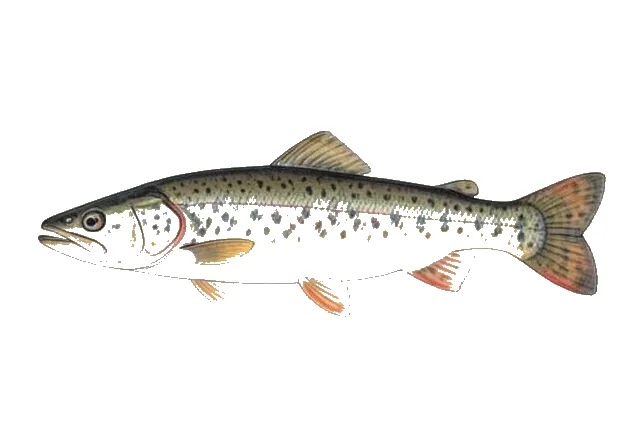
Central Mudminnow field guide illustration

About Central Mudminnow

The central mudminnow (Umbra limi) is a small fish in the family Umbridae of the order Esociformes. It is found in central and eastern North America in productive waters. It is fairly tolerant of low oxygen concentrations and, as a result, it is sometimes the only, or one of a very few, fish species present in waters susceptible to winter or summer kill.

Description

The central mudminnow lives in slow-moving water around ponds, lakes, and streams in central North America, and ranges in length from 51–102 mm. It burrows tail-first in mud and can tolerate low oxygen levels, allowing it to live in waterways unavailable to other fishes. Its coloration matches this habitat, being brownish above with mottled sides and a pale belly. It is eaten by many species of fish such as grass pickerel, sunfishes, northern pike, and catfishes; it is also preyed upon by birds, foxes, and snakes when caught out of water. According to Paszkowski and Tonn, mudminnows perform better in environments with other fish species than in environments with just mudminnows, because the "interspecific interactions override a similar contribution for the mudminnow, which is regarded as a fugitive species". Central mudminnows are known to eat a large variety of zooplankton and benthic and epiphytic macroinvertebrates. Adults are also known to feed energetically in the winter months on littoral fish. One experiment conducted by Colgan and Silburt resulted in mudminnows typically feeding more on benthic than planktonic resources, with zooplankton making up only 0.7% out of 511 items found in the stomach. This mudminnow uses a modified gas bladder to breathe air pockets trapped between the ice and water during the winter to feed and stay active.

Distribution

Umbra limi is a widely distributed species that inhabits many freshwater systems such as lakes, streams, and wetlands near the littoral zone, or near the shore, and around dense cover in central North America west of the Appalachian Mountains, including the St. Lawrence River, Great Lakes, Hudson Bay, Red River, and the Mississippi River basins from Quebec to Manitoba and south to central Ohio, western Tennessee, and northeastern Arkansas. The central mudminnow has also been introduced into many of the tributaries in Connecticut and Massachusetts. Their habitats being marshy lands and rivers are under attack by human development and contact constantly and is likely causing a decline in their populations.

Ecology

The central mudminnow is carnivorous and typically feeds in the benthic area of freshwater habitats. According to Colgan and Silburt, it prefers amphipods, coleopterans, and anisopterans while avoiding zooplankton and other planktonic species. In a study by Colgan and Silburt, they found that an average of only 0.9% of the contents of dissected stomachs of U. limi contained zooplankton. Chironoids and gastropods, when taken from the dissection, had a combined volume of about 60%, which proves that the mudminnow feeds mainly in benthic areas.

This fish seems to prefer water with low dissolved oxygen levels, warmer temperatures, and low flow. It is able to live in hypoxic conditions because of its ability to breathe air. This species is also known to feed in the winter in temperatures as low as 1.1 °C. According to Jenkins and Miller, some animals that feed on the mudminnow are the grass pickerel, sunfishes, northern pike, and catfishes; it is also preyed upon by birds, foxes, and snakes when caught out of water. This mudminnow is known to bury itself in the mud or sand to avoid capture in some situations. Also, Jenkins and Miller found that the mudminnow is a shoaling fish; they prefer to be with other mudminnows rather than by themselves. This shoaling mechanism seems to reduce their predation risk.

Life history

The central mudminnow tends to spawn in mid-April in temperatures of 13 °C with the higher temperature stimulating the spawning. Spawning can take place in shallow waters and produce up to 2,500 eggs in one season. The average age of the central mudminnow is three, while they can reach ages of five or six. Females are typically larger than males when compared around age two. The egg stage is generally six days and then they enter the larval stage of development.

Article text: Wikipedia contributors, Central mudminnow (source revision). Licensed under CC BY-SA 4.0. Retrieved 2026-10-11.
Diet and feeding

The FishTraits compilation records these diet categories for this species: aquatic or other vascular plants; invertebrates or larval fish; larger animal prey (a source category covering fish, crayfish, crabs, or frogs). These are broad categories, not a claim that every individual consumes every example in a category.

Reported feeding positions include bottom feeding and surface or water-column feeding. The compilation combines published observations; diets can vary with age, locality, and available food.

Habitat preferences

Reported habitat associations include streams and small rivers, creeks, still-water habitats.

The source records associations with muck, clay or silt, sand, gravel, cobble, boulders, organic debris. An association indicates reported use, rather than an exclusive requirement.

Reproduction and parental care

The compilation reports a representative maturity age of 1 years. Its maturity field summarizes mean, median, or modal estimates, usually for females; male estimates can be used when female data are unavailable. It is not a fixed age at which every fish first breeds.

Recorded spawning months are Mar, Apr for the source’s reporting region (WI). This is a regional calendar, not a range-wide schedule.

The reproductive-guild classification includes guarding eggs or young at a spawning substrate or nest.

Size and recorded longevity

FishTraits reports a maximum total length of 14 centimetres. Some entries use an estimated asymptotic length; this value should not be treated as a certified record catch.

Recorded longevity in the compilation is 4 years. Wild observations were preferred, but captive records were accepted where wild records were unavailable, and unspecified records were assumed wild. The value is not a guaranteed wild lifespan or an aquarium life expectancy.

Native range

St. Lawrence-Great Lakes, Hudson Bay (Red River), and Mississippi River basins from Quebec to Manitoba and south to central Ohio, western Tennessee, and northeastern Arkansas; Hudson River drainage (Atlantic Slope), New York. Isolated populations in Missouri River drainage of east central South Dakota and western Iowa (Page and Burr 1991).

Habitat and ecology

Commonly found in slow moving streams, creeks, drainage ditches, and ponds with abundant vegetation and bottom layer of organic matter (Scott and Crossman 1973). Primarily consumes benthic invertebrates (ostracods, cladocerans, copepods, chironomids, gastropods) and occasionally small fishes (Peckham and Dineen 1957).

Introduction history

Released lab animals in Massachusetts. First collected in 1975 in Massachusetts (Hartel et al. 2002). Unknown in Maine, Montana, Oklahoma, and Texas. Biologists of the Oklahoma Department of Wildlife Conservation found a single specimen in a shipment of fathead minnows from a fish farm in Pontotoc County, Oklahoma (Pigg et al. 1996).

Range

Where it lives

Share of 4,913 GBIF observation records with a state location, across 27 states. The orange dots are USGS stream-survey sites where this species was caught.
0%
26.3%
Share of 4,913 GBIF observation records with a state location, across 27 states. The orange dots are USGS stream-survey sites where this species was caught.

A blank area on the dot layer usually means nobody sampled there, not that the fish is absent. Turn on “every survey site” to see where the survey looked.

The USGS stream survey caught it at 2,249 of its sites, in 14 states. That survey and the GBIF records are two different counts of two different things, so the site keeps them apart.

Habitat

Water and movement

Water
WoRMS records this species in fresh water.
USGS NAS habitat
Freshwater
US status
Native transplant — native to part of the United States, moved to other waters inside it.
Migration
Undetermined
Pattern
Disagreement
4 published references do not agree on the pattern: Non-migratory, Potamodromous. The site shows every assignment rather than picking one.

Classification

Taxonomy

Kingdom
Animalia
Phylum
Chordata
Superclass
Actinopterygii
Class
Teleostei
Order
Esociformes
Family
Umbridae
Genus
Umbra
Species
Umbra limi
ITIS TSN
162153
WoRMS AphiaID
1022375
GBIF key
5203110
Outside the US
ITIS also files it in Canada.

Common questions about Central Mudminnow

What is the scientific name of Central Mudminnow?
The scientific name is Umbra limi, in the family Umbridae. Classification follows ITIS.
Does Central Mudminnow live in fresh water or salt water?
WoRMS records this species in fresh water.
Where has Central Mudminnow been recorded in the United States?
GBIF has observations in 27 states, with the most records in Michigan, Minnesota, Wisconsin. The map shows observation records, which do not establish the complete natural range.

Closest relatives

Other Umbra species

Same family

More Umbridae