Olympic Mudminnow

Novumbra hubbsi

Umbridae · freshwater water fish

4 minute read · Species guide

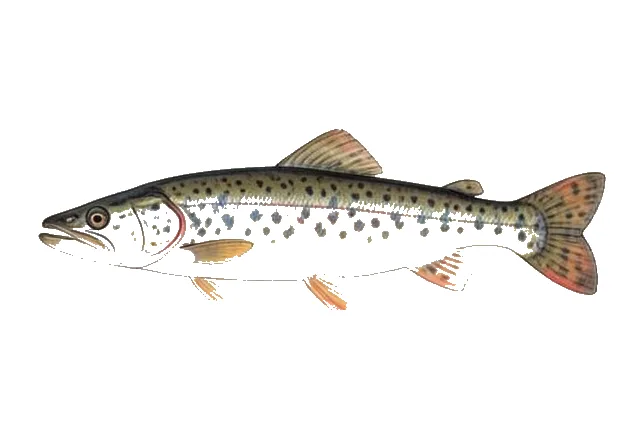
Olympic Mudminnow field guide illustration

About Olympic Mudminnow

The Olympic mudminnow (Novumbra hubbsi) is a fish native to the western lowlands of the US state of Washington: the Chehalis River basin, Deschutes River basin, and some Olympic Peninsula basins. It grows to 8 cm (about 3 in) in length, and is Washington's only known endemic freshwater fish species. Although they strongly resemble killifish, mudminnows are more closely related to pike and muskellunge.

The Olympic mudminnow is the only living species in the genus Novumbra, and one of eight living species worldwide in the paraphyletic family Umbridae. It predominantly resides in darkly stained tannic waters in the lower levels of lentic ecosystems, although may be found in clearwater swamps, and feeds on fish larvae, eggs, but more often small invertebrates. It prefers areas with mudbeds and dense vegetation, and has a remarkable tolerance for low oxygen levels. The Olympic mudminnow is listed as a sensitive species by the state of Washington. Although many populations are found, the range is limited, and suitable habitat is easily lost to development.

Spawning occurs after overwintering with a short photoperiod and temperatures under 40 degrees Fahrenheit. Once temperatures are in the high 50's, fish will start producing gametes. Females will become noticeably fatter, while males will darken and begin to move into their spawning territories. Spawning takes place over fine leaved plants (submerged terrestrial moss and water wisteria have both been documented in the lab and in the wild) in which the male entices the female to spawn. Spawning happens multiple times as the female only releases one or two eggs for each copulation. Once finished resealing eggs, the female is chased off the territory by the male. After around 10 days, the fry hatch and remain glued to their natal plant until absorbing their yolk sac; after 7 days they become free swimming. The male shows no parental care aside from chasing off any intruders in the territory.

Knowledge of the ecology of Olympic mudminnow is limited, which limits management and conservation actions for this species.

Where their ranges overlap, the spawning coloration of the three-spined stickleback is black, similarly to male Olympic mudminnows. This causes rivalry between the males of the two species.

Etymology

The fish is named in honor of ichthyologist Carl Leavitt Hubbs.

Article text: Wikipedia contributors, Olympic mudminnow (source revision). Licensed under CC BY-SA 4.0. Retrieved 2026-10-11.
Diet and feeding

The FishTraits compilation records these diet categories for this species: aquatic or other vascular plants; invertebrates or larval fish; larger animal prey (a source category covering fish, crayfish, crabs, or frogs). These are broad categories, not a claim that every individual consumes every example in a category.

Reported feeding positions include bottom feeding and surface or water-column feeding. The compilation combines published observations; diets can vary with age, locality, and available food.

Habitat preferences

Reported habitat associations include medium to large rivers, streams and small rivers, still-water habitats.

The source records associations with muck, vegetation, organic debris. An association indicates reported use, rather than an exclusive requirement.

Reproduction and parental care

The compilation reports a representative maturity age of 1 years. Its maturity field summarizes mean, median, or modal estimates, usually for females; male estimates can be used when female data are unavailable. It is not a fixed age at which every fish first breeds.

Recorded spawning months are Jan, Feb, Mar, Apr, May, Jun, Nov, Dec for the source’s reporting region (WA). This is a regional calendar, not a range-wide schedule.

The reproductive-guild classification includes spawning on open substrates without guarding the brood.

Size and recorded longevity

FishTraits reports a maximum total length of 9 centimetres. Some entries use an estimated asymptotic length; this value should not be treated as a certified record catch.

Recorded longevity in the compilation is 4 years. Wild observations were preferred, but captive records were accepted where wild records were unavailable, and unspecified records were assumed wild. The value is not a guaranteed wild lifespan or an aquarium life expectancy.

Native range

Coastal lowlands of Olympic Peninsula, Washington, from Ozette Lake and Queets River drainage to upper Chehalis River drainage (Mongillo and Hallock 1999). Occasionally found in lower Deschutes River (Puget Sound drainage), apparently as a result of floodwater exchange with Chehalis River (Wydoski and Whitney 1979; Page and Burr 1991).

Habitat and ecology

Generally found in lowlands in slow moving streams, marshes, ponds, wetlands, and other habitats with low water flow, muddy bottoms, and abundant aquatic vegetation. Primarily consumes benthic and aquatic invertebrates (ostracods, isopods, oligochaetes, mysids, mollusks, and insect larvae) (Mongillo and Hallock 1999).

Range

Where it lives

Share of 135 GBIF observation records with a state location, across 1 states.
0%
100%
Share of 135 GBIF observation records with a state location, across 1 states.

Share of records by state

Habitat

Water and movement

Water
WoRMS records this species in fresh water.
USGS NAS habitat
Freshwater
US status
Native transplant — native to part of the United States, moved to other waters inside it.
Migration
Not migratory

Classification

Taxonomy

Kingdom
Animalia
Phylum
Chordata
Superclass
Actinopterygii
Class
Teleostei
Order
Esociformes
Family
Umbridae
Genus
Novumbra
Species
Novumbra hubbsi
ITIS TSN
162161
WoRMS AphiaID
1015953
GBIF key
2346616

Common questions about Olympic Mudminnow

What is the scientific name of Olympic Mudminnow?
The scientific name is Novumbra hubbsi, in the family Umbridae. Classification follows ITIS.
Does Olympic Mudminnow live in fresh water or salt water?
WoRMS records this species in fresh water.
Where has Olympic Mudminnow been recorded in the United States?
GBIF has observations in 1 states, with the most records in Washington. The map shows observation records, which do not establish the complete natural range.

Same family

More Umbridae