Swampfish

Chologaster cornuta

Amblyopsidae · freshwater water fish

3 minute read · Species guide

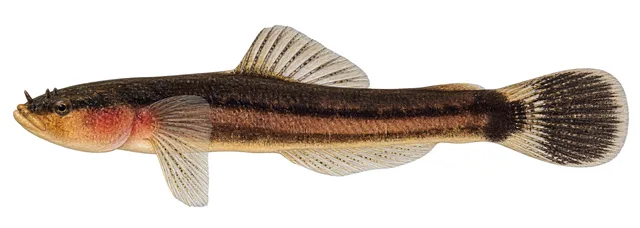
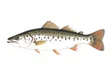
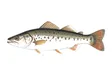
Swampfish field guide illustration

About Swampfish

Chologaster cornuta, commonly named swampfish, ricefish, or riceditch killifish, is a freshwater fish of the family Amblyopsidae. It is the only living species of the genus Chologaster. It only lives in US rivers in the Atlantic Coastal Plain drainages, from southeast Virginia to central Georgia. It lives up to two years. The Latin name refers to a very tiny horned bulge at front of the eye. They are commonly 4 cm (1.6 in) long, but may reach about 6.8 cm (2.7 in).

Characteristics

This species is part of the family Amblyopsidae (typically known as cavefish or blindfish). It is dorsally brown and ventrally creamy white, with three dark stripes on each side. It inhabits above-ground swamps, rather than caves as most other species in its family. Although many Amblyopsidae species have vestigial eyes, the swampfish has functional eyes.

Behavior

Chologaster cornuta feeds mostly at night, on small crustaceans and aquatic insects. It spawns in March and April. Although locally common, individuals are hard to spot because they are largely nocturnal and found in heavily vegetated waters. They are highly sensitive to touch and light, and will quickly move away from a source of either, hiding on the bottom until dark. Its thigmotaxic tendency is shown by the difficulty in seining it from the roots and debris of its preferred habitat along edges of submerged weed banks which border sand-bottomed channels.

This fish is found over vegetation and debris in swamps, sloughs, and quiet pools and backwaters of streams. They prefer highly oxygenated water and have a high temperature tolerance. They are found year-round in small and well-shaded open streams, where temperatures don't exceed 23 °C (73 °F). This habitat is rich in potential food for C. cornuta, such as amphipods, ostracods, and copepods.

Article text: Wikipedia contributors, Chologaster (source revision). Licensed under CC BY-SA 4.0. Retrieved 2026-10-11.
Diet and feeding

The FishTraits compilation records these diet categories for this species: invertebrates or larval fish. These are broad categories, not a claim that every individual consumes every example in a category.

Reported feeding positions include bottom feeding. The compilation combines published observations; diets can vary with age, locality, and available food.

Habitat preferences

Reported habitat associations include streams and small rivers, creeks, still-water habitats, springs or subterranean waters.

The source records associations with muck, clay or silt, vegetation, organic debris, large woody material. An association indicates reported use, rather than an exclusive requirement.

Reproduction and parental care

The compilation reports a representative maturity age of 1 years. Its maturity field summarizes mean, median, or modal estimates, usually for females; male estimates can be used when female data are unavailable. It is not a fixed age at which every fish first breeds.

Recorded spawning months are Mar, Apr for the source’s reporting region (NC). This is a regional calendar, not a range-wide schedule.

Size and recorded longevity

FishTraits reports a maximum total length of 6.8 centimetres. Some entries use an estimated asymptotic length; this value should not be treated as a certified record catch.

Recorded longevity in the compilation is 3 years. Wild observations were preferred, but captive records were accepted where wild records were unavailable, and unspecified records were assumed wild. The value is not a guaranteed wild lifespan or an aquarium life expectancy.

Range

Where it lives

Share of 487 GBIF observation records with a state location, across 4 states.
0%
66.9%
Share of 487 GBIF observation records with a state location, across 4 states.

Habitat

Water and movement

Water
WoRMS records this species in fresh water.
Migration
Not migratory

Classification

Taxonomy

Kingdom
Animalia
Phylum
Chordata
Superclass
Actinopterygii
Class
Teleostei
Order
Percopsiformes
Genus
Chologaster
Species
Chologaster cornuta
ITIS TSN
164390
WoRMS AphiaID
1021666
GBIF key
2401726

Common questions about Swampfish

What is the scientific name of Swampfish?
The scientific name is Chologaster cornuta, in the family Amblyopsidae. Classification follows ITIS.
Does Swampfish live in fresh water or salt water?
WoRMS records this species in fresh water.
Where has Swampfish been recorded in the United States?
GBIF has observations in 4 states, with the most records in North Carolina, South Carolina, Virginia. The map shows observation records, which do not establish the complete natural range.

Same family

More Amblyopsidae