Description
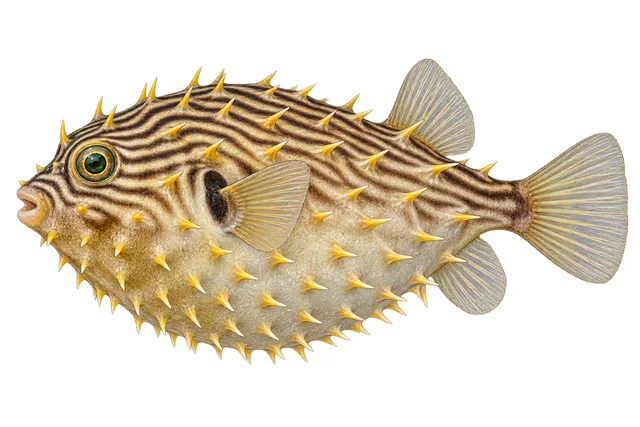
It is distinguished from the porcupinefish by the shorter, less sharply pointed, and immovable spines which cover the somewhat spherical body. It can inflate its body by taking either air or water into a ventral extension of the stomach. Its color is olivaceous or brownish above and pale yellow below. The back and sides are irregularly striped with brownish, dusky, or black lines which are parallel to each other and which run obliquely downward. There are several large black spots on the sides, one just below the dorsal fin, and another behind the pectoral fin. Its maximum size is about 10 inches.
Distribution
It is found mostly in the tropics of the western Atlantic Ocean from Brazil to Florida as well as along the Atlantic coast of North America, sometimes as far north as Cape Cod and regularly during the late summer and fall in the vicinity of New York. One has been reported caught on dead shrimp as far as Oyster Lake, near Matagorda Bay, Tx.
Habitat
It spawns off New Jersey in July. Juveniles are also found in the Chesapeake Bay in the summertime.
Diet
It feeds on invertebrates such as oysters, barnacles, mussels, small crabs, and hermit crabs.
Fishing technique
It has no commercial value but is occasionally taken by fishermen and stuffed as curio. Some end up in the aquarium pet trade. It occasionally is killed in gill nets and then tossed back by the fishermen. It is often washed ashore along the beach and is a treacherous object if stepped on by mistake with bare feet. Other species of burr and porcupinefish are found in the tropics.
Additional field notes
Striped burrfish is a rounded, spiny coastal fish with a strong beak-like mouth. Its short fixed spines distinguish its appearance from that of a smooth-skinned puffer.
Field identification notes
The head is wide and blunt, the eyes large, and the body covered with short, permanently projecting spines. Thin dark lines cross the pale body, with larger dark blotches on the back. It has no pelvic fins. Juveniles can be yellowish and carry a noticeable tentacle above the eye.
Habitat and range notes
The Smithsonian account lists soft bottoms, seagrass, estuaries, and lagoons, with movement to reefs in winter. Its regional range extends from Nova Scotia to the northwestern Caribbean. Very young fish have a pelagic stage before taking up the more familiar coastal habitats.
Feeding and life-history notes
Recorded food groups include mollusks, crustaceans, and echinoderms. The fused teeth form a powerful beak suited to hard prey. The source lists about 33 cm as a maximum size. The catalog retains the spelling Chilomycterus schoepfii; other references may use schoepfi for the same fish.
Guide sources
Research reviewed 2026-10-17.
- Chilomycterus schoepfii species account — Smithsonian Tropical Research Institute
Article text: Wikipedia contributors, Striped burrfish (source revision). Licensed under CC BY-SA 4.0. Retrieved 2026-10-11.