Description
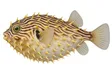
The long-spine porcupinefish is pale in color with large black blotches and smaller black spots; these spots becoming fewer in number with age. It has many long, two-rooted depressible spines particularly on its head. The teeth of the two jaws are fused into a parrot-like "beak". Adults may reach 50 cm (20 in) in length. The only other fish with which it might be confused is the black-blotched porcupinefish (Diodon liturosus), but it has much longer spines than that species.
Diet
The long-spine porcupine fish is an omnivore that feeds on mollusks, sea urchins, hermit crabs, snails, and crabs during its active phase at night. They use their beak combined with plates on the roof of their mouths to crush their prey such as mollusks and sea urchins that would otherwise be indigestible.
Distribution
The long-spine porcupinefish has a circumtropical distribution, being found in the tropical zones of major seas and oceans:
Habitat
They are found over the muddy sea bottom, in estuaries, in lagoons or on coral and rocky reefs around the world in tropical and subtropical seas.
Spawning
Spawns at the surface at dawn or at dusk in pairs or in groups of males with a single female; the juveniles remain pelagic until they are at least 7 cm (3 in) long. Young and sub-adult fish sometimes occur in groups.
Additional field notes
Balloonfish change habitat as they grow from drifting juveniles into bottom-associated adults.
Sources: Diodon holocanthus species summary
Young fish and adult habitat
Young balloonfish often accompany floating Sargassum, and FishBase describes a pelagic juvenile phase lasting until roughly 6–9 centimetres in length. A small fish near floating weed may therefore be using a normal nursery setting, even though adults are better known from reefs. Juveniles and subadults sometimes gather in small groups; older fish are often solitary.
Adult habitat includes rocky ground, coral reefs, and open soft or muddy bottoms. Most depth records summarized by FishBase fall between 2 and 35 metres, within a wider recorded range extending to 200 metres. The species should therefore not be treated as confined to coral cover.
Sources: Diodon holocanthus species summary
Reading the markings
FishBase distinguishes the conspicuous belly spotting of pelagic juveniles from the adult pattern of large dark back blotches with smaller spots between them. The fins are described as unspotted. Brown bars above and below the eyes are another useful detail to check when comparing photographs. The appearance of a juvenile can differ enough from an adult that body pattern should be considered together with size.
Sources: Diodon holocanthus species summary
Article text: Wikipedia contributors, Long-spine porcupinefish (source revision). Licensed under CC BY-SA 4.0. Retrieved 2026-10-11.