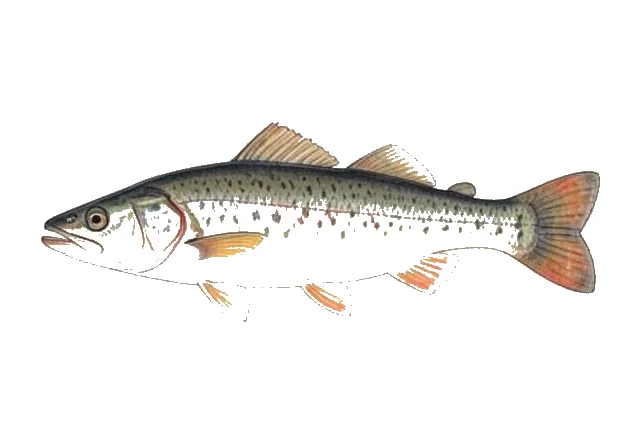
The body gives a somewhat heavy or massive impression, particularly forward, the head being almost as wide as deep. Each side has a distinctive row of dark blotches, with pale bars in between. The pelvic fins are entirely absent, while the anal fin is large, with 13 rays. The dorsal fin is set far back on the body, just above the anal fin, and is somewhat smaller than the anal fin, with 12 rays.
This springfish is omnivorous, with animal food representing 2/3 or more of its consumption during the summer, primarily consisting of gastropods. Plant consumption is mostly filamentous algae. While intestine length is consistent with an omnivore, Sigler & Sigler suggest that the high water temperatures of the springfish habitat may demand the higher energy available with animal food.
The warm springs in which these are found range in temperature from 77 to 102 °F (25 to 39 °C).
The Railroad Valley springfish is federally listed as a species threatened with extinction. Its extremely limited range makes it vulnerable to competition from introduced species, and to habitat modifications. For instance, it was nearly eliminated from Duckwater Spring in the early 1980s by introduced channel catfish. The springfish has been introduced to Chimney Springs and Hot Creek Canyon in Nye County, Nevada.
Article text: Wikipedia contributors, Railroad Valley springfish (source revision). Licensed under CC BY-SA 4.0. Retrieved 2026-10-11.
Diet and feeding
The FishTraits compilation records these diet categories for this species: algae or phytoplankton; aquatic or other vascular plants; detritus or unidentified plant material; invertebrates or larval fish. These are broad categories, not a claim that every individual consumes every example in a category.
Reported feeding positions include bottom feeding and surface or water-column feeding. The compilation combines published observations; diets can vary with age, locality, and available food.
Habitat preferences
Reported habitat associations include springs or subterranean waters.
The source records associations with muck, clay or silt, sand, gravel, cobble, vegetation, organic debris. An association indicates reported use, rather than an exclusive requirement.
Reproduction and parental care
The compilation reports a representative maturity age of 0.2 years. Its maturity field summarizes mean, median, or modal estimates, usually for females; male estimates can be used when female data are unavailable. It is not a fixed age at which every fish first breeds.
Batch or serial spawning has been reported somewhere in the species’ range. This does not establish the same spawning pattern for every population.
Recorded spawning months are Jan, Feb, Mar, Apr, May, Jun, Jul, Aug, Sep, Oct, Nov, Dec for the source’s reporting region (NV). This is a regional calendar, not a range-wide schedule.
The reproductive-guild classification includes spawning on open substrates without guarding the brood.
Size and recorded longevity
FishTraits reports a maximum total length of 6 centimetres. Some entries use an estimated asymptotic length; this value should not be treated as a certified record catch.
Recorded longevity in the compilation is 1.5 years. Wild observations were preferred, but captive records were accepted where wild records were unavailable, and unspecified records were assumed wild. The value is not a guaranteed wild lifespan or an aquarium life expectancy.
Native range
Springs in Railroad Valley, Nye County, Nevada (Page and Burr 1991).
Introduction history
The Sodaville introduction was performed by Thomas Trelease of the Nevada Fish and Game Commission in response to the possible stocking of bass into the species' native habitat (La Rivers 1962). The U.S. Bureau of Land Management and Nevada Department of Wildlife introduced the species into Chimney Hot Springs in response to deterioration of its native habitats (Williams and Williams 1989). According to Williams and Williams (1989), the purpose of these introductions was to establish a refuge population for conservation of the species.