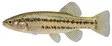
Pahrump Killifish

Empetrichthys latos

Goodeidae · freshwater water fish

6 minute read · Species guide

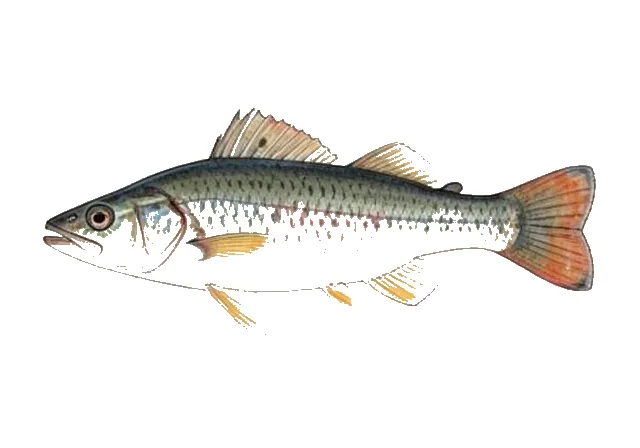
Pahrump Killifish field guide illustration

About Pahrump Killifish

Empetrichthys latos is a rare species of fish in the family Goodeidae, the splitfins. It is known by the common names Pahrump poolfish and Pahrump killifish, the former being more correct today. It is endemic to Nevada in the United States, where it was limited to the Pahrump Valley near the California border. It nearly became extinct due to habitat destruction and no longer occurs there. It is a federally listed endangered species of the United States. The Pahrump Poolfish is long-lived for a small-bodied fish, with ages up to 10 years for females and 7 years for males documented.

The Pahrump Poolfish is sexually dimorphic; females being significantly larger. This is an important consideration for management as establishing populations with a balanced sex ratio is likely desired. This fish reaches a maximum length of about 7 cm (2.8 in). It has its dorsal and anal fins far back on its body and it lacks pelvic fins. The head is depressed in front and the mouth is wide. The jaws are unequal, the lower projecting farther than the upper. The fish is greenish on its back and silvery green on the belly. The male takes on a blue tinge during spawning.

It is omnivorous, feeding on varied plant and animal material. Spawning is most common in spring but can occur at any time of the year when conditions are right. Adults are more active at night, but juveniles appear to be more active during the day. The native habitat of the fish was made up of pools and marshes. The water at one pool was a constant 24 °C (75 °F). This may be the optimal temperature for the species but it can tolerate a relatively wide range of temperatures. It has been noted to survive under a layer of ice during winter. The water is alkaline.

This species is the only surviving member of genus Empetrichthys, the other, the Ash Meadows killifish (Empetrichthys merriami), having become extinct in the 1940s. There were three subspecies of E. latos, two of which are extinct today. Each occurred in a different spring in the Pahrump Valley. The Raycraft Ranch springfish (E. latos concavus) became extinct when its spring was destroyed in the 1950s. The Pahrump Ranch killifish (E. latos pahrump) disappeared when its spring was pumped dry in 1958. The remaining fish is the nominal subspecies E. latos latos. It is known simply as the Pahrump poolfish.

In 1975 the Pahrump poolfish was extirpated from its habitat, Manse Spring, when it experienced competition from the introduced goldfish, some vegetation was removed, and the spring dried up due to groundwater pumping nearby. On noting its impending extinction, scientists and officials removed specimens of the fish and transplanted them into three pools in different locations in Nevada. When the official recovery plan for the species was published by the United States Fish and Wildlife Service in 1980, it aimed to manage and protect the three transplanted populations. The fish has not been returned to its native habitat at Manse Spring because the area is under development and the water supply is not reliable.

Though the fish reproduced successfully and appeared to thrive in its new pools, it faced a number of challenges there. Flooding destroyed one of the pools, vandalism killed specimens at another, and the unauthorized introduction of mosquitofish and crawfish further threatened the fish. Some fish were transplanted into a reservoir to replace the flooded population, but the USFWS had to intervene when Nevada State Parks officials planned to dredge the pond. Today the populations remain, but the habitat must be artificially maintained at times. As of 2004 only one population is stable. Threats still exist from groundwater pumping, vandalism, and introduced species. In 2018, the Southern Nevada Water Authority is planning on establishing a refuge population into ponds at the Las Vegas Springs Preserve. The USFWS still considers the species to be "in imminent danger of extinction" and is maintaining its endangered status.

Article text: Wikipedia contributors, Empetrichthys latos (source revision). Licensed under CC BY-SA 4.0. Retrieved 2026-10-11.
Diet and feeding

The FishTraits compilation records these diet categories for this species: algae or phytoplankton; detritus or unidentified plant material; fish or frog eggs. These are broad categories, not a claim that every individual consumes every example in a category.

Reported feeding positions include bottom feeding and surface or water-column feeding. The compilation combines published observations; diets can vary with age, locality, and available food.

Habitat preferences

Reported habitat associations include springs or subterranean waters.

The source records associations with muck, clay or silt, sand, vegetation. An association indicates reported use, rather than an exclusive requirement.

Reproduction and parental care

The compilation reports a representative maturity age of 1 years. Its maturity field summarizes mean, median, or modal estimates, usually for females; male estimates can be used when female data are unavailable. It is not a fixed age at which every fish first breeds.

Batch or serial spawning has been reported somewhere in the species’ range. This does not establish the same spawning pattern for every population.

Recorded spawning months are Jan, Feb, Mar, Apr, May, Jun, Jul, Aug, Sep, Oct, Nov, Dec for the source’s reporting region (NV). This is a regional calendar, not a range-wide schedule.

The reproductive-guild classification includes spawning on open substrates without guarding the brood.

Size and recorded longevity

FishTraits reports a maximum total length of 6 centimetres. Some entries use an estimated asymptotic length; this value should not be treated as a certified record catch.

Recorded longevity in the compilation is 3 years. Wild observations were preferred, but captive records were accepted where wild records were unavailable, and unspecified records were assumed wild. The value is not a guaranteed wild lifespan or an aquarium life expectancy.

Identification and appearance

This species was once represented by three subspecies: Empetrichthys latos latos, Empetrichthys latos concavus, and Empetrichthys latos pahrump; two are extinct, and only E. l. latos remains (U.S. Fish and Wildlife Service 1979).

Native range

Each subspecies was confined to an isolated spring in Pahrump Valley, Nye County, Nevada, where it was the only native fish. The Pahrump Poolfish E. l. latos disappeared from Manse Springs in August 1975 and now exists only outside the Pahrump Valley in transplanted locations (U.S. Fish and Wildlife Service 1979, Page and Burr 1991).

Habitat and ecology

Empetrichthys latos uses all areas of its desert spring habitat, with adults more commonly found in the deeper open waters and juveniles found in shallower vegetated areas near the water’s surface (U.S. Fish and Wildlife Service 1979). It is omnivorous and will eat a wide variety of available plants and small animals (U.S. Fish and Wildlife Service 1979). After breeding, which occurs throughout the year under favorable conditions, females seek seclusion to lay their eggs (U.S. Fish and Wildlife Service 1979).

Introduction history

This species was intentionally stocked to establish refuge populations for preservation of the species. The transplant to Corn Creek Spring took place in 1971 and involved 29 fish; Shoshone Ponds complex, a site created by the US Bureau of Land Management, was stocked in 1972 with 16 fish from Corn Creek or Manse Ranch Spring (an additional 50 fish were transplanted to the site in 1976); Spring Mountain Ranch State Park was stocked in 1983 with an unrecorded number of fish (Pister 1974, U.S. Fish and Wildlife Service 1979, Minckley et al. 1991). The Nevada Department of Fish and Game was instrumental in at least two of these introductions (Pister 1974).

Range

Where it lives

Share of 104 GBIF observation records with a state location, across 1 states.
0%
100%
Share of 104 GBIF observation records with a state location, across 1 states.

Share of records by state

Habitat

Water and movement

Water
WoRMS records this species in fresh water.
USGS NAS habitat
Freshwater
US status
Native transplant — native to part of the United States, moved to other waters inside it.
Migration
Undetermined

Classification

Taxonomy

Kingdom
Animalia
Phylum
Chordata
Superclass
Actinopterygii
Class
Teleostei
Order
Cyprinodontiformes
Family
Goodeidae
Genus
Empetrichthys
Species
Empetrichthys latos
ITIS TSN
165691
WoRMS AphiaID
1014289
GBIF key
4284453

Common questions about Pahrump Killifish

What is the scientific name of Pahrump Killifish?
The scientific name is Empetrichthys latos, in the family Goodeidae. Classification follows ITIS.
Does Pahrump Killifish live in fresh water or salt water?
WoRMS records this species in fresh water.
Where has Pahrump Killifish been recorded in the United States?
GBIF has observations in 1 states, with the most records in Nevada. The map shows observation records, which do not establish the complete natural range.

Closest relatives

Other Empetrichthys species

Same family

More Goodeidae