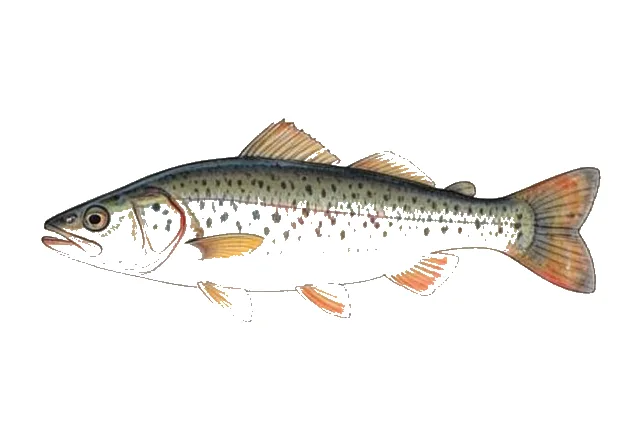
Hogchoker

Trinectes maculatus

Achiridae · freshwater and saltwater and brackish water fish

2 minute read · Species guide

Hogchoker field guide illustration

About Hogchoker

The hogchoker (Trinectes maculatus) is a small species of flatfish found along the Atlantic and Gulf coasts of North and South America, ranging from Massachusetts to Venezuela. They prefer brackish water, and the nominate subspecies is abundant in many bays and estuaries north of the Carolinas (the southern subspecies T. m. fasciatus replaces it south of the Carolinas). It is a member of the American sole family Achiridae. They are usually brown to dark brown in color, and lighter on their "blind side"(side lacking an eye). The overall body color is often broken by a series of spots and thin stripes, which can be lighter or darker than the main body color. The fins and tail have fringed edges helping hide the fish from its prey. They mainly feed on small aquatic insects and invertebrates. They get their common name because East Coast fishermen would feed these so-called"trash" fish to their hogs, after which the fish would bow its body into a suction cup and stick to the soft palate of the hog, rather like peanut butter in a dog's mouth.

Distinguished from other species by an interbrachial septum lacking a foramen, T. maculatus often has no rays, or rarely one ray, in its pectoral fin.

In the aquarium

Hogchokers are sometimes offered for sale in aquarium stores, often marketed as "freshwater flounder"or"freshwater fluke". This is not entirely accurate, however. While some species of full freshwater flatfish exist from Southeast Asia and South America, the hogchoker is thought to be a species of coastal estuaries and mud flats. While some aquarists have kept specimens for their whole lives in freshwater, it is not known whether or not they can thrive without salt. Large adult specimens have been found quite regularly up the Mississippi, Hudson, and East Rivers, so long as the bottom is soft sand and rich enough to cultivate small invertebrates on the substrate. They spend their time in aquariums attached to rocks, driftwood, and the glass, using their bellies as suction cups in much the same manner as hillstream loaches. They are known to spawn in various salinities but prefer moderate salinities of 10 to 16 parts per thousand and a temperature of around 25 °C (77 °F). After hatching the larvae move upstream into freshwater. In Spring they migrate back downstream to spawn.

They are hard to feed, preferring live food such as brine shrimp, Daphnia, mosquito larvae, and Tubifex worms. In the wild, they feed mainly by sifting tiny organisms (white sandworms in salt and brackish water, insect larvae in fresh) out of sand and mud. When unhealthy, the spots on this fish's belly often change color or move.

Article text: Wikipedia contributors, Hogchoker (source revision). Licensed under CC BY-SA 4.0. Retrieved 2026-10-11.
Range

Where it lives

Share of 18,258 GBIF observation records with a state location, across 18 states.
0%
56.1%
Share of 18,258 GBIF observation records with a state location, across 18 states.

Habitat

Water and movement

Water
WoRMS records this species in fresh water, brackish water and the sea.
Migration
Migratory
Pattern
  • Catadromous — spawns at sea, grows in fresh water
  • SemiCatadromous — spawns in an estuary, grows in fresh water
Disagreement
6 published references do not agree on the pattern: Catadromous, Semi-catadromous. The site shows every assignment rather than picking one.

Classification

Taxonomy

Kingdom
Animalia
Phylum
Chordata
Superclass
Actinopterygii
Class
Teleostei
Order
Pleuronectiformes
Family
Achiridae
Genus
Trinectes
Species
Trinectes maculatus
ITIS TSN
172982
WoRMS AphiaID
159271
GBIF key
2408252

Common questions about Hogchoker

What is the scientific name of Hogchoker?
The scientific name is Trinectes maculatus, in the family Achiridae. Classification follows ITIS.
Does Hogchoker live in fresh water or salt water?
WoRMS records this species in fresh water, brackish water and the sea.
Where has Hogchoker been recorded in the United States?
GBIF has observations in 18 states, with the most records in Texas, Alabama, Florida. The map shows observation records, which do not establish the complete natural range.

Closest relatives

Other Trinectes species

Same family

More Achiridae