Goldeye

Hiodon alosoides

Hiodontidae · freshwater water fish

5 minute read · Species guide

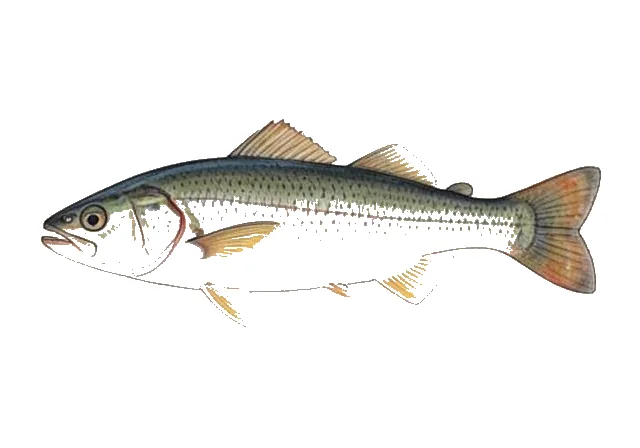
Goldeye field guide illustration

About Goldeye

The goldeye (Hiodon alosoides) is a freshwater fish found in Canada and the Upland South plus central United States. It is one of only two extant species in the family Hiodontidae, the other species being Hiodon tergisus. The species name alosoides means shad -like. It is also called Winnipeg goldeye, western goldeye, yellow herring, toothed herring, shad mooneye, la Queche, weepicheesis, or laquaiche aux yeux d'or in French.

Morphology

Goldeyes are recognizable by their silver compressed body form and their large gold-coloured eyes. Their body appears to be a blue-green silver from above and a more white silver from below. They have two abdominal and pelvic fins as well as a dorsal on their back and an anal fin on their underside. The dorsal fin is positioned opposite or behind the origin of the anal fin. Goldeyes also have a fleshy keel that extends from the pectoral fins to the base of the anal fin. Their mouth is large and in the terminal position with a blunt round snout. There are teeth present on the tongue, the roof of the mouth on the parasphenoid bone and the palatopterygoid arch and along the jaws. The goldeye fish has cycloid scales that lack spines. They also have a sensory system known as the lateral line system. Adults are usually about 15–17 inches (380–430 mm) but can reach 20 inches (510 mm). Goldeyes typically weigh only 1–2 pounds (0.45–0.91 kg).

Reproduction

The age of first reproduction for goldeyes is 7–10 years for females and 6–9 years for males. They spawn in late May or early June. The eggs that they lay are about 4 millimetres (0.16 in) in size and they are semi-buoyant. This is a rare trait in fresh water fish, but is more common in marine fish. The eggs are suspended in the water and they drift downstream or to quiet waters. The majority of growth that occurs between June and September.

Range

Goldeyes occur from as far down the Mackenzie River as Aklavik in the north to Mississippi in the south, and from Alberta in the west to Ohio south of the Great Lakes, with an isolated population south of James Bay. It prefers turbid slower-moving waters of lakes and rivers.

Diet

Goldeyes feed on insects, crustaceans, fish and frogs. The fish averages less than 1 lb (450 g) or 12 in (30 cm) in length, but can be found up to 2 lb (910 g) or 16 in (41 cm) in some lakes. It has been reported up to 52 cm (20 in) in length.

Fishing

The goldeye is considered a good fly-fishing fish, but not popular with most anglers because of its small size. It is one of 122 new species of animals, birds, and fish documented by the Lewis & Clark Corps of Discovery. Commercial fishing of this species was reported as early as 1876. Its fresh flesh is considered soft and unappealing, so it was only taken randomly in gillnets and (in the past) sold for dogfood. They are now consumed as a smoked fish commonly smoked in oak or apple wood and marinated in a brine of salt, sugar, and spices.

Its commercial viability was realized by Robert Firth, who immigrated to Winnipeg, Manitoba from Hull, England in 1886. Firth was carrying on a mediocre trade in cold-smoked goldeye, when he miscalculated the heat of his smoker and accidentally developed the now-standard method of hot-smoking it whole. The bright red or orange colour of the smoked fish resulted from using only willow smoke, but today is achieved through aniline dye. It became a fashionable gourmet dish after 1911, with Woodrow Wilson and the Prince of Wales counted amongst its fans. In 1926–29 the annual catch exceeded a million pounds, but stocks declined from 1931 and little was fished from Lake Winnipeg after 1938. A small amount of the commercial harvest is shipped to the United States, but most is consumed in Canada. Although Lake Winnipeg was once the main commercial source, it now comes from elsewhere, especially in Saskatchewan and Alberta, and the culinary name Winnipeg goldeye has come to be associated with the city where it is processed.

The fish is the namesake of Winnipeg's minor league baseball team, the Winnipeg Goldeyes.

Article text: Wikipedia contributors, Goldeye (source revision). Licensed under CC BY-SA 4.0. Retrieved 2026-10-11.
Diet and feeding

The FishTraits compilation records these diet categories for this species: invertebrates or larval fish. These are broad categories, not a claim that every individual consumes every example in a category.

Reported feeding positions include bottom feeding and surface or water-column feeding. The compilation combines published observations; diets can vary with age, locality, and available food.

Habitat preferences

Reported habitat associations include medium to large rivers, streams and small rivers, still-water habitats.

The source records associations with gravel, open water. An association indicates reported use, rather than an exclusive requirement.

Reproduction and parental care

The compilation reports a representative maturity age of 4 years. Its maturity field summarizes mean, median, or modal estimates, usually for females; male estimates can be used when female data are unavailable. It is not a fixed age at which every fish first breeds.

Recorded spawning months are May, Jun, Jul for the source’s reporting region (WI). This is a regional calendar, not a range-wide schedule.

The reproductive-guild classification includes spawning on open substrates without guarding the brood.

Size and recorded longevity

FishTraits reports a maximum total length of 52 centimetres. Some entries use an estimated asymptotic length; this value should not be treated as a certified record catch.

Recorded longevity in the compilation is 12 years. Wild observations were preferred, but captive records were accepted where wild records were unavailable, and unspecified records were assumed wild. The value is not a guaranteed wild lifespan or an aquarium life expectancy.

Native range

Tributaries of James Bay, Quebec and Ontario; the Arctic, Missouri, Mississippi, and Ohio basins from the Mackenzie River drainage, Northern Territories, to western Pennsylvania and south to Louisiana (Page and Burr 1991).

Introduction history

Intentionally stocked, probably as forage.

Record fish

State records in 4 states

  • Minnesota3 lb 5 oz

    Minnesota River · Blue Earth · 5/3/2020

  • Montana3.18 lbs.

    Nelson Reservoir · 7/4/00 · Don Nevrivy

  • Arkansas2 lb., 12 oz.

    Cache River · 03/22/2020 · Tommy Medler, Judsonia, AR · other legal means

  • Oklahoma2 lbs 8.00 ozs

    Arkansas River · 04/27/1996 · James R. Smith · rod and line

  • Arkansas2 lbs., 3 oz.

    State Line Outlet Ditch · 04/02/2021 · Jamie Wilhoite, Manila, AR · rod and reel

Each figure is the state agency’s own certified record. The site holds record tables for 11 states so far, so a state missing here has not been read yet. It is not a state where this fish holds no record.

Range

Where it lives

Share of 992 GBIF observation records with a state location, across 22 states. The orange dots are USGS stream-survey sites where this species was caught.
0%
21.7%
Share of 992 GBIF observation records with a state location, across 22 states. The orange dots are USGS stream-survey sites where this species was caught.

A blank area on the dot layer usually means nobody sampled there, not that the fish is absent. Turn on “every survey site” to see where the survey looked.

The USGS stream survey caught it at 266 of its sites, in 19 states. That survey and the GBIF records are two different counts of two different things, so the site keeps them apart.

Habitat

Water and movement

Water
WoRMS records this species in fresh water.
USGS NAS habitat
Freshwater
US status
Native transplant — native to part of the United States, moved to other waters inside it.
Migration
Migratory
Pattern

Classification

Taxonomy

Kingdom
Animalia
Phylum
Chordata
Superclass
Actinopterygii
Class
Teleostei
Order
Osteoglossiformes
Genus
Hiodon
Species
Hiodon alosoides
ITIS TSN
161905
WoRMS AphiaID
567532
GBIF key
2402320
Outside the US
ITIS also files it in Canada.

Common questions about Goldeye

What is the scientific name of Goldeye?
The scientific name is Hiodon alosoides, in the family Hiodontidae. Classification follows ITIS.
Does Goldeye live in fresh water or salt water?
WoRMS records this species in fresh water.
Where has Goldeye been recorded in the United States?
GBIF has observations in 22 states, with the most records in Illinois, Missouri, Oklahoma. The map shows observation records, which do not establish the complete natural range.

Closest relatives

Other Hiodon species

Same family

More Hiodontidae