There is no recorded data on the average lifespan of C. aurolineata. On March 18, 2024, Pata Zoo in Thailand announced that it would permanently retire its C. aurolineata, named Pi-lim (Thai: พี่หลิม, lit. ' 'Brother Lim' '), due to old age, cloudy eyes, and loss of appetite. The zoo had raised him for 20 years.
Article text: Wikipedia contributors, Channa aurolineata (source revision). Licensed under CC BY-SA 4.0. Retrieved 2026-10-11.
Identification and appearance
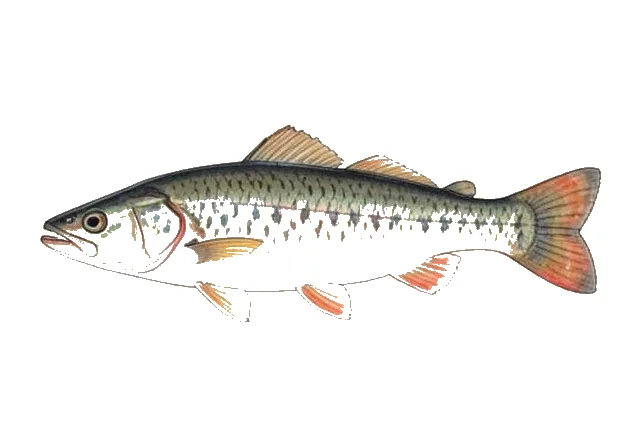
Snakeheads (family Channidae) are morphologically similar to the North American native Bowfin (Amia calva), and identification of the two are often confused. Morphological differences used for identification between the two are depicted here. Snakeheads are distinguished from Bowfin by the position of pelvic fins (directly behind pectoral fins in snakeheads, farther posterior in Bowfin) and the size of the anal fin (elongate and similar in size to dorsal fin in snakeheads, short and much smaller than dorsal fin in Bowfin). Additionally, Bowfin can be identified by the presence of a bony plate between the lower jaws (gular plate) and a distinctive method of swimming using undulations of the dorsal fin. Goldline Snakehead has a distinctive orange spot (ocellus) on caudal peduncle that may fade with growth. One of the largest species of Channa (Talwar and Jhingran 1992).
Native range
Myanmar (Salween, Chindwin, Sittang, and Ayeyarwady River basins) and western Thailand (Mae Khlong River basin) (Adamson and Britz 2018, 2019).
Habitat and ecology
Prefers deep clear lakes and rivers with rocky or sandy substrate (Talwar and Jhingran 1992), although other authors report them inhabiting standing water in canals, lakes, and swamps with submerged aquatic vegetation (Rainboth 1996). Spawning period and timing seems to vary geographically, but generally occurs between May to August (summarized by Courtenay and Williams 2004). Snakeheads exhibit parental care, with parents guarding eggs/juveniles in a nest until the young reach ~10 cm in length (Courtenay and Williams 2004). Snakeheads have an air-breathing organ and are capable of extracting oxygen from both water and air, with oxygen uptake from air representing a large portion of total oxygen acquired. Adult snakeheads require surface oxygen to meet total respiratory requirements (Ojha et al. 1979). Goldline Snakehead are predatory, with fishes and crustaceans comprising the majority of its diet (summarized as Bullseye Snakehead in Courtenay and Williams 2004).
Introduction history
Unknown, but illegally introduced in Florida most likely as a food source for human consumption. Through DNA barcode testing, Thailand was suggested as the likely source of the Florida population (Adamson and Britz 2019).
Ecological impacts
Summary of species impacts derived from literature review. Click on an icon to find out more... Unknown. This predatory species has the potential to impact native fishes and crustaceans directly. Bullseye snakeheads have been found to consume native centrarchids, lizards, toads, and small fishes; however, snakeheads are also consumed by other large predatory fishes present in south Florida canals (e.g., Largemouth Bass Micropterus salmoides and Butterfly Peacock bass Cichla ocellaris; P. Shafland, pers. comm.). Bioaccumulation of mercury and arsenic could pose a human health risk if this fish is consumed by humans (Krishna et. al. 2018, Qadir et al. 2006).