Taxonomy
The Atlantic tomcod is one of two species in the Microgadus genus, the other being Microgadus proximus, the Pacific tomcod.
Tomcod fishing
In 1757, Count Louis-Antoine de Bougainville (1729-1811) noted that the French settlers of New France practiced angling under the ice to capture the Microgadus tomcod which swims upstream to spawn in the streams flowing into Lake Saint-Pierre and its tributaries, near Trois-Rivières.
The fishing season of the tomcod varies by location—one known example is the Sainte-Anne River in Quebec.
A winter visitor, the Microgadus tomcod spawns between mid-December and the end of January mainly up to the Sainte-Anne and Batiscan rivers, in the Estuary of St. Lawrence River.
Science
A biomonitoring program tracked hormone levels of Atlantic tomcod caught near Miramichi and Kouchibouguac in 1993 and 1994, demonstrating that the preparatory period for spawning began in September with maximal steroid levels in November, and spawning took place from late December to January. The town of Sainte-Anne-de-la-Pérade is notable for its fishing village built on the frozen waters of the Ste-Anne, playing host to the scores of fishermen visiting the town to fish for the species.
After General Electric dumped polychlorinated biphenyls (PCBs) in the Hudson River from 1947 through 1976, tomcod living in the river were found to have developed an increased resistance to the compound's toxic effects. Scientists identified the genetic mutation that conferred the resistance, and found that the mutated form was present in 99 percent of the tomcods in the river, compared to fewer than 10 percent of the tomcods from other waters.
Additional field notes
Atlantic tomcod occupy a broader range of salinities than their coastal reputation suggests.
Sources: Microgadus tomcod species summary
Habitat and feeding
FishBase records Atlantic tomcod in marine, brackish, and fresh water, including populations isolated in lakes. The species is classed as demersal, meaning it generally uses the water near the bottom. Its reported depth range reaches 69 metres, although that maximum does not describe the depth of every population.
Small crustaceans are the principal food listed in the species summary, particularly shrimp and amphipods. Worms, small mollusks, squid, and fish also occur in its diet. This combination of bottom-associated invertebrates and fish makes the tomcod an opportunistic coastal predator rather than a specialist on one prey species.
Sources: Microgadus tomcod species summary
Recognizing a tomcod
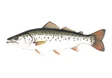
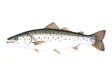
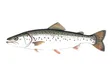
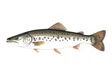
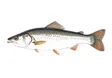
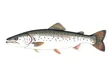
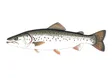
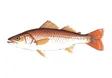
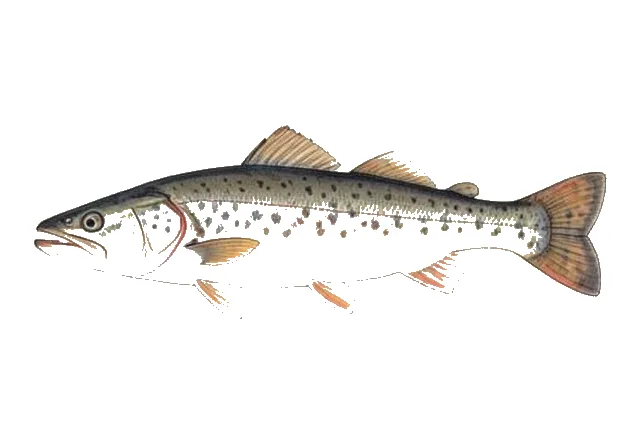
The body is elongated, with a relatively small head and eyes. Look for an olive, brown, or yellowish back fading toward a paler underside, with darker mottling on the sides and fins. FishBase also notes a slightly extended filament on the pelvic fins. These features provide useful context alongside location when examining a possible tomcod.
Sources: Microgadus tomcod species summary
Article text: Wikipedia contributors, Microgadus tomcod (source revision). Licensed under CC BY-SA 4.0. Retrieved 2026-10-11.